
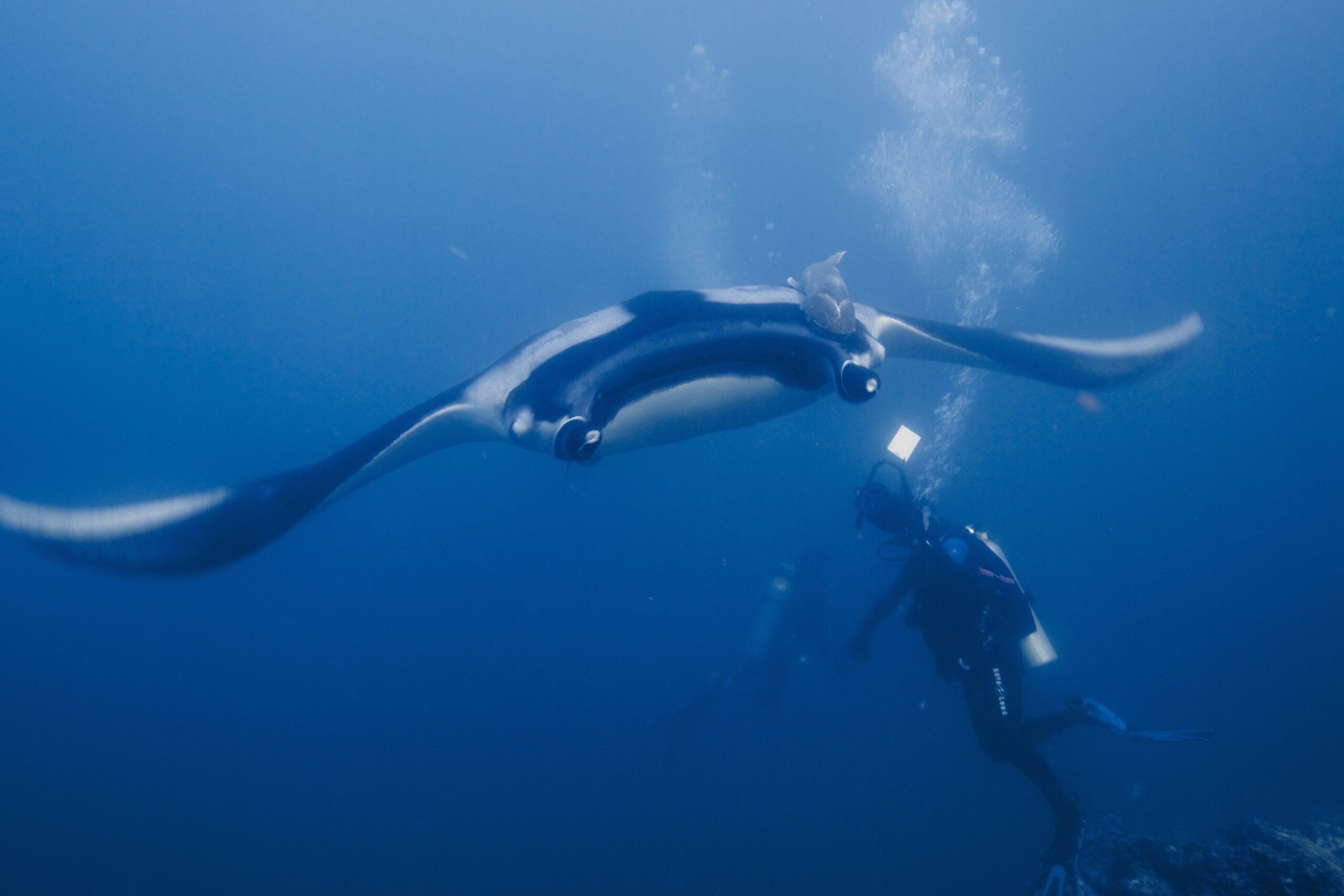
Giant Oceanic Manta Ray (Mobula birostris) is a huge, highly mobile ray found in tropical, subtropical and some temperate seas. Its wing-like pectoral fins can span about eight metres, yet it feeds by filtering zooplankton and small animals rather than using a sting or large cutting teeth. This guide separates well-supported biology from common assumptions and covers identification, range, habitat, diet, behavior, reproduction and conservation.
Identification
The body forms a broad diamond with long triangular pectoral fins, a forward-facing rectangular mouth and two flexible cephalic lobes that unroll beside the mouth during feeding. Chevron-colored individuals are black or dark gray above with pale shoulder patches and white below; melanistic animals may be almost black. Every underside bears a distinctive pattern of spots around the gills and abdomen. Giant oceanic mantas usually show a T-shaped dark shoulder pattern, rougher skin and a small caudal thorn behind the dorsal fin. Females grow larger than males. Mature males have paired claspers beside the pelvic fins, while females lack them. Size alone cannot reliably identify sex because age classes overlap, and color pattern does not indicate sex.
Identification should combine body shape, markings, size, voice or movement, and location. One feature by itself can overlap with a related animal, a juvenile, or an individual in unusual light.
Photographs are most useful when they preserve scale and show several diagnostic features. Handling or repositioning a wild giant oceanic manta ray for identification can cause stress and is unnecessary.
Size and physical adaptations
Giant Oceanic Manta Ray typically measures disc width commonly 4.5–7 m, reaching about 8 m and weighs exceptional adults may weigh about 2,400 kg. Disc width is measured from one pectoral wingtip to the other. NOAA reports a maximum near 26 ft and 5,300 lb, but most observed animals are smaller.
Its useful adaptations include cephalic lobes funnel prey-rich water into the mouth, gill plates filter zooplankton from seawater, large pectoral fins generate lift efficiently, dark dorsal and pale ventral surfaces provide countershading, unique belly spots allow individual recognition, deep-diving physiology accesses mesopelagic prey, a large brain supports complex movement and social behavior. These traits work together in the animal’s normal setting rather than serving as isolated curiosities.
Published measurements may use different methods, life stages or sample locations. Comparing figures responsibly means checking what was measured rather than selecting the largest number available.
Range and distribution
Occurs worldwide in tropical, subtropical and temperate seas, with major populations and seasonal aggregations in the eastern Pacific, Gulf of Mexico, Caribbean, western Indian Ocean and Indo-Pacific. The native range includes United States, Mexico, Ecuador, Brazil, South Africa, Mozambique, Tanzania, Kenya, Egypt, Oman, India, Sri Lanka, Maldives, Indonesia, Philippines, Japan, Australia, New Zealand.
A country-level map indicates broad distribution, not continuous occupation. Climate, elevation, water, vegetation, prey, breeding sites, barriers and survey effort all affect where records occur.
Records near the edge of the range deserve careful documentation because they may reflect natural movement, improved survey coverage, accidental transport or a genuine distribution change.
Habitat
Open ocean, continental shelves, productive coastlines, seamounts, offshore islands, upwelling zones, bays and cleaning stations.
Giant mantas track productivity rather than remaining at one reef. They visit surface fronts, shelf edges and upwelling zones when plankton concentrates, then move offshore or descend as prey shifts. Tags record dives beyond 1,000 m, although feeding groups are often photographed in the upper ten metres. Cleaning stations near reefs let small fish remove parasites, while offshore pinnacles and islands provide navigation and social meeting points. Protecting a population therefore requires the feeding, shelter and breeding features that make a site usable, along with connections that allow movement.
Microhabitat matters. Shade, soil, current, moisture, shelter or host plants can determine whether a small area is usable even when the surrounding landscape appears suitable.
Diet and feeding
Giant Oceanic Manta Ray is a filter-feeding carnivore. Important foods include copepods, krill and euphausiids, mysids, shrimp and crab larvae, fish eggs, small schooling fish, mesopelagic zooplankton. During surface feeding, the ray unfurls its cephalic lobes into a funnel and swims with its mouth open. Water passes across gill plates that retain prey. An individual may barrel-roll repeatedly through a dense patch, make straight feeding runs or join a chain in which several mantas follow one another. Stable-isotope work indicates that deeper mesopelagic prey can contribute substantially even when spectacular surface feeding is easier for people to observe.
Diet changes with age, season, location and food supply. A dramatic prey record does not establish what most individuals eat most of the time; repeated field observations provide a stronger picture.
Feeding opportunities also create risk. An animal focused on prey may be less alert to predators, traffic or people, while contaminated prey can transfer pollutants through the food web.
Behavior and communication
Active by day and night, with movement and diving driven by prey, currents, temperature, tides and cleaning opportunities. Most sightings involve one ray or a loose group, but rich plankton, cleaning stations and courtship can draw many together. Mantas glide by beating flexible pectoral fins and sometimes leap clear of the surface. Courtship may involve a train of males following one female through repeated turns and dives. Site fidelity can coexist with long migrations, so protection at one aggregation does not cover the entire annual range.
No vocal system is known. Giant mantas respond to posture, spacing, swimming direction and close following during feeding or courtship. Vision, smell, water-motion detection and electroreception provide information about prey and other animals. A manta that changes direction, speeds away or stops feeding near a swimmer is signaling disturbance through behavior even without a deliberate social display. Behavior should be interpreted in context: alarm, courtship, feeding and temperature regulation can produce very different actions from the same animal.
Daily schedules are flexible responses, not rigid rules. Weather, breeding condition, disturbance, tides or food can move activity into a different part of the day.
Reproduction and development
Courtship trains culminate when a male bites the edge of a female’s pectoral fin to hold position and inserts one clasper. Fertilization is internal. The embryo develops inside the uterus without a placenta and receives lipid-rich uterine secretions called histotroph after using its yolk. This produces an unusually large, capable newborn but limits reproductive output. Usually 1 pup A newborn has a disc width near 2 m and is folded inside the uterus before birth. It receives no parental care. Growth is slow, and maturity requires many years and a large body size. Females may rest for several years between pregnancies, so a mature female may produce very few pups over her lifetime.
Young animals face different risks and may use different microhabitats or food than adults. Breeding success depends on adult condition, suitable sites and the survival of offspring through vulnerable early stages.
Counts of eggs or young describe reproductive output, not the number expected to reach adulthood. Mortality is normally greatest during eggs, larval or juvenile stages.
Predators and ecological role
The species is a large secondary consumer that moves plankton-derived energy across depth zones and between offshore and coastal systems. Surface feeding follows blooms and spawning events, while deep foraging reaches mesopelagic communities. Cleaner fish remove parasites from its skin and gills, and remoras travel with it. Large sharks and orcas can prey on mantas, leaving characteristic bite scars on survivors. Documented or likely predators include Tiger Shark, Great White Shark, Orca, Humans.
This animal is both a consumer and a food source. Its influence comes through many repeated interactions, so ecological claims should be based on measured populations rather than assumptions drawn from appearance.
Predator and prey relationships differ among places. A species can be ecologically influential without being abundant everywhere, and its role can change across its range.
Relationship with people
People value mantas for wildlife tourism, science and cultural identity, but fisheries have targeted them for meat and especially gill plates sold internationally. Gillnets, purse seines, longlines and trawls also catch them accidentally. Photo identification and tagging support non-lethal study. Tourism can fund conservation when boats limit speed and swimmers keep distance; crowding, touching and chasing interrupt feeding and cleaning.
Giant mantas lack a functional stinging spine and are not aggressive toward people. Their size still demands space. Never touch, ride, feed or block one, approach from the side, keep clear of the head and tail, and follow local limits on swimmers. Boats should slow to idle, post a lookout and avoid crossing the animal’s path. Responsible observation means keeping an appropriate distance, avoiding capture or feeding, protecting habitat and following local wildlife or invasive-species guidance.
Wildlife guidance should come from the responsible local agency because collection rules, reporting requests and appropriate responses differ between native and introduced ranges.
Conservation
The IUCN Red List classifies the giant oceanic manta ray as Endangered. Targeted fishing, bycatch and trade have caused severe regional declines, and one pup every several years makes depleted populations exceptionally slow to recover. The reported global trend is Decreasing.
Important pressures include targeted fishing for gill plates and meat, bycatch in gillnets, purse seines, longlines and trawls, illegal retention and international trade, entanglement in discarded gear, vessel strikes, unregulated tourism disturbance, climate-driven changes to plankton and upwelling. Global status can hide local decline or recovery, so current regional monitoring and habitat management remain necessary.
The most useful conservation action follows the documented pressure. Protecting breeding sites, reducing road deaths or limiting pollutants can require different tools in different populations.