
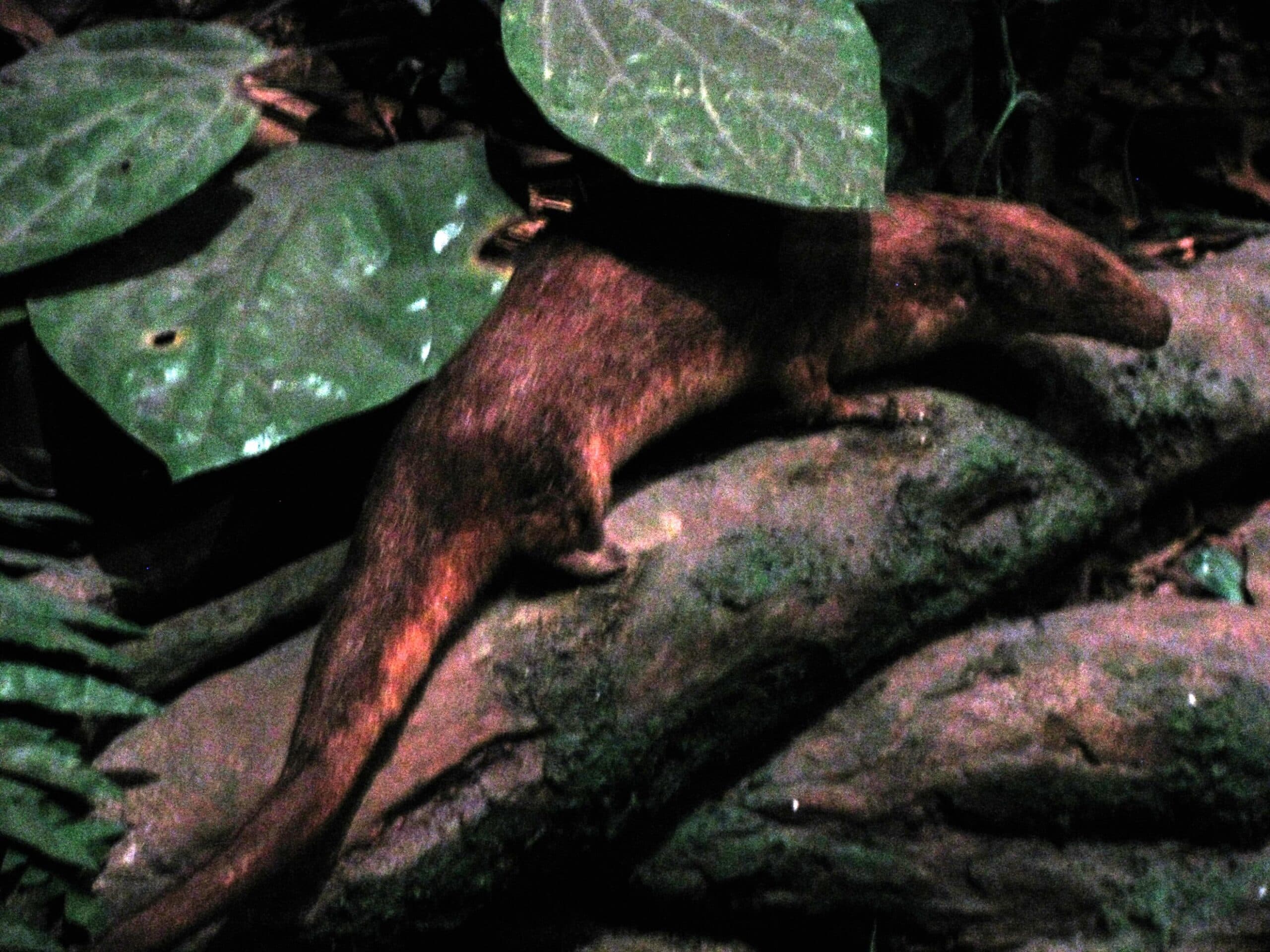
Giant Otter Shrew (Potamogale velox) is a semiaquatic mammal of Central and West African rainforests. Despite its common name, it is neither an otter nor a true shrew. The American Society of Mammalogists places Potamogale velox in family Potamogalidae and order Afrosoricida, an African lineage related to tenrecs and golden moles. It hunts at night in streams, swamps and forest pools, using a sensitive muzzle and muscular tail to find aquatic prey. This guide separates well-supported biology from common assumptions and covers identification, range, habitat, diet, behavior, reproduction and conservation.
Identification
The giant otter shrew has a long low body, dense dark brown fur, a pointed muzzle, small eyes and ears, and a thick tail compressed from side to side. The tail provides most swimming thrust through lateral waves, while the feet contribute relatively little. Long sensory whiskers and a mobile snout help it search turbid water, undercut banks and submerged debris at night. Published field descriptions do not identify a dependable external sex difference. Males and females overlap in appearance, so sex should not be inferred from color or size alone.
Identification should combine body shape, markings, size, voice or movement, and location. One feature by itself can overlap with a related animal, a juvenile, or an individual in unusual light.
Photographs are most useful when they preserve scale and show several diagnostic features. Handling or repositioning a wild giant otter shrew for identification can cause stress and is unnecessary.
Size and physical adaptations
Giant Otter Shrew typically measures Body about 29–35 cm, with a tail about 24–29 cm and weighs roughly 300–950 g. Measurements vary among sources and specimens; the tail makes up a large share of total length.
Its useful adaptations include laterally flattened tail that drives swimming, dense water-resistant fur, sensitive whiskers and mobile muzzle for locating prey, streamlined body with small external ears, nocturnal activity that reduces heat and exposure, powerful jaws for crabs and other aquatic prey. These traits work together in the animal’s normal setting rather than serving as isolated curiosities.
Published measurements may use different methods, life stages or sample locations. Comparing figures responsibly means checking what was measured rather than selecting the largest number available.
Range and distribution
The Mammal Diversity Database records the species in eleven African countries from southern Nigeria and Cameroon through the Congo Basin, extending south into Angola and east to Uganda, South Sudan and a small Kenya border area. Records are tied to forested waterways, so the mapped country range is much broader than the actual ribbon of suitable stream habitat. The native range includes Angola, Cameroon, Central African Republic, Democratic Republic of the Congo, Equatorial Guinea, Gabon, Kenya, Nigeria, Republic of the Congo, South Sudan, Uganda.
A country-level map indicates broad distribution, not continuous occupation. Climate, elevation, water, vegetation, prey, breeding sites, barriers and survey effort all affect where records occur.
Records near the edge of the range deserve careful documentation because they may reflect natural movement, improved survey coverage, accidental transport or a genuine distribution change.
Habitat
Rainforest streams, swamp margins, riverbanks and temporary forest pools.
It favors clean or lightly silted water with overhanging cover, submerged structure and banks that offer dry resting places. Animals may use small tributaries and seasonal pools during rains. Because suitable habitat follows waterways, dams, mining sediment, forest clearing and removal of bank vegetation can fragment populations even when surrounding forest remains. Protecting a population therefore requires the feeding, shelter and breeding features that make a site usable, along with connections that allow movement.
Microhabitat matters. Shade, soil, current, moisture, shelter or host plants can determine whether a small area is usable even when the surrounding landscape appears suitable.
Diet and feeding
Giant Otter Shrew is a carnivore. Important foods include freshwater crabs, fish, frogs and tadpoles, aquatic insects and larvae, mollusks, other small aquatic animals. The giant otter shrew forages mainly after dark, probing around rocks, roots and bank cavities. Whiskers and touch help locate prey where vision is limited. Small prey can be eaten at the capture site, while larger crabs or fish may be carried to a bank or regular feeding place. Its teeth and jaws crush hard-bodied invertebrates and grip slippery prey.
Diet changes with age, season, location and food supply. A dramatic prey record does not establish what most individuals eat most of the time; repeated field observations provide a stronger picture.
Feeding opportunities also create risk. An animal focused on prey may be less alert to predators, traffic or people, while contaminated prey can transfer pollutants through the food web.
Behavior and communication
Nocturnal and semiaquatic. During a swim, the body undulates and the flattened tail sweeps laterally to create thrust. On land it moves with a low, somewhat awkward gait compared with its fluid motion in water. Individuals use bank shelters or cavities above the waterline and may repeatedly travel familiar stream sections. Much of the species’ private life remains poorly documented because it is nocturnal, secretive and difficult to observe.
Direct evidence is limited. The species probably relies heavily on touch and smell at close range because it forages at night and has small eyes. Whiskers detect water movement and contact with objects. Scent marking or vocal communication may occur, but reliable field documentation is too sparse to state a detailed repertoire. Behavior should be interpreted in context: alarm, courtship, feeding and temperature regulation can produce very different actions from the same animal.
Daily schedules are flexible responses, not rigid rules. Weather, breeding condition, disturbance, tides or food can move activity into a different part of the day.
Reproduction and development
The reproductive biology of Potamogale velox is poorly known. Published summaries report small litters, with young likely born in sheltered bank nests. It is a placental mammal and gives birth to live young. Precise mating season, gestation and parental-care duration should not be guessed from better-known tenrecs or true shrews. Usually reported as a small litter; exact typical size remains uncertain Young are born alive and depend on the mother in a protected nest before beginning independent aquatic foraging. Detailed milestones, weaning age and juvenile survival are not well documented in the wild.
Young animals face different risks and may use different microhabitats or food than adults. Breeding success depends on adult condition, suitable sites and the survival of offspring through vulnerable early stages.
Counts of eggs or young describe reproductive output, not the number expected to reach adulthood. Mortality is normally greatest during eggs, larval or juvenile stages.
Predators and ecological role
As an aquatic predator, the giant otter shrew links stream and forest food webs. It consumes crabs, insects, amphibians and fish, then rests and feeds along banks where nutrients cross between water and land. Its dependence on intact waterways makes it vulnerable to changes in water quality and bank structure, while its presence can indicate a functioning forest-stream system. Documented or likely predators include Large snakes, Owls, Small carnivorans, Crocodilians, Humans.
This animal is both a consumer and a food source. Its influence comes through many repeated interactions, so ecological claims should be based on measured populations rather than assumptions drawn from appearance.
Predator and prey relationships differ among places. A species can be ecologically influential without being abundant everywhere, and its role can change across its range.
Relationship with people
The species is rarely seen and has little direct interaction with people. Local fishing, traps and stream use can bring accidental captures, while forest communities share the same waterways for food and water. Protecting riparian vegetation and avoiding destructive fishing methods benefits both aquatic wildlife and downstream water quality.
Giant otter shrews avoid people and are not considered dangerous. Any wild individual should be observed without pursuit or handling. A cornered mammal can bite, and handling also risks injury or disease transmission to both animal and person. Responsible observation means keeping an appropriate distance, avoiding capture or feeding, protecting habitat and following local wildlife or invasive-species guidance.
Wildlife guidance should come from the responsible local agency because collection rules, reporting requests and appropriate responses differ between native and introduced ranges.
Conservation
The American Society of Mammalogists Mammal Diversity Database reports the giant otter shrew as Least Concern, reflecting its broad Central African distribution. That category does not mean every population is secure. Forest loss, stream degradation, sediment, fishing gear and local harvest can affect populations, and field information remains limited. The reported global trend is Not well quantified across its range.
Important pressures include deforestation and loss of streamside cover, mining sediment and water pollution, dams and altered stream flow, fishing nets and traps, local hunting, scarcity of population data. Global status can hide local decline or recovery, so current regional monitoring and habitat management remain necessary.
The most useful conservation action follows the documented pressure. Protecting breeding sites, reducing road deaths or limiting pollutants can require different tools in different populations.
