
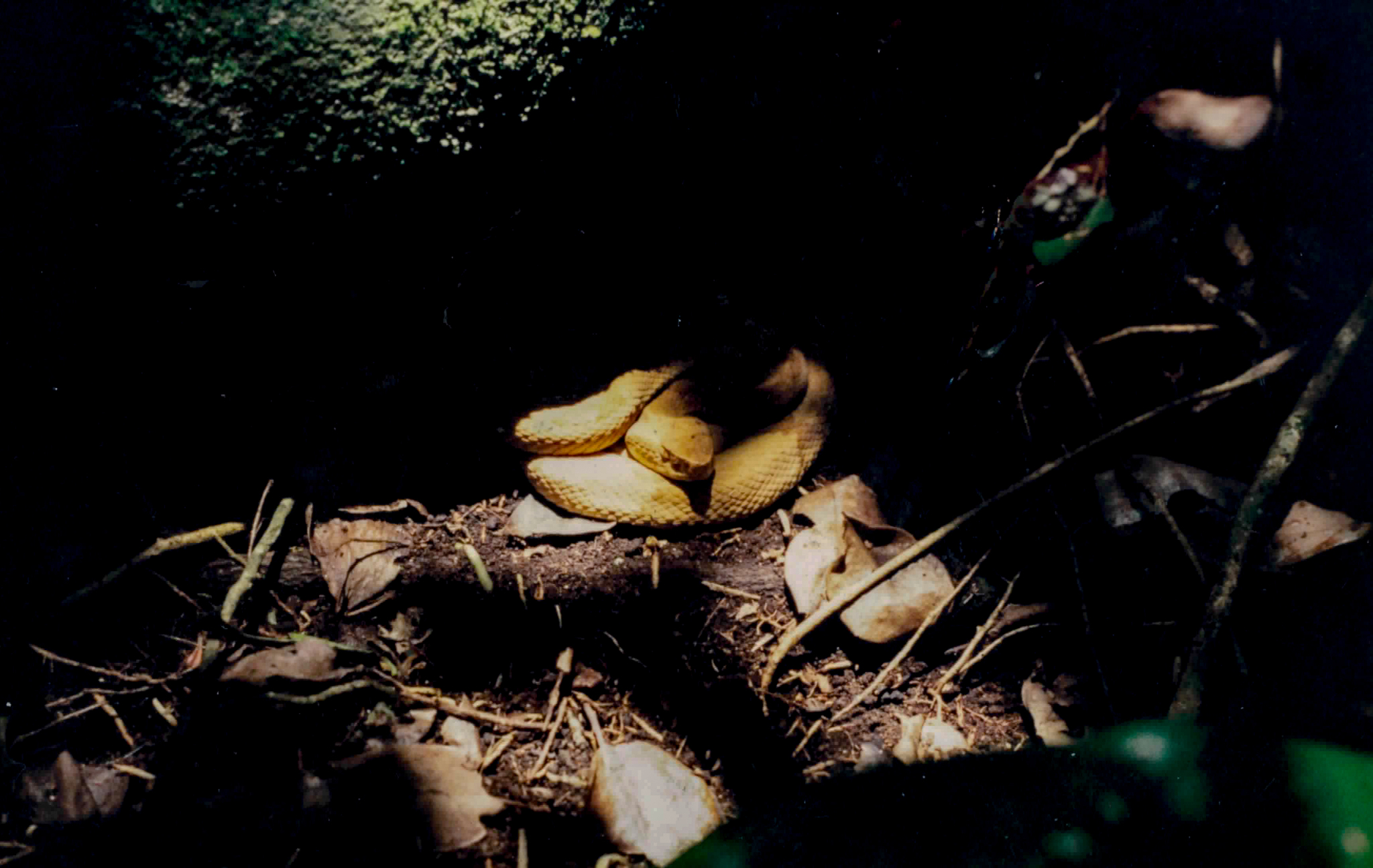
Golden Lancehead (Bothrops insularis) is Bothrops insularis, a venomous pit viper endemic to Ilha da Queimada Grande off São Paulo, Brazil. Isolation on this tiny forested island shaped a snake that climbs readily and feeds heavily on seasonal migratory birds. Its restricted range makes conservation and scientific monitoring essential. This guide separates well-supported biology from common assumptions and covers identification, range, habitat, diet, behavior, reproduction and conservation.
Identification
Adults are usually yellowish tan, golden brown or olive, marked with darker triangular or blotched bands. The head is broad and lance-shaped with a distinct neck, vertical pupils and heat-sensing pits between eyes and nostrils. The tail is comparatively long and prehensile enough to support climbing. Juveniles have a pale tail tip used to lure prey. Females are longer and heavier than males. Some individuals show intersex traits, a feature studied in this isolated population, but most adults can be sexed through reproductive anatomy and tail proportions.
Identification should combine body shape, markings, size, voice or movement, and location. One feature by itself can overlap with a related animal, a juvenile, or an individual in unusual light.
Photographs are most useful when they preserve scale and show several diagnostic features. Handling or repositioning a wild golden lancehead for identification can cause stress and is unnecessary.
Size and physical adaptations
Golden Lancehead typically measures commonly 70–90 cm; large females may approach 120 cm and weighs often about 300–700 g, with large females heavier. Females attain greater body length and mass, supporting the high energy cost of reproduction.
Its useful adaptations include heat-sensing facial pits locate warm prey, hinged fangs inject venom, prehensile tail supports climbing, golden pattern blends with foliage, juvenile tail lure attracts small prey, long body moves through branches, venom rapidly immobilizes birds. These traits work together in the animal’s normal setting rather than serving as isolated curiosities.
Published measurements may use different methods, life stages or sample locations. Comparing figures responsibly means checking what was measured rather than selecting the largest number available.
Range and distribution
The entire natural range is Ilha da Queimada Grande, a roughly 43-hectare island about 33–35 km off the coast of São Paulo state, Brazil. It occurs nowhere else in the wild, so one island holds the global population. The native range includes Brazil.
A country-level map indicates broad distribution, not continuous occupation. Climate, elevation, water, vegetation, prey, breeding sites, barriers and survey effort all affect where records occur.
Records near the edge of the range deserve careful documentation because they may reflect natural movement, improved survey coverage, accidental transport or a genuine distribution change.
Habitat
Atlantic Forest remnants, shrubs, vines, grasses, rocky openings and low trees on a humid subtropical oceanic island.
Golden Lanceheads use both the forest floor and vegetation. They climb shrubs and low trees when migratory passerines visit, coil among leaves and vines, and descend at other times. Rock crevices, litter and dense plants provide shelter. With no permanent freshwater stream, the snakes depend on island moisture, rainfall and water retained on vegetation. Protecting a population therefore requires the feeding, shelter and breeding features that make a site usable, along with connections that allow movement.
Microhabitat matters. Shade, soil, current, moisture, shelter or host plants can determine whether a small area is usable even when the surrounding landscape appears suitable.
Diet and feeding
Golden Lancehead is a ambush predator specializing in migratory birds as an adult. Important foods include migratory passerine birds, small lizards, amphisbaenians, centipedes, frogs, occasional small snakes. An adult waits along branches or on the ground where birds land, strikes rapidly and uses venom to prevent winged prey from escaping. It may hold a bird after striking rather than releasing it. Juveniles use their contrasting tail tips as lures and take ectothermic prey such as lizards, frogs and centipedes before shifting toward birds.
Diet changes with age, season, location and food supply. A dramatic prey record does not establish what most individuals eat most of the time; repeated field observations provide a stronger picture.
Feeding opportunities also create risk. An animal focused on prey may be less alert to predators, traffic or people, while contaminated prey can transfer pollutants through the food web.
Behavior and communication
Mostly crepuscular and nocturnal, with seasonal climbing tied to bird availability. The snake usually relies on camouflage and stillness. When threatened it may flatten the body, vibrate the tail, strike and retreat. It climbs more frequently than mainland jararacas, using the tail as an anchor. Activity, body condition and reproduction track seasonal bird migration, because prey can be scarce during parts of the year.
Tongue flicks deliver chemical particles to the vomeronasal system, helping locate prey and mates. Facial pits detect heat from birds at close range. Ground and branch vibration warn of movement. Courtship uses scent and tactile contact, while defensive coiling, tail vibration and striking communicate danger. Behavior should be interpreted in context: alarm, courtship, feeding and temperature regulation can produce very different actions from the same animal.
Daily schedules are flexible responses, not rigid rules. Weather, breeding condition, disturbance, tides or food can move activity into a different part of the day.
Reproduction and development
Mating occurs mainly during the cooler part of the year. Females store sperm and invest heavily in yolk before retaining embryos internally. Limited and seasonal food means many females cannot reproduce every year. Researchers monitor reproductive condition closely because the species has one tiny population and low output. Usually 2–10 live young, often fewer than mainland relatives Females give birth to independent live young. Neonates already possess venom, functional fangs and a contrasting tail tip. They lure and capture small ectothermic prey while growing, then add birds as climbing ability and body size increase. There is no parental care after birth.
Young animals face different risks and may use different microhabitats or food than adults. Breeding success depends on adult condition, suitable sites and the survival of offspring through vulnerable early stages.
Counts of eggs or young describe reproductive output, not the number expected to reach adulthood. Mortality is normally greatest during eggs, larval or juvenile stages.
Predators and ecological role
As the island’s dominant terrestrial predator, the Golden Lancehead links visiting birds with the resident food web. It consumes migratory passerines and smaller reptiles and invertebrates, while juveniles may be vulnerable to birds and other snakes. The species offers a rare natural example of how isolation, seasonal prey and climbing behavior shape evolution. Documented or likely predators include Burrowing Owl, Southern Caracara, Large centipede, Golden Lancehead, Human.
This animal is both a consumer and a food source. Its influence comes through many repeated interactions, so ecological claims should be based on measured populations rather than assumptions drawn from appearance.
Predator and prey relationships differ among places. A species can be ecologically influential without being abundant everywhere, and its role can change across its range.
Relationship with people
The island is closed to ordinary tourism, and authorized researchers follow strict field protocols. Sensational claims have encouraged myths and illegal demand, which harms conservation. Scientists from Instituto Butantan study ecology, venom, genetics and reproduction and maintain an ex situ conservation program. The correct public response is to respect access controls and never seek a wild specimen.
This is a medically important venomous snake. No untrained person should approach, touch or attempt to capture one. Envenomation can disrupt clotting, damage tissue and injure kidneys. A suspected bite requires immediate emergency care and appropriate antivenom evaluation; cutting, suction and tourniquets are dangerous. Responsible observation means keeping an appropriate distance, avoiding capture or feeding, protecting habitat and following local wildlife or invasive-species guidance.
Wildlife guidance should come from the responsible local agency because collection rules, reporting requests and appropriate responses differ between native and introduced ranges.
Conservation
The species is Critically Endangered because its entire wild range is one very small island and habitat quality remains vulnerable. Fire, disease, extreme weather, illegal collection and genetic isolation could affect the whole population. Protection of Queimada Grande and coordinated ex situ conservation are therefore crucial. The reported global trend is Uncertain and closely monitored; long-term security is limited by the single-island range.
Important pressures include extremely restricted range, habitat degradation, wildfire, illegal collection, disease outbreak, genetic isolation, extreme weather. Global status can hide local decline or recovery, so current regional monitoring and habitat management remain necessary.
The most useful conservation action follows the documented pressure. Protecting breeding sites, reducing road deaths or limiting pollutants can require different tools in different populations.