
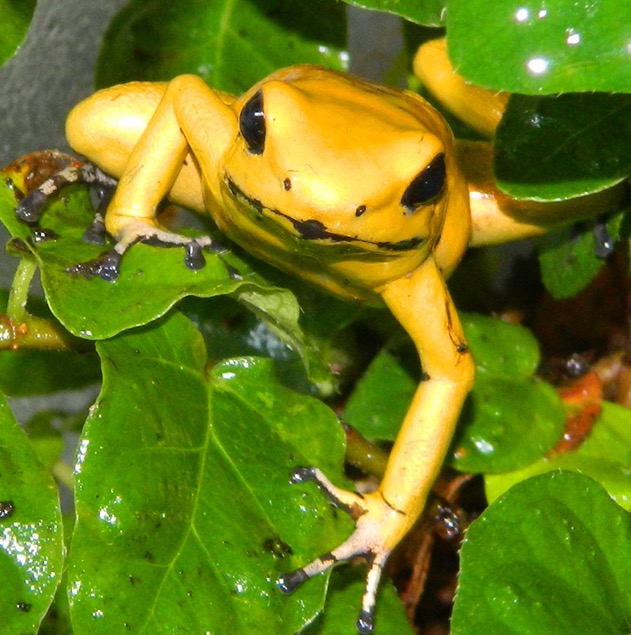
Golden Poison Frog (Phyllobates terribilis) is a small, day-active amphibian found naturally only in a narrow part of Colombia’s Pacific lowlands. Its yellow, orange or pale green body is a warning display. Wild frogs obtain potent batrachotoxins from their diet, while captive-bred animals fed ordinary invertebrates do not develop the same toxicity. This guide separates well-supported biology from common assumptions and covers identification, range, habitat, diet, behavior, reproduction and conservation.
Identification
Adults are sturdy for a poison frog, with a rounded snout, smooth-looking skin, long limbs and expanded toe tips used for gripping wet vegetation. Most are uniformly golden yellow, orange or mint green, although the feet and mouth may be darker. Juveniles are black with paired golden stripes and become more uniformly bright as they grow. The dark eyes stand out against the vivid body. Females are generally larger and more robust than males. Males can also be recognized during breeding by their advertisement calls and subtle differences in finger pads.
Identification should combine body shape, markings, size, voice or movement, and location. One feature by itself can overlap with a related animal, a juvenile, or an individual in unusual light.
Photographs are most useful when they preserve scale and show several diagnostic features. Handling or repositioning a wild golden poison frog for identification can cause stress and is unnecessary.
Size and physical adaptations
Golden Poison Frog typically measures Adults about 37–55 mm snout to vent and weighs Usually several grams; commonly about 3–7 g. Females commonly reach the upper end of the size range, and published values vary with sex, age and condition.
Its useful adaptations include bright aposematic color warns potential predators, skin can store diet-derived batrachotoxins in the wild, expanded toe pads grip wet leaves and stems, diurnal vision supports active daytime foraging, a sticky projectile tongue captures tiny arthropods, males guard terrestrial eggs, adults transport tadpoles to water, small body size permits use of humid leaf litter. These traits work together in the animal’s normal setting rather than serving as isolated curiosities.
Published measurements may use different methods, life stages or sample locations. Comparing figures responsibly means checking what was measured rather than selecting the largest number available.
Range and distribution
Endemic to a small area of humid Pacific lowland in western Colombia, principally in the departments of Cauca and Valle del Cauca. Records are localized rather than continuous, and the species has one of the smallest ranges among well-known poison frogs. The native range includes Colombia.
A country-level map indicates broad distribution, not continuous occupation. Climate, elevation, water, vegetation, prey, breeding sites, barriers and survey effort all affect where records occur.
Records near the edge of the range deserve careful documentation because they may reflect natural movement, improved survey coverage, accidental transport or a genuine distribution change.
Habitat
Very wet lowland tropical rainforest, usually on the forest floor among deep leaf litter, roots and fallen branches near small streams.
Adults forage and call in humid leaf litter during daylight and use low plants, logs and root tangles as cover. Eggs develop on land in moist protected sites. After hatching, a parent carries tadpoles to small pools or slow water, so a viable site must preserve both terrestrial forest structure and clean aquatic nursery habitat. Protecting a population therefore requires the feeding, shelter and breeding features that make a site usable, along with connections that allow movement.
Microhabitat matters. Shade, soil, current, moisture, shelter or host plants can determine whether a small area is usable even when the surrounding landscape appears suitable.
Diet and feeding
Golden Poison Frog is a insectivore. Important foods include ants, mites, small beetles, termites, springtails, other tiny arthropods. The frog searches leaf litter during the day and snaps up very small invertebrates with its tongue. Research indicates that alkaloid-bearing arthropods provide the chemical building blocks of its skin toxins. Captive diets of fruit flies, crickets and other standard feeder insects do not supply those compounds, demonstrating that the poison is sequestered rather than manufactured entirely from scratch.
Diet changes with age, season, location and food supply. A dramatic prey record does not establish what most individuals eat most of the time; repeated field observations provide a stronger picture.
Feeding opportunities also create risk. An animal focused on prey may be less alert to predators, traffic or people, while contaminated prey can transfer pollutants through the food web.
Behavior and communication
Diurnal and most active under warm, humid rainforest conditions. Golden Poison Frogs move openly across the forest floor, relying on warning color and chemical defense rather than remaining continuously hidden. Males defend calling areas and give repeated notes to attract females and challenge rivals. Individuals use moist cover during dry moments and may gather where food, shelter and breeding sites are concentrated.
Males produce rapid, high-pitched trilling or buzzing calls. Call timing and position help females locate a mate and warn other males. Close-range courtship includes following, postures and touch, while bright coloration communicates danger to visually hunting predators. Behavior should be interpreted in context: alarm, courtship, feeding and temperature regulation can produce very different actions from the same animal.
Daily schedules are flexible responses, not rigid rules. Weather, breeding condition, disturbance, tides or food can move activity into a different part of the day.
Reproduction and development
Courtship takes place on the forest floor. The female deposits a small clutch in a humid terrestrial site and the male usually tends it, keeping the eggs moist. Once they hatch, tadpoles climb onto an adult’s back and are transported to water where larval development continues. Usually about 8–20 terrestrial eggs Aquatic tadpoles feed and grow for several weeks before metamorphosing. Newly transformed froglets retain dark juvenile markings and gradually develop the nearly uniform adult color. Survival depends on moist egg sites, clean water and the continuing forest canopy.
Young animals face different risks and may use different microhabitats or food than adults. Breeding success depends on adult condition, suitable sites and the survival of offspring through vulnerable early stages.
Counts of eggs or young describe reproductive output, not the number expected to reach adulthood. Mortality is normally greatest during eggs, larval or juvenile stages.
Predators and ecological role
This frog consumes large numbers of tiny forest-floor arthropods and in turn presents a chemically defended prey item to predators. Its need for intact humid forest, terrestrial egg sites and clean nursery water makes it sensitive to changes across several linked parts of the ecosystem. Scientists also study batrachotoxin because it locks voltage-gated sodium channels open and has illuminated nerve and muscle physiology. Documented or likely predators include Fire-bellied Snake, Human, Fungal Pathogens.
This animal is both a consumer and a food source. Its influence comes through many repeated interactions, so ecological claims should be based on measured populations rather than assumptions drawn from appearance.
Predator and prey relationships differ among places. A species can be ecologically influential without being abundant everywhere, and its role can change across its range.
Relationship with people
Indigenous Emberá people historically used secretions from Phyllobates frogs on blowgun darts for hunting; the common name reflects that practice. Today the species is also important in biochemical research, conservation education and carefully regulated captive breeding. Habitat conversion, mining and illegal wildlife collection can damage the small wild population.
Never touch a wild Golden Poison Frog. Skin secretions can enter cuts or mucous membranes, and handling also harms the frog by transferring salts, oils or pathogens. Observe at a distance and follow local guidance. Captive-bred animals are far less toxic, but they still require hygienic, hands-off care. Responsible observation means keeping an appropriate distance, avoiding capture or feeding, protecting habitat and following local wildlife or invasive-species guidance.
Wildlife guidance should come from the responsible local agency because collection rules, reporting requests and appropriate responses differ between native and introduced ranges.
Conservation
The IUCN lists the Golden Poison Frog as Endangered because its distribution is extremely restricted and the extent and quality of its habitat continue to decline. Forest loss and degradation from agriculture, logging, settlement and mining are serious pressures; collection and amphibian disease add concern. The reported global trend is Decreasing.
Important pressures include lowland rainforest loss, illegal mining, agricultural expansion, logging and settlement, illegal collection, water contamination, emerging amphibian disease. Global status can hide local decline or recovery, so current regional monitoring and habitat management remain necessary.
The most useful conservation action follows the documented pressure. Protecting breeding sites, reducing road deaths or limiting pollutants can require different tools in different populations.