
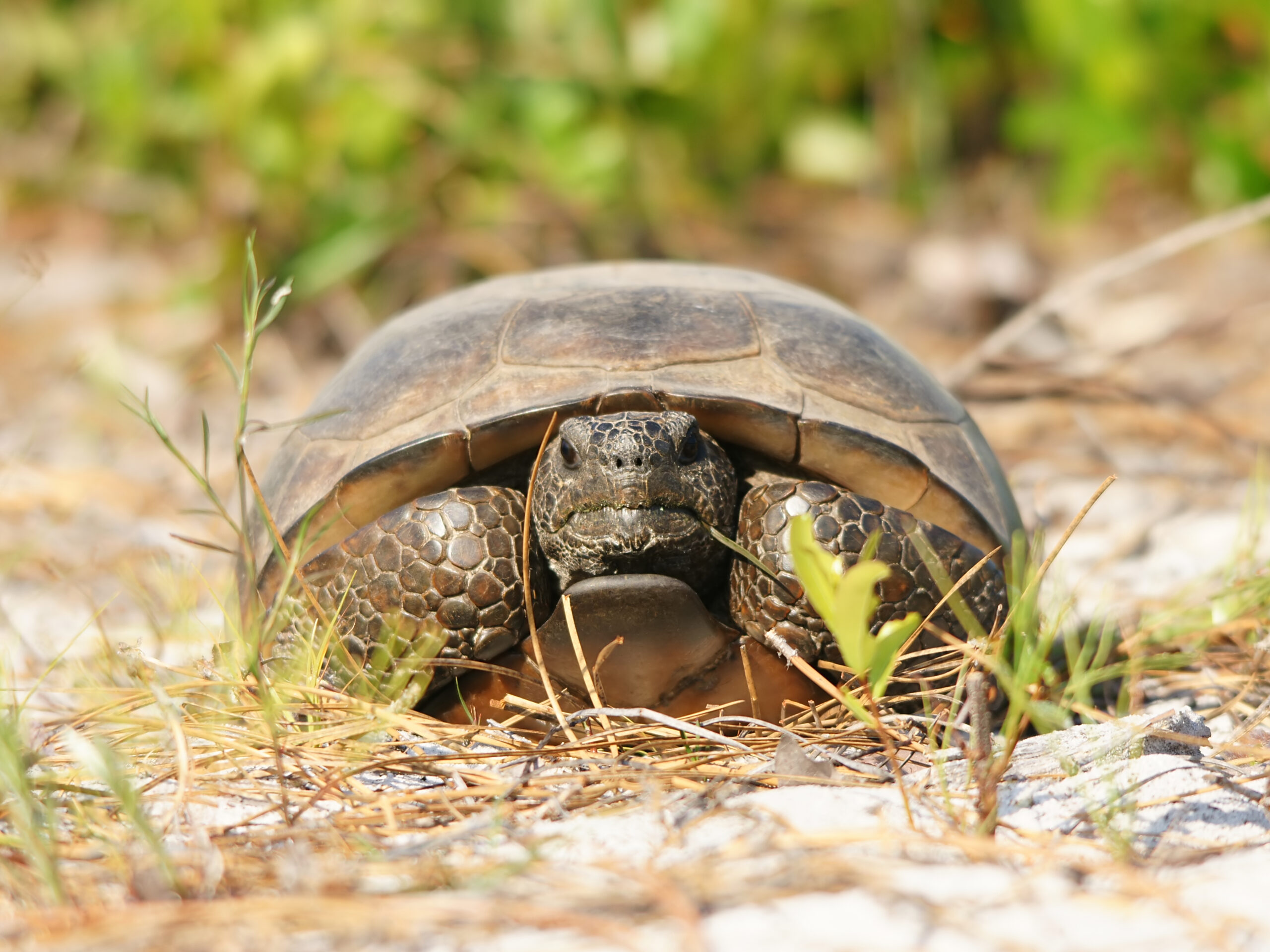
Gopher Tortoise (Gopherus polyphemus) is Gopherus polyphemus, the only tortoise native to the southeastern United States. Its broad shovel-like forelimbs excavate long burrows in sandy ground. Those stable underground refuges make the tortoise an ecosystem engineer whose survival supports an entire community of fire-adapted wildlife. This guide separates well-supported biology from common assumptions and covers identification, range, habitat, diet, behavior, reproduction and conservation.
Identification
Adults have a high oval shell colored tan, gray or dark brown, with a pale yellowish lower shell. The head is blunt and the rear legs are thick and column-like. Flattened forelegs carry enlarged scales and strong claws for digging. Young tortoises are brighter yellow-orange with distinct growth rings and a softer shell that hardens with age. Adult males have a concave plastron and longer tail, while females usually have a flatter lower shell. Males also develop more prominent projections at the front of the plastron, used during contests.
Identification should combine body shape, markings, size, voice or movement, and location. One feature by itself can overlap with a related animal, a juvenile, or an individual in unusual light.
Photographs are most useful when they preserve scale and show several diagnostic features. Handling or repositioning a wild gopher tortoise for identification can cause stress and is unnecessary.
Size and physical adaptations
Gopher Tortoise typically measures adult shell commonly 23–38 cm and weighs commonly 4–7 kg; exceptionally heavier. Shell length and growth vary with habitat quality, latitude and age; females often reach a larger average size in some populations.
Its useful adaptations include shovel-like forefeet excavate sand, domed shell protects the body, deep burrows buffer heat and cold, scaly legs reduce abrasion, strong claws loosen compacted soil, slow metabolism supports seasonal scarcity, powerful shoulder girdle drives digging. These traits work together in the animal’s normal setting rather than serving as isolated curiosities.
Published measurements may use different methods, life stages or sample locations. Comparing figures responsibly means checking what was measured rather than selecting the largest number available.
Range and distribution
The native range follows the southeastern Coastal Plain from southern South Carolina through Georgia and Florida and west across southern Alabama and Mississippi into extreme southeastern Louisiana. Most remaining habitat occurs in Florida and Georgia, with fragmented populations farther west. The native range includes United States.
A country-level map indicates broad distribution, not continuous occupation. Climate, elevation, water, vegetation, prey, breeding sites, barriers and survey effort all affect where records occur.
Records near the edge of the range deserve careful documentation because they may reflect natural movement, improved survey coverage, accidental transport or a genuine distribution change.
Habitat
Longleaf pine sandhills, scrub, dry prairie, coastal dunes, oak hammocks, open pine flatwoods and other sunny uplands with deep well-drained soil.
Each tortoise digs one or more burrows, often beneath open sunny ground near feeding areas. A burrow slopes downward and can extend many metres while remaining close to the water table. It buffers heat, freezing temperatures, drought and fire. Tortoises forage in open vegetation and retreat underground when threatened or during temperature extremes. Protecting a population therefore requires the feeding, shelter and breeding features that make a site usable, along with connections that allow movement.
Microhabitat matters. Shade, soil, current, moisture, shelter or host plants can determine whether a small area is usable even when the surrounding landscape appears suitable.
Diet and feeding
Gopher Tortoise is a primarily herbivorous browser and grazer. Important foods include wiregrass, broadleaf grasses, legumes, wildflowers, palmetto berries, prickly pear fruit, mushrooms. Gopher Tortoises crop grasses and low herbs, browse leaves and take seasonal flowers, berries and fruit. Their movements disperse seeds and their grazing shapes plant growth near burrows. Occasional fungi, bone fragments or carrion may supply minerals, but native plants dominate a healthy diet. Sunlit, frequently burned habitat produces the low vegetation they can reach.
Diet changes with age, season, location and food supply. A dramatic prey record does not establish what most individuals eat most of the time; repeated field observations provide a stronger picture.
Feeding opportunities also create risk. An animal focused on prey may be less alert to predators, traffic or people, while contaminated prey can transfer pollutants through the food web.
Behavior and communication
Diurnal, most active in warm mornings and afternoons outside temperature extremes. A tortoise alternates between feeding trips and long periods inside its burrow. It maintains a home range containing several refuges and follows familiar paths. Adults usually avoid conflict, although males ram and push rivals during courtship season. Cold, heat, drought and fire send animals underground, where soil temperature changes slowly.
Smell helps tortoises recognize sex, reproductive state and occupied burrows. Males bob their heads, bite at shell edges and use tactile contact during courtship and contests. Vision guides feeding and navigation, while low-frequency ground vibration may alert a resting tortoise to nearby movement. Behavior should be interpreted in context: alarm, courtship, feeding and temperature regulation can produce very different actions from the same animal.
Daily schedules are flexible responses, not rigid rules. Weather, breeding condition, disturbance, tides or food can move activity into a different part of the day.
Reproduction and development
Courtship begins in spring and may continue through summer. A female digs a sunny nest, often in the apron of loose sand outside her burrow, and usually produces one clutch per year. Incubation temperature influences hatchling sex. Raccoons, armadillos and other predators destroy many nests soon after laying. Usually 3–15 eggs, varying with female size and region Hatchlings emerge with soft bright shells and receive no parental care. They dig small burrows or use adult refuges, eating tender plants while the shell hardens. Juvenile mortality is high, and survivors grow slowly. Maturity may require more than a decade, especially in cooler northern parts of the range.
Young animals face different risks and may use different microhabitats or food than adults. Breeding success depends on adult condition, suitable sites and the survival of offspring through vulnerable early stages.
Counts of eggs or young describe reproductive output, not the number expected to reach adulthood. Mortality is normally greatest during eggs, larval or juvenile stages.
Predators and ecological role
The tortoise is a keystone ecosystem engineer. Its burrows provide humid, temperature-stable shelter to gopher frogs, indigo snakes, Florida mice, rabbits, insects and many other animals. Burrow spoil creates bare ground for specialized plants, and feeding disperses seeds. Where tortoises disappear, many dependent species lose critical refuge from fire and weather. Documented or likely predators include Raccoon, Nine-banded Armadillo, Red Fox, American Alligator, Human.
This animal is both a consumer and a food source. Its influence comes through many repeated interactions, so ecological claims should be based on measured populations rather than assumptions drawn from appearance.
Predator and prey relationships differ among places. A species can be ecologically influential without being abundant everywhere, and its role can change across its range.
Relationship with people
Roads, housing and intensive land conversion fragment upland habitat and leave tortoises vulnerable to vehicles and buried burrows. Prescribed fire keeps longleaf pine systems open and food-rich. Landowners and agencies protect colonies, manage vegetation and relocate animals only under permits. Never move a tortoise to a new site without official guidance.
Gopher Tortoises are not aggressive, but handling causes stress and is illegal in many places without authorization. Never put hands into a burrow because protected snakes and other wildlife may be inside. If a tortoise is crossing a road, follow local wildlife guidance and move it only in its original direction when this can be done safely. Responsible observation means keeping an appropriate distance, avoiding capture or feeding, protecting habitat and following local wildlife or invasive-species guidance.
Wildlife guidance should come from the responsible local agency because collection rules, reporting requests and appropriate responses differ between native and introduced ranges.
Conservation
The IUCN classifies the Gopher Tortoise as Vulnerable. The U.S. Endangered Species Act protects the western distinct population segment as Threatened, while states apply additional protections elsewhere. Habitat loss, fragmentation, road deaths, disease and insufficient fire remain major pressures. The reported global trend is Declining overall, although trends vary among managed and fragmented populations.
Important pressures include habitat loss, fire suppression, road mortality, development entombment, fragmentation, disease, illegal collection. Global status can hide local decline or recovery, so current regional monitoring and habitat management remain necessary.
The most useful conservation action follows the documented pressure. Protecting breeding sites, reducing road deaths or limiting pollutants can require different tools in different populations.