
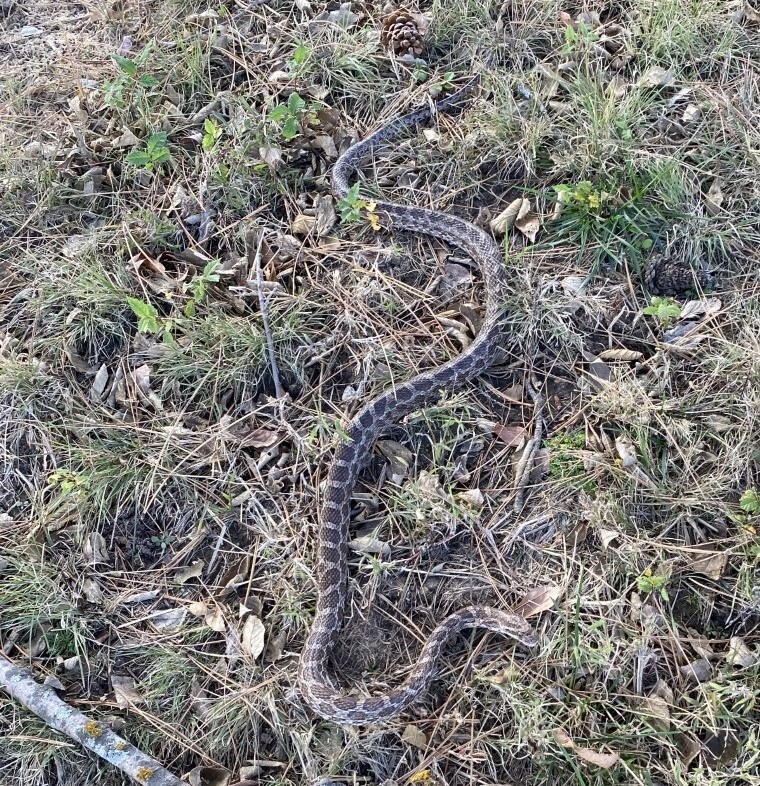
Great Plains Rat Snake (Pantherophis emoryi) is Pantherophis emoryi, a medium-sized nonvenomous constrictor of the central United States and northern Mexico. It spends daylight in burrows, crevices and debris, then hunts rodents after dark. The permanent blotched pattern and spear-shaped head mark help distinguish it from neighboring rat snakes. This guide separates well-supported biology from common assumptions and covers identification, range, habitat, diet, behavior, reproduction and conservation.
Identification
The ground color is light gray, tan or pale brown, crossed by 25–45 dark-edged brown dorsal blotches and smaller side spots. A dark spear-point marking lies on top of the head, and an eye stripe continues onto the neck. The belly is white with bold black checks, changing to dark stripes beneath the tail. Scales are slightly keeled and pupils are round. Males average slightly longer and heavier and have proportionally longer tails, but sexes overlap strongly in appearance. Reliable sexing requires anatomical examination by an experienced professional.
Identification should combine body shape, markings, size, voice or movement, and location. One feature by itself can overlap with a related animal, a juvenile, or an individual in unusual light.
Photographs are most useful when they preserve scale and show several diagnostic features. Handling or repositioning a wild great plains rat snake for identification can cause stress and is unnecessary.
Size and physical adaptations
Great Plains Rat Snake typically measures commonly 60–120 cm; large individuals may reach about 150 cm and weighs often roughly 300–900 g depending on length and condition. Great Plains Rat Snakes are generally smaller and retain more obvious adult blotches than many neighboring western rat snakes.
Its useful adaptations include constriction subdues rodents, blotches camouflage prairie litter, slightly keeled scales aid climbing, chemical senses track hidden prey, nocturnal activity avoids daytime heat, swimming crosses river habitat, winter dens protect from freezing. These traits work together in the animal’s normal setting rather than serving as isolated curiosities.
Published measurements may use different methods, life stages or sample locations. Comparing figures responsibly means checking what was measured rather than selecting the largest number available.
Range and distribution
The species ranges across the central United States from southwestern Illinois and Missouri west through Kansas, Nebraska, Colorado and New Mexico, south through Oklahoma and Texas, and into northern Mexico. Distribution is patchy near the eastern and western margins and often follows rocky slopes, canyons and river systems. The native range includes United States, Mexico.
A country-level map indicates broad distribution, not continuous occupation. Climate, elevation, water, vegetation, prey, breeding sites, barriers and survey effort all affect where records occur.
Records near the edge of the range deserve careful documentation because they may reflect natural movement, improved survey coverage, accidental transport or a genuine distribution change.
Habitat
Hill prairie, rocky bluff, brushland, open woodland, canyon, riparian corridor, field edge, barnyard, cave and abandoned building.
Great Plains Rat Snakes avoid extensive dense forest. They shelter beneath rocks, logs and boards, inside small-mammal burrows and rock fissures, or in old structures. They climb trees and cave walls to reach birds and bats and can swim across waterways. South-facing rocky slopes and deep crevices provide protected winter sites. Protecting a population therefore requires the feeding, shelter and breeding features that make a site usable, along with connections that allow movement.
Microhabitat matters. Shade, soil, current, moisture, shelter or host plants can determine whether a small area is usable even when the surrounding landscape appears suitable.
Diet and feeding
Great Plains Rat Snake is a carnivorous constrictor of small vertebrates. Important foods include mice, rats, voles, birds, bird eggs, bats, lizards. The snake follows rodent scent through grass, burrows, barns and abandoned buildings. It bites, wraps muscular coils around prey and tightens until circulation stops, then swallows it whole. Adults focus on rodents but also climb for birds, eggs and bats. Hatchlings begin with small lizards, frogs and newborn mammals.
Diet changes with age, season, location and food supply. A dramatic prey record does not establish what most individuals eat most of the time; repeated field observations provide a stronger picture.
Feeding opportunities also create risk. An animal focused on prey may be less alert to predators, traffic or people, while contaminated prey can transfer pollutants through the food web.
Behavior and communication
Primarily nocturnal in warm months, with spring basking and winter brumation. This snake usually remains hidden during daylight and emerges after dusk to forage. It moves on the ground, climbs trees and cave walls, and swims when necessary. Individuals reuse established home ranges. When threatened, one may freeze, flee, release musk, vibrate the tail or bite; the display can sound like a rattlesnake in dry leaves, but the species is harmless.
Tongue flicks deliver chemical particles to the vomeronasal organ, revealing prey, predators and pheromone trails. Females attract males chemically in spring. Rival males use raised-body pushing contests. Tail vibration, musking, body kinking and striking communicate defense. Behavior should be interpreted in context: alarm, courtship, feeding and temperature regulation can produce very different actions from the same animal.
Daily schedules are flexible responses, not rigid rules. Weather, breeding condition, disturbance, tides or food can move activity into a different part of the day.
Reproduction and development
Mating follows spring emergence. Males locate females through pheromone trails and may compete through pushing and body alignment. A female later deposits leathery eggs in a warm humid cavity such as rotting vegetation, loose soil, a mammal burrow or sheltered debris. There is no parental care. Usually 5–20 eggs Hatchlings cut the shell with an egg tooth and emerge already patterned like adults. They hunt tiny lizards, frogs and newborn rodents independently. Growth depends on prey and climate, and maturity comes after several active seasons. Northern animals spend longer underground each winter than snakes in Texas or Mexico.
Young animals face different risks and may use different microhabitats or food than adults. Breeding success depends on adult condition, suitable sites and the survival of offspring through vulnerable early stages.
Counts of eggs or young describe reproductive output, not the number expected to reach adulthood. Mortality is normally greatest during eggs, larval or juvenile stages.
Predators and ecological role
Great Plains Rat Snakes suppress mice, rats and voles in grasslands, farms and buildings. By hunting birds and bats above ground as well as rodents below it, they connect prairie, cave and woodland-edge food webs. Hawks, owls, kingsnakes, mammals and vehicles cause mortality, while the snake itself provides prey for larger native predators. Documented or likely predators include Red-Tailed Hawk, Speckled Kingsnake, Great Horned Owl, Raccoon, Coyote.
This animal is both a consumer and a food source. Its influence comes through many repeated interactions, so ecological claims should be based on measured populations rather than assumptions drawn from appearance.
Predator and prey relationships differ among places. A species can be ecologically influential without being abundant everywhere, and its role can change across its range.
Relationship with people
The species benefits farms by consuming rodents and sometimes appears in sheds, barns, cellars or caves. Seal gaps and reduce rodent food to prevent entry. Its tail vibration and blotches sometimes cause fatal confusion with rattlesnakes. Observe from a distance and use a qualified local relocator rather than attempting identification by handling.
Great Plains Rat Snakes are nonvenomous. A restrained animal can bite and musk, leaving superficial punctures. Never handle an unidentified snake. Wash a bite with soap and water, control bleeding and seek care for deep wounds or infection. Avoid moving wild snakes across roads unless local guidance says it is safe. Responsible observation means keeping an appropriate distance, avoiding capture or feeding, protecting habitat and following local wildlife or invasive-species guidance.
Wildlife guidance should come from the responsible local agency because collection rules, reporting requests and appropriate responses differ between native and introduced ranges.
Conservation
The IUCN assesses Pantherophis emoryi as Least Concern because it remains widespread. Peripheral populations can be rare or protected locally, and road mortality, collecting, development and persecution cause regional losses. The reported global trend is Stable overall, with local declines and range-edge concern.
Important pressures include road mortality, deliberate killing, habitat conversion, rock and den disturbance, excessive collection, pesticide effects on prey, building entrapment. Global status can hide local decline or recovery, so current regional monitoring and habitat management remain necessary.
The most useful conservation action follows the documented pressure. Protecting breeding sites, reducing road deaths or limiting pollutants can require different tools in different populations.