
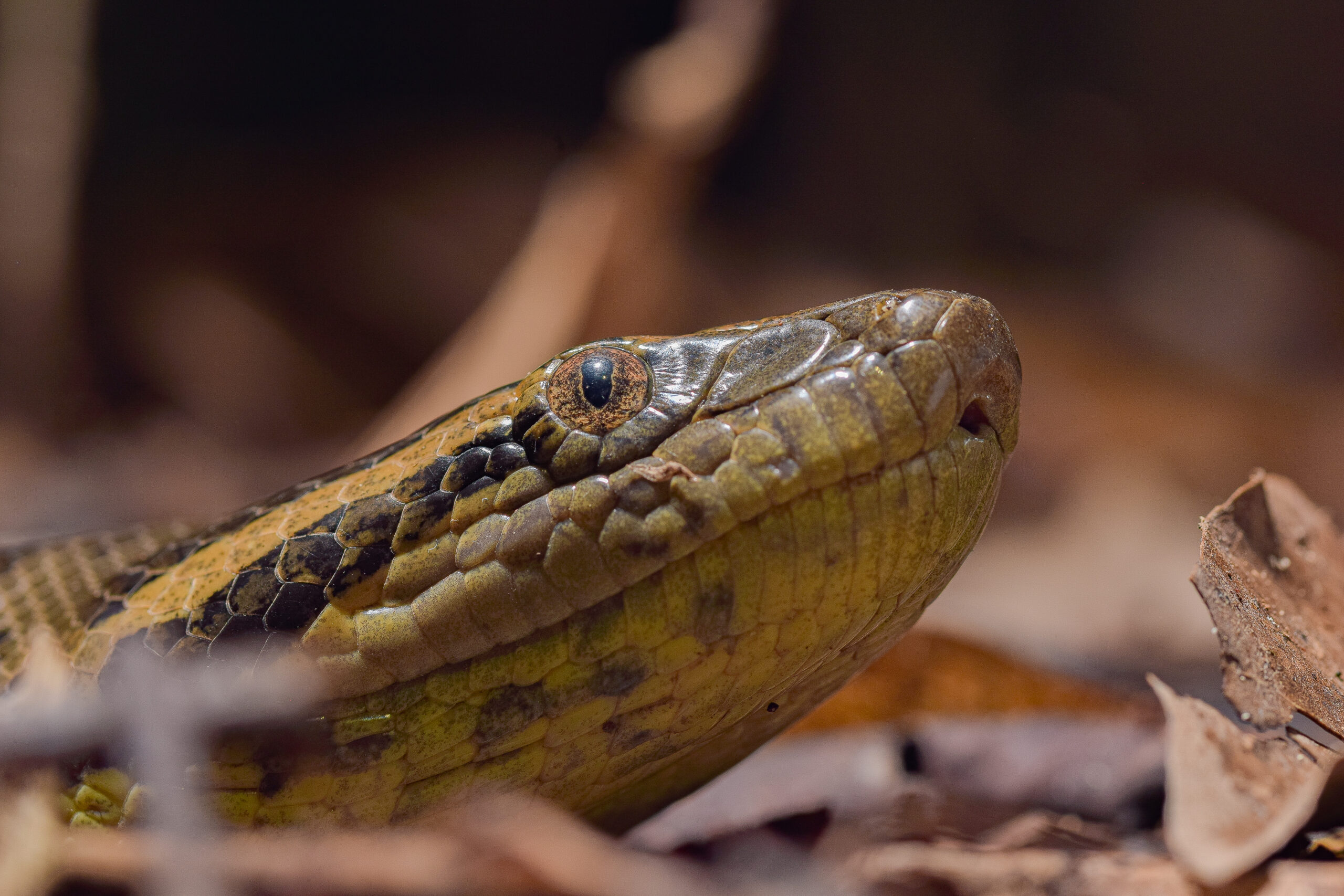
Green Anaconda (Eunectes murinus) is the world’s heaviest snake, an aquatic constrictor of tropical south american rivers, marshes and flooded forests. This evidence-based guide covers identification, range, habitat, diet, behaviour, reproduction and conservation without repeating the FAQ block shown elsewhere on the page.
Taxonomy
Green Anaconda (Eunectes murinus) is the world’s heaviest snake, an aquatic constrictor of tropical south american rivers, marshes and flooded forests. The green anaconda is a boa in genus Eunectes; recent genetic work has proposed additional northern lineages, but this profile follows Eunectes murinus in the established sense. This distinction matters because names and appearances can hide important biological relationships. A reliable profile begins with the animal’s actual taxonomic scope rather than treating every familiar label as a separate species.
Key field marks include very heavy olive-green boa with large black oval blotches, smaller yellow-centered side spots and eyes positioned high on the head. Females are dramatically longer and heavier than males. Together, these traits are more useful for identification than colour alone, because age, season, light and geographic variation can all change how an individual looks.
Size evidence
Typical measurements are Females commonly 4–5 m; exceptional verified animals are longer (Females commonly 13–16 ft; exceptional verified animals are longer), with a weight of Large females may exceed 100 kg (Large females may exceed 220 lb). Body size varies with sex, age, season, food and location, so these figures describe a practical range rather than a limit that every individual must fit.
Its physical design reflects the demands of its way of life. Important adaptations include eyes and nostrils high on head permit surface watching, muscular body constricts large prey, aquatic body moves efficiently through flooded vegetation, heat-sensitive facial pits help locate warm prey. Each reduces the cost of moving, feeding or surviving in the conditions this animal regularly experiences.
South American range
Tropical South America east of the Andes, especially the Amazon and Orinoco basins and connected wetlands. Recorded native locations include Brazil, Venezuela, Colombia, Peru, Bolivia, Guyana, Suriname. Distribution maps show broad presence, but they should not be read as proof that the animal occupies every place inside a shaded country or region.
Local occurrence depends on usable habitat, prey or food, shelter, breeding sites and safe connections between them. Populations may therefore be common in one valley, island or watershed and absent from apparently similar areas nearby.
Wetlands
Slow rivers, oxbow lakes, swamps, marshes, seasonally flooded grasslands and flooded forest. Habitat quality depends on structure as well as climate: animals need places to feed, hide, rest and reproduce, and those features may change over short distances.
Seasonal conditions alter how the habitat is used. Food peaks, snow or ice, drought, flooding and human disturbance can shift daily movements. Protecting a species consequently requires more than preserving a point on a map; the working ecological system around it must remain intact.
Prey
Green Anaconda is a carnivore. Important foods include capybaras, wading birds, caimans, fish and turtles. Availability changes through the year, and individuals adjust where and how long they forage rather than following one fixed menu.
Feeding also connects this animal to the wider ecosystem. By consuming, moving or storing food and by becoming prey itself, it transfers energy through its community. Diet evidence should come from field observations and analysed remains, not from dramatic isolated records.
Constriction
Activity is described as often crepuscular or nocturnal. Typical behaviour includes waits submerged beside animal trails, constriction stops prey circulation, mating males may form breeding balls around one female. These actions help individuals find resources, warn others, maintain space or reduce exposure to predators.
Solitary outside mating aggregations Communication may involve posture, scent, touch and calls. What appears simple from a distance often carries precise information about identity, alarm, breeding condition or ownership of a site.
Aquatic adaptations
Females give birth to live young in or near wetland cover; no egg nest is built. provides shelter from weather and enemies. The location and structure of that refuge can be as important as food, especially when young are immobile or when adults must conserve energy.
Repeated use of paths, dens, nests or colony sites makes them vulnerable to disturbance. Observers should keep their distance, avoid blocking access and never handle young or alter a shelter to obtain a photograph.
Sexual size difference
Breeding occurs often during the seasonal dry-to-wet transition. Usually 20–40 live young, with wide variation are produced after about 6–7 months. Young depend on parental protection and food while their movement, insulation and foraging skills develop.
Sexual maturity is reached roughly 3–4 years. Reproductive success depends on adult condition and local resources, so a population can contain visible adults yet decline when too few young survive to replace them.
Live birth
Natural pressures include predation, severe weather, competition and variable food. Known predators or major sources of mortality include Jaguar, Black Caiman, Humans. Avoidance, camouflage, shelter and vigilance reduce risk but cannot remove it.
Human activity can add faster pressures. Roads, pollution, disturbance, habitat conversion and altered food webs may act together, which is why local monitoring often reveals problems that a broad global category cannot show.
Human conflict
Least Concern globally, while wetland loss, hunting and conflict can reduce local populations. The reported population trend is Unknown. Major concerns include wetland drainage, deliberate killing, hunting for skin or meat, declining prey. Conservation decisions should use the species’ current assessment and local evidence.
Effective protection retains habitat connections, breeding and resting sites, and dependable food. It also reduces preventable mortality and measures results over time. Responsible wildlife viewing supports that work when people keep distance, follow local rules and avoid feeding wild animals.