
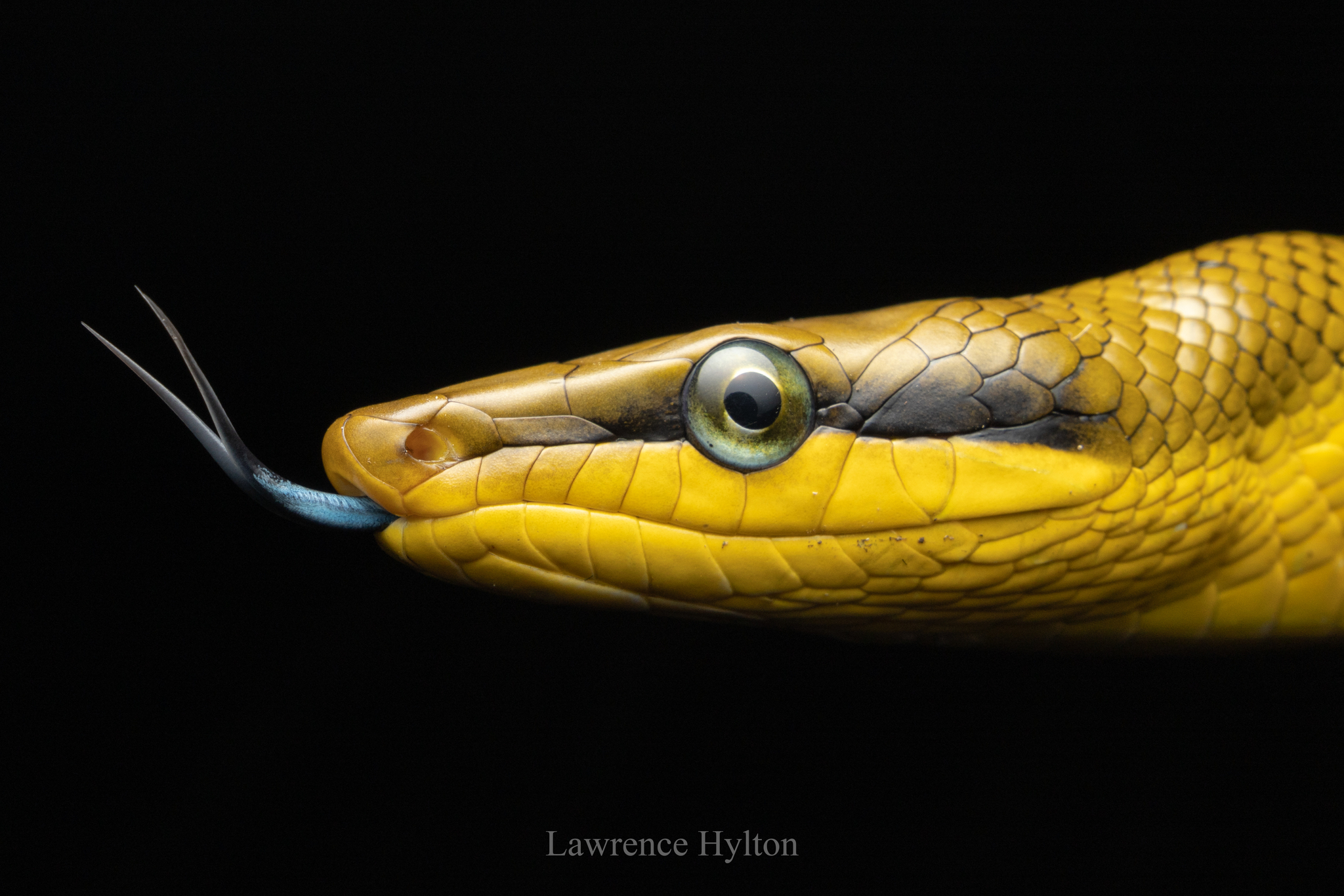
Green Rat Snake (Gonyosoma oxycephalum) is Gonyosoma oxycephalum, a large nonvenomous colubrid of South and Southeast Asian forests. Its narrow pointed head, compressed body and gripping tail suit life among branches. Despite the name racer, it is primarily an arboreal ambush and active-search predator rather than an open-ground speed specialist. This guide separates well-supported biology from common assumptions and covers identification, range, habitat, diet, behavior, reproduction and conservation.
Identification
Adults are slender and laterally compressed, usually bright leaf-green with smooth or weakly keeled scales. The head is long, pointed and clearly separated from the neck, with large eyes and round pupils. Many mainland animals have a rusty red or reddish-brown tail, while Bornean populations may have a gray tail. A dark line can run through the eye, and the underside is yellow-green. Males often have proportionally longer tails and may attain greater total length, but color overlaps completely. Reliable sexing depends on tail anatomy or examination by an experienced reptile veterinarian.
Identification should combine body shape, markings, size, voice or movement, and location. One feature by itself can overlap with a related animal, a juvenile, or an individual in unusual light.
Photographs are most useful when they preserve scale and show several diagnostic features. Handling or repositioning a wild green rat snake for identification can cause stress and is unnecessary.
Size and physical adaptations
Green Rat Snake typically measures commonly 1.4–1.8 m; large individuals approach 2.3 m and weighs often about 500–1,200 g depending on size and condition. The long narrow body and tail make this snake appear larger while keeping it light enough for fine branches.
Its useful adaptations include compressed body balances on branches, long tail anchors climbing movements, green scales provide leaf camouflage, large eyes support daytime hunting, curved teeth retain active prey, flexible ribs bridge gaps, constriction subdues mammals and birds. These traits work together in the animal’s normal setting rather than serving as isolated curiosities.
Published measurements may use different methods, life stages or sample locations. Comparing figures responsibly means checking what was measured rather than selecting the largest number available.
Range and distribution
The species occurs from the Andaman Islands and mainland Southeast Asia through Thailand, Indochina and the Malay Peninsula to Singapore, Sumatra, Java, Bali, Borneo and many Indonesian and Philippine islands. Island populations vary in color, especially the tail. The native range includes India, Myanmar, Thailand, Malaysia, Singapore, Cambodia, Laos, Vietnam, Indonesia, Philippines.
A country-level map indicates broad distribution, not continuous occupation. Climate, elevation, water, vegetation, prey, breeding sites, barriers and survey effort all affect where records occur.
Records near the edge of the range deserve careful documentation because they may reflect natural movement, improved survey coverage, accidental transport or a genuine distribution change.
Habitat
Lowland and montane tropical rainforest, peat swamp forest, mangrove edge, plantation margin, cave forest and mature secondary woodland.
This is a strongly arboreal snake that moves through shrubs, tree crowns, palms and vines. It rests in foliage or tree hollows and may use caves where bats are available. Individuals descend to cross gaps or search near buildings at forest edges. Humid, structurally complex forest supplies both cover and a continuous network of branches. Protecting a population therefore requires the feeding, shelter and breeding features that make a site usable, along with connections that allow movement.
Microhabitat matters. Shade, soil, current, moisture, shelter or host plants can determine whether a small area is usable even when the surrounding landscape appears suitable.
Diet and feeding
Green Rat Snake is a carnivorous constrictor of small vertebrates. Important foods include rats, mice, squirrels, birds, bird eggs, bats, lizards. The snake searches branches, hollows, nests and cave walls using sight and scent. It seizes rodents, squirrels, birds or bats with recurved teeth, then constricts before swallowing. Eggs and lizards supplement the diet. Its long body can bridge between supports while the tail anchors the rear half, allowing it to reach prey on thin vegetation.
Diet changes with age, season, location and food supply. A dramatic prey record does not establish what most individuals eat most of the time; repeated field observations provide a stronger picture.
Feeding opportunities also create risk. An animal focused on prey may be less alert to predators, traffic or people, while contaminated prey can transfer pollutants through the food web.
Behavior and communication
Mostly diurnal and arboreal, with local and seasonal activity extending into dusk. Green Rat Snakes travel deliberately through vegetation, often holding the front body above a branch while scanning. Their camouflage lets them remain motionless beside leaves. A threatened animal may inflate the neck, expose bluish skin between scales, gape, strike and release musk. It is nonvenomous but can defend itself vigorously when restrained.
Tongue flicking samples chemical trails from prey and mates. Large eyes detect movement in daylight, and the body reads vibration through branches. During courtship, males follow female scent and align their bodies. Defensive neck inflation, gaping and striking create a clear visual warning. Behavior should be interpreted in context: alarm, courtship, feeding and temperature regulation can produce very different actions from the same animal.
Daily schedules are flexible responses, not rigid rules. Weather, breeding condition, disturbance, tides or food can move activity into a different part of the day.
Reproduction and development
Mating occurs after seasonal increases in warmth and rain, though timing varies across the broad tropical range. A female deposits leathery eggs inside a humid tree hollow, decaying log, deep litter or another protected cavity. Captive observations show that suitable females may produce more than one clutch in favorable conditions. Usually 5–12 eggs Hatchlings slit the eggs with an egg tooth and receive no parental care. Young snakes are slimmer and may be olive or brownish before becoming vividly green. They take lizards, frogs and newborn rodents, then add birds and larger mammals as their gape and climbing reach increase.
Young animals face different risks and may use different microhabitats or food than adults. Breeding success depends on adult condition, suitable sites and the survival of offspring through vulnerable early stages.
Counts of eggs or young describe reproductive output, not the number expected to reach adulthood. Mortality is normally greatest during eggs, larval or juvenile stages.
Predators and ecological role
Green Rat Snakes connect canopy, cave and forest-edge food webs. They control arboreal rodents and take birds, eggs, bats and lizards, while raptors, monitors, civets and larger snakes prey on them. Their presence depends on connected vegetation, because clearing breaks the aerial pathways used for hunting and escape. Documented or likely predators include Crested Serpent Eagle, Reticulated Python, Asian Water Monitor, Malay Civet, Human.
This animal is both a consumer and a food source. Its influence comes through many repeated interactions, so ecological claims should be based on measured populations rather than assumptions drawn from appearance.
Predator and prey relationships differ among places. A species can be ecologically influential without being abundant everywhere, and its role can change across its range.
Relationship with people
People sometimes encounter this snake in gardens, plantations, caves or buildings near forest. Its green color may cause confusion with venomous tree snakes, so observation should remain hands-off. Maintain connected canopy and reduce rodent attractants rather than killing snakes. Wildlife trade should use only legal, traceable captive-bred stock.
The species is nonvenomous but has many sharp teeth and may bite repeatedly when cornered. Never handle an unidentified green snake. Wash any bite with soap and water and seek medical advice for deep wounds, retained teeth or infection. Leave relocation to trained local wildlife personnel. Responsible observation means keeping an appropriate distance, avoiding capture or feeding, protecting habitat and following local wildlife or invasive-species guidance.
Wildlife guidance should come from the responsible local agency because collection rules, reporting requests and appropriate responses differ between native and introduced ranges.
Conservation
The species is considered Least Concern across a broad range, but local populations lose habitat to logging, plantations and development. Road mortality, persecution and collection add pressure, especially on islands and fragmented forest patches. The reported global trend is Not well quantified; probably declining locally with forest loss.
Important pressures include deforestation, plantation expansion, forest fragmentation, road mortality, illegal collection, deliberate killing, loss of large trees and caves. Global status can hide local decline or recovery, so current regional monitoring and habitat management remain necessary.
The most useful conservation action follows the documented pressure. Protecting breeding sites, reducing road deaths or limiting pollutants can require different tools in different populations.