
A living North American freshwater fish
The Green Sunfish, Lepomis cyanellus, is a living freshwater fish in the sunfish family Centrarchidae. It is a true species, not a color form of the bluegill and not the ocean sunfish. The U.S. Geological Survey identifies it as a widespread North American species native to the Great Lakes, Hudson Bay and Mississippi River basins, Gulf-slope drainages and northern Mexico. People have also moved it far beyond that native range.
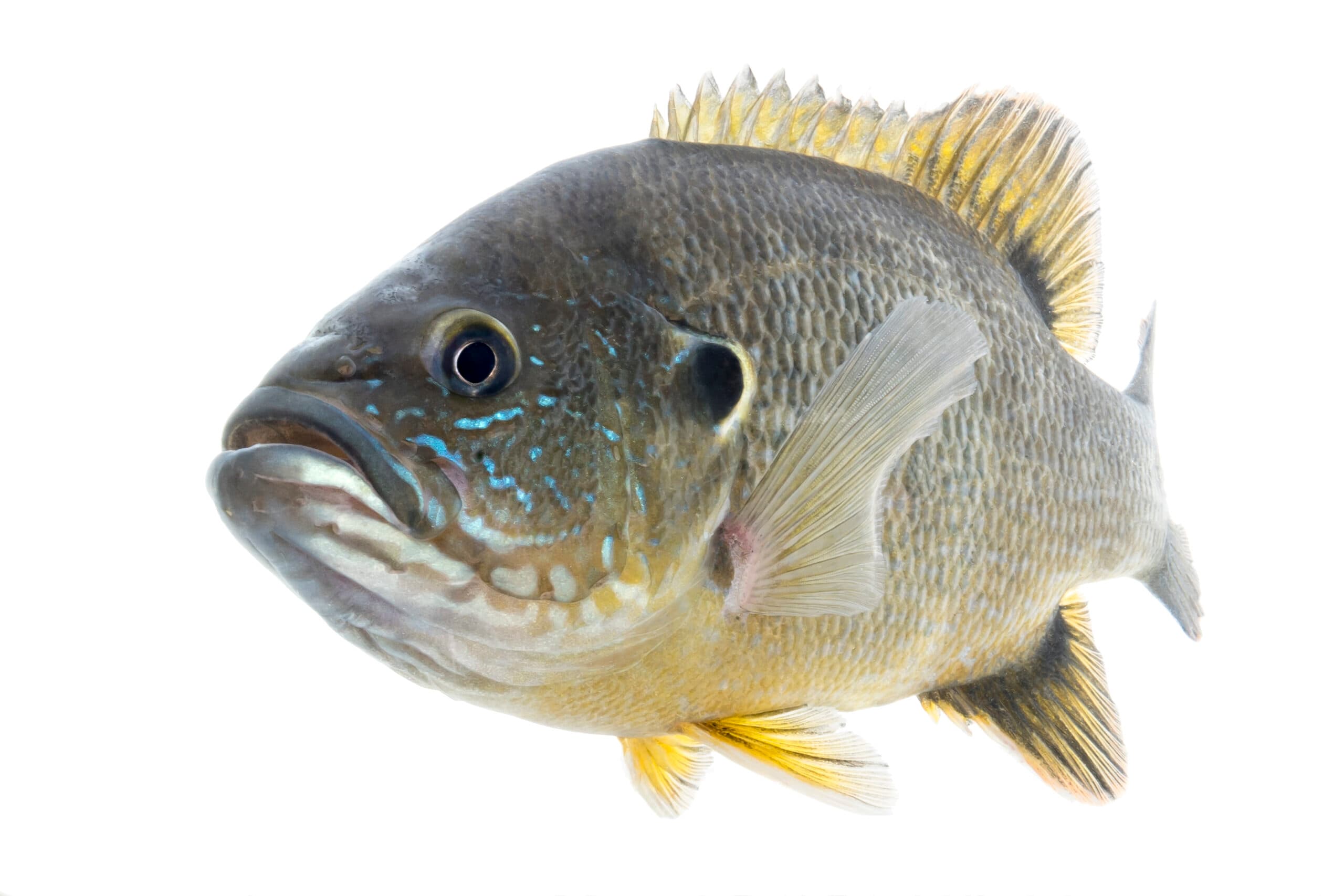
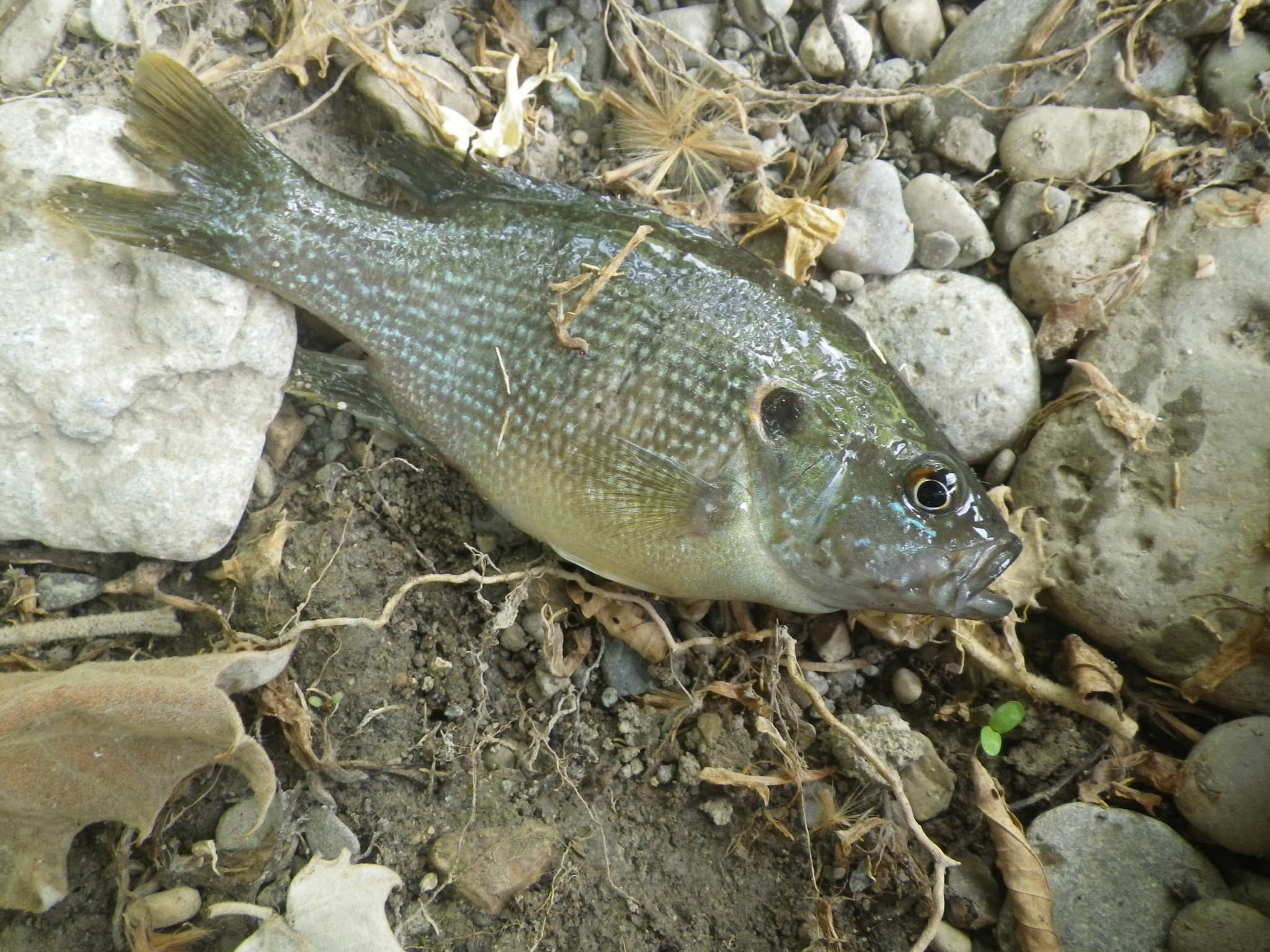
The name “green” can be misleading because an individual may look olive, blue-green, brownish or almost black depending on water, light, age and breeding condition. A large mouth and sturdy body distinguish it from deeper-bodied bluegills. Because green sunfish readily hybridize with related sunfishes, identification should use several traits rather than color alone.
Identification and appearance
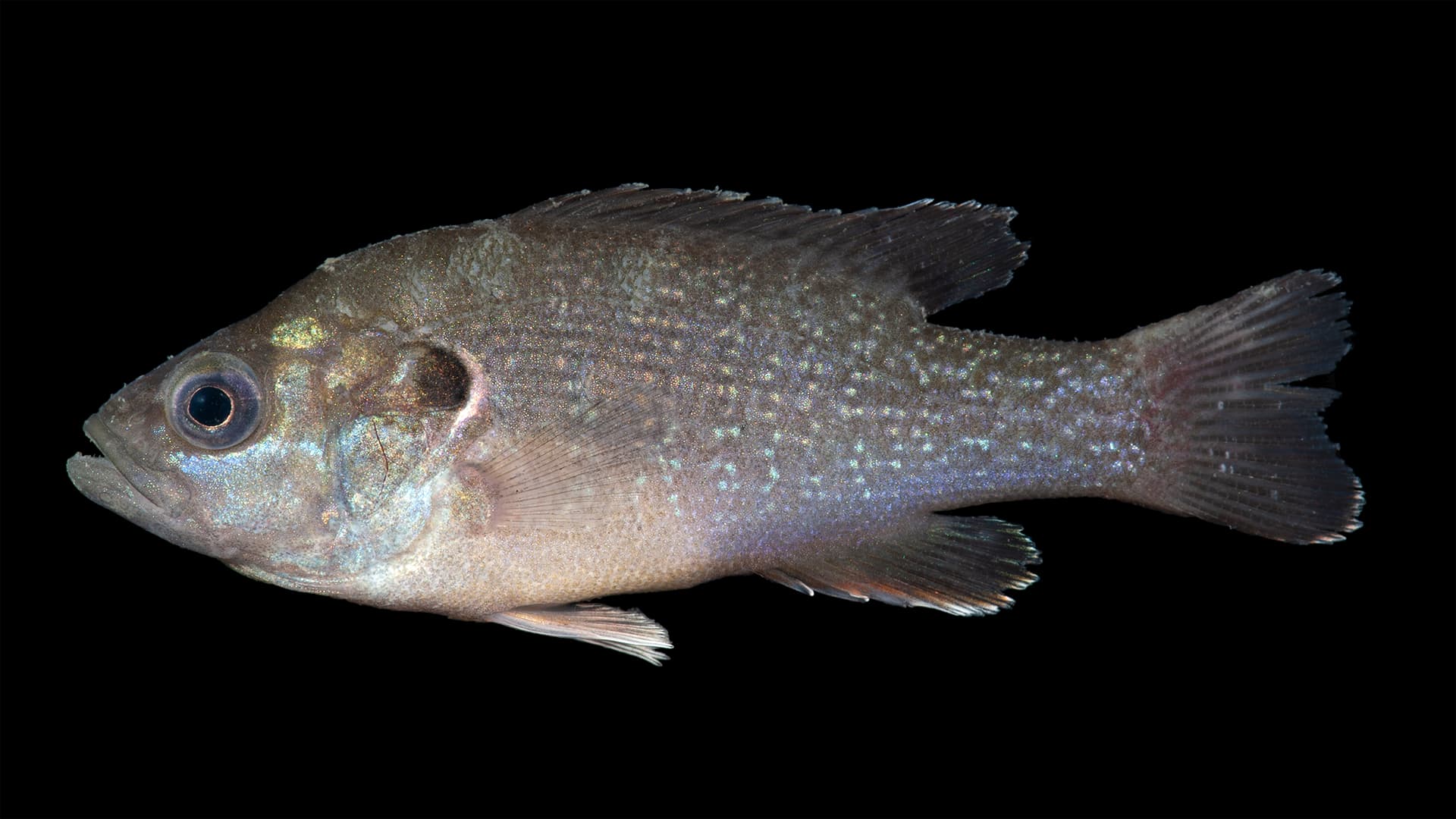
Green sunfish have a moderately compressed body, a relatively long snout and a mouth whose upper jaw reaches to about the middle of the eye. The back is usually dark olive to blue-green, the lower sides fade toward yellow or white, and faint vertical bars may cross the flanks. Turquoise or blue-green spots can mark the scales and cheek. The dark flap at the rear of the gill cover often has a pale yellow, orange or whitish edge.
The rounded pectoral fins are shorter than those of a bluegill, while yellow or orange margins may brighten the dorsal, anal and tail fins. Adult males can become more intense during the spawning season. The species commonly remains under 20 centimetres, but the USGS species profile reports a maximum size near 31 centimetres. Local growth depends strongly on food, temperature and competition.
Native range and introduced populations
The native distribution covers a broad center of North America. It includes Great Lakes, Hudson Bay and Mississippi drainage systems from New York and Ontario west toward Minnesota, South Dakota and Wyoming, then south to the Gulf of Mexico. Native Gulf-slope populations extend from Mobile Bay toward the Rio Grande, with records in northern Mexico. Country-level maps simplify this pattern; a fish still needs connected freshwater habitat within those boundaries.
Stocking and accidental transport have established green sunfish in many waters outside their native drainage basins. Some introductions occurred when fish were mixed with shipments intended for other sport species. The species can spread from reservoirs into tributaries and may persist in altered streams. Introduced status is therefore regional: the same fish can be native in one basin and non-native, managed or invasive in another.
Habitat and tolerance
Green sunfish occupy creeks, rivers, ponds, reservoirs, backwaters and lake margins. They often favor quiet or slow water near rocks, logs, undercut banks and vegetation. The Texas Parks and Wildlife Department notes their ability to tolerate unstable prairie streams and a wide range of environmental conditions. That flexibility helps them recolonize pools after drought or disturbance.
Tolerance does not mean the fish can live without oxygen or clean water. Extremely hot, polluted or oxygen-poor conditions can still kill it. Instead, green sunfish often withstand fluctuations that exclude more specialized fishes. Their success can be especially noticeable in small pools, intermittent streams and human-altered waters where cover remains available.
Diet and feeding behavior
Green sunfish are opportunistic predators. Young fish begin with zooplankton and small aquatic invertebrates. As the mouth grows, the diet expands to aquatic and terrestrial insects, insect larvae, small crustaceans, crayfish, fish eggs and small fishes. Colorado Parks and Wildlife summarizes the adult diet as insects, crayfish and other fish, while young animals rely more heavily on small crustaceans and larvae.
The fish commonly waits beside structure, then darts forward to seize prey. Its comparatively large mouth lets it take larger items than similarly sized bluegills. Feeding changes with season and local opportunity, so no single prey list describes every population. Green sunfish are themselves eaten by larger predatory fish, wading birds, watersnakes and mammals.
Spawning and parental care
Spawning usually occurs in warm shallow water during spring and summer, with timing varying by latitude and temperature. A male sweeps a shallow circular nest in gravel, sand or another firm substrate. Nests may occur close together in colonies. The male courts a female into the nest, where eggs are released and fertilized externally.
After spawning, the male guards the eggs and newly hatched fry, fanning the nest and driving away intruders. Eggs hatch quickly in warm water, and the fry eventually leave the nest to feed on tiny plankton and invertebrates. Fish may mature within one to three years where growth is fast. The U.S. Fish and Wildlife Service habitat account reports a maximum age around ten years, although many wild individuals die much sooner.
Ecological role and introduced-range impacts
Within its native food web, the green sunfish links invertebrate production to larger predators. It consumes abundant insects and small aquatic animals, competes with related sunfishes and provides food for larger species. Hybridization with bluegill, pumpkinseed and other Lepomis species occurs where their ranges overlap, which can make field identification difficult.
Outside the native range, its broad diet, large mouth and tolerance can create conservation problems. The USGS documents competition and predation involving native western fishes, including effects on young chubs and minnows. These impacts vary among waters, but moving green sunfish between drainages can spread both the fish and aquatic pathogens. Anglers should never release bait or relocate catches without legal authorization.
Conservation and responsible fishing
The species is widespread and generally secure across much of its native range, and it is commonly treated as Least Concern. That broad status does not erase local pressures from channelization, contaminated runoff, excessive sediment, barriers and loss of streamside cover. Protecting connected pools, stable banks and varied in-stream structure benefits green sunfish and many less tolerant native fishes.
Fishing rules differ because agencies may value the species as a small sport fish in its native range while controlling it where introduced. People should check local regulations, use clean gear and dispose of unused bait responsibly. A caught fish should be handled with wet hands only when necessary and released promptly where release is legal. Never transfer it to a new pond, aquarium or stream.