
An American wetland tree frog
The Green Tree Frog, Dryophytes cinereus, is a living North American tree frog native to the central and southeastern United States. Older books and many wildlife agencies use the scientific name Hyla cinerea. The American Museum of Natural History’s Amphibian Species of the World currently places it in Dryophytes, while preserving the older name in its synonymy.
This page covers that species specifically, rather than every frog called a green tree frog worldwide. The American species is a small, smooth-skinned frog associated with ponds, marshes, swamps and vegetated lake margins. Its bright color, pale side stripe and loud nasal call make it familiar across much of the southern United States.
Appearance and identification
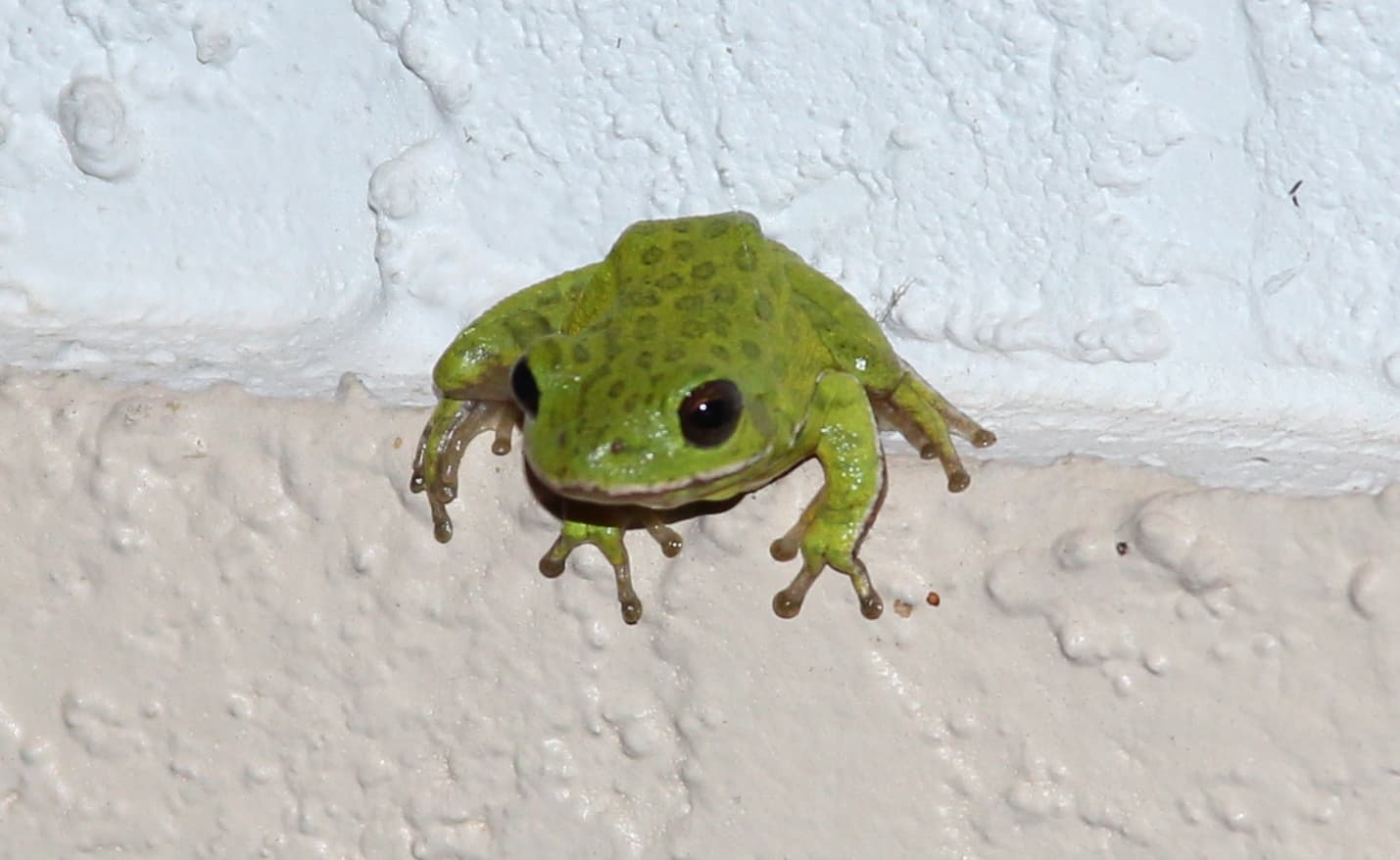
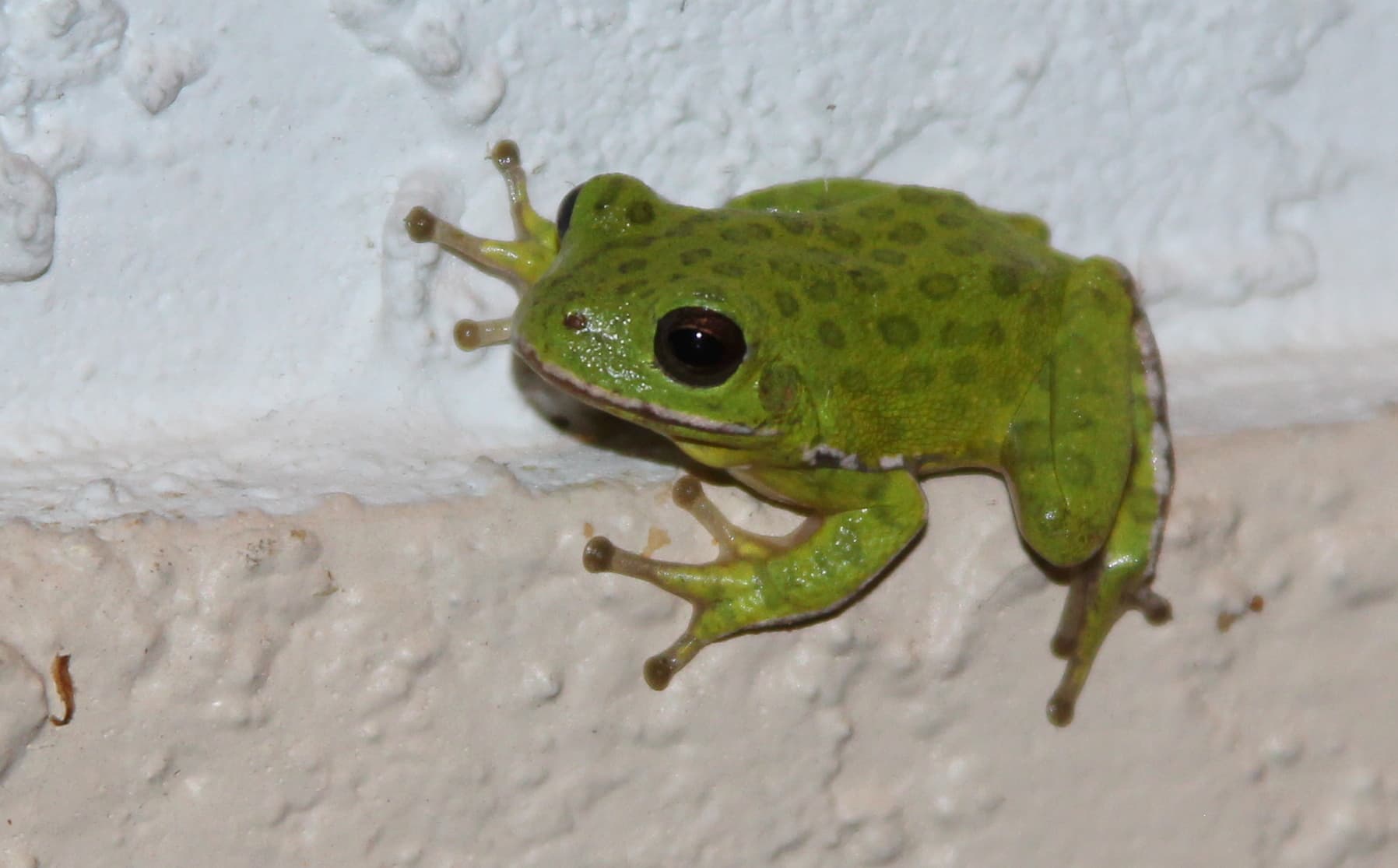
Adults usually measure about 3.2–6.4 centimetres from snout to vent. Females tend to be larger than males. The back may be bright leaf green, gray-green, olive or occasionally brownish according to temperature, moisture and background. Many individuals carry small yellow or gold flecks. A cream or white stripe often runs from the upper lip along each side, sometimes edged by a darker line.
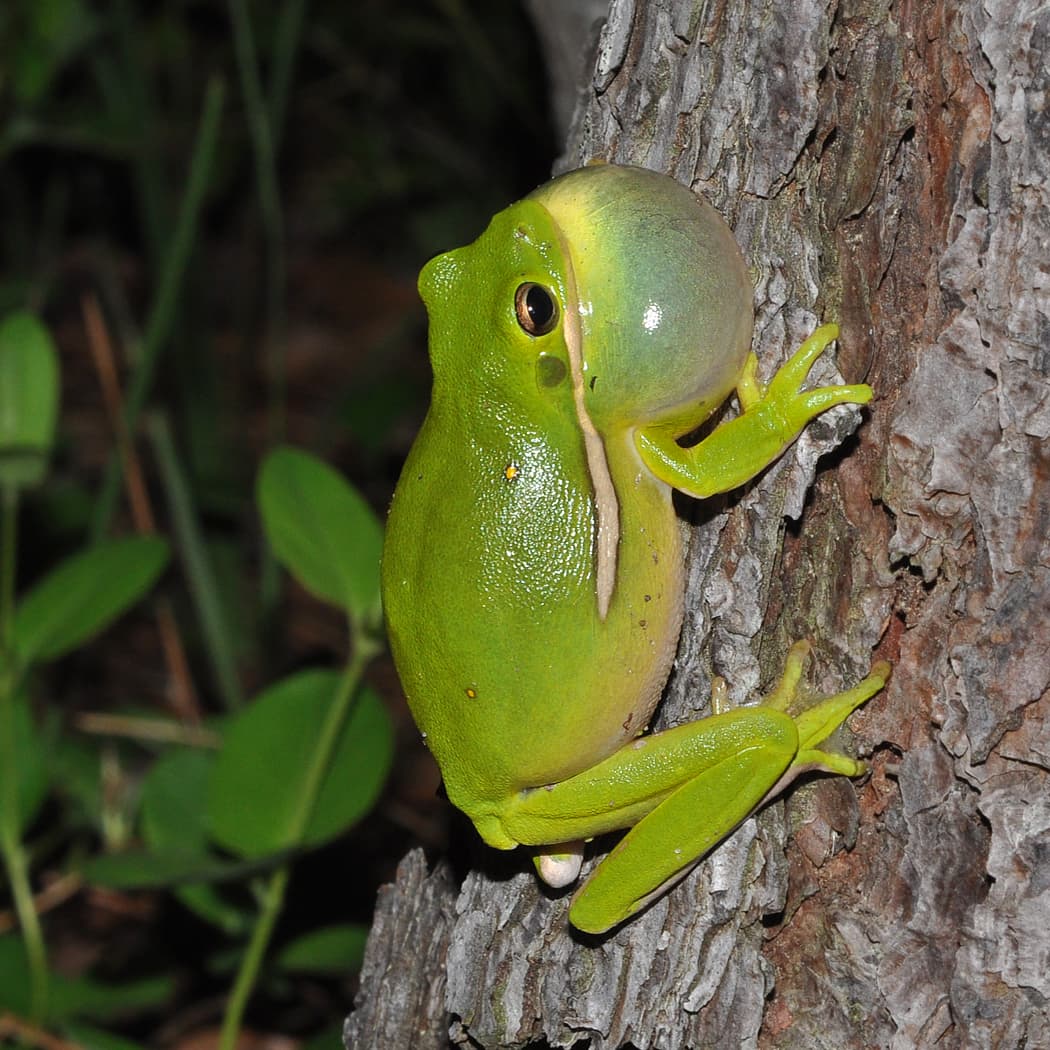
Expanded toe pads grip leaves, bark and smooth surfaces. The skin is smoother and the body more slender than those of the invasive Cuban tree frog. Identification should combine size, skin texture, toe-pad proportions, side stripe, call and location. Color alone is unreliable because several unrelated frogs can turn green, and a resting Green Tree Frog can darken considerably.
Range and wetland habitat
The native range extends across the southeastern coastal plain and lower Mississippi region, from Florida and eastern Texas north toward Maryland, Delaware, southern Illinois and adjoining areas. Florida Museum of Natural History describes the species as statewide and native in Florida, with a broader range west to Texas and north into the mid-Atlantic states.
Green Tree Frogs use permanent or semi-permanent water bordered by dense vegetation. Cattails, reeds, grasses, shrubs and low tree branches provide daytime cover, calling perches and feeding sites. Adults spend much of their time above the water, but eggs and tadpoles require aquatic habitat. They also visit porch lights and windows where insects gather, especially on warm, humid nights.
Nocturnal behavior and climbing
These frogs usually shelter through the day and become active after dusk or during rain. Moist skin makes humidity important, while adhesive toe pads let an animal climb stems and bark. A frog may tuck its legs close and remain motionless against a leaf, using color and posture as camouflage. Movement between feeding and breeding sites is usually local rather than a long migration.
Individuals are mostly solitary outside the breeding season. Crowds form near suitable water when males call after warm rain. Predators include snakes, birds, larger frogs and fish. Tadpoles are also eaten by fish and aquatic insects. Hiding among vegetation reduces risk, but the species still depends on a connected mosaic of shallow water, emergent plants and nearby shelter.
Calls and communication
The male’s advertisement call is a short, nasal “queenk” or “quonk” repeated from vegetation near water. A vocal sac beneath the throat expands dramatically as sound is produced. Calling intensity rises with warm temperatures, rain and longer spring or summer evenings. Females use call features to locate and assess males in noisy breeding choruses.
The species also gives rain, alarm and aggressive calls. The Florida Museum provides recordings that help distinguish it from similar frogs. Sound is often more useful than a distant nighttime view, but observers should avoid playback that repeatedly disrupts calling animals. Recording the natural chorus from a respectful distance provides better behavioral evidence.
Diet and ecological role
Adult Green Tree Frogs are insectivores. Flies, mosquitoes, moths, beetles and other small arthropods are taken with a rapid tongue strike. Animal Diversity Web notes that actively moving prey are especially likely to be pursued. Porch lights can create concentrated feeding opportunities, although pesticide exposure around buildings can harm frogs and reduce their food.
Tadpoles begin by grazing algae and microscopic material in water. As both predator and prey, the frog transfers energy between wetlands and surrounding vegetation. Adults reduce insect numbers, while eggs, tadpoles and frogs feed fish, aquatic insects, snakes, birds and other amphibians. A healthy population therefore reflects more than the presence of trees; it needs productive wetland food webs.
Eggs, tadpoles and growth
Breeding usually follows warm rain from spring into summer, with timing varying by latitude. A male clasps a female in amplexus while eggs are released and fertilized externally. Females may lay several hundred eggs, often in small surface clusters among aquatic vegetation. There is no prolonged parental care after spawning.
Eggs can hatch within several days in warm water. Tadpoles develop external and then internal gills, grow hind and front limbs, and gradually absorb the tail during metamorphosis. Development commonly takes roughly two months but changes with temperature, water level and food. Newly transformed froglets are tiny and especially vulnerable to drying, predators and sudden habitat loss.
Conservation and practical protection
The Green Tree Frog is widespread and assessed as Least Concern, but local populations can decline when wetlands are drained, shorelines are cleared or water is polluted. Road traffic around breeding wetlands, insecticides, disease and introduced predators add pressure. In Florida, invasive Cuban tree frogs may eat native Green Tree Frogs and compete with them for shelter.
Useful protection includes retaining native shoreline vegetation, keeping fish-free seasonal pools where appropriate, reducing pesticide use and preserving safe connections between wetlands and upland refuges. People should not collect wild frogs or move them between sites. Amphibians can carry pathogens without obvious signs, so boots and field equipment should be cleaned between wetlands.
Responsible observation
The best way to encounter this frog is to listen after warm rain and scan vegetation with a gentle light. Avoid grabbing or repositioning an animal for a photograph. Amphibian skin is permeable and can absorb oils, sunscreen, soap and chemicals from hands. If a frog is in immediate danger, follow local wildlife guidance and use clean wet hands only when absolutely necessary.
Wild Green Tree Frogs are not domesticated pets. Captive care requires legal sourcing, a vertically structured enclosure, clean water, appropriate humidity and varied live food. Releasing a captive frog is unsafe because it can introduce disease or genes from another population. Observation in native habitat offers a better view of climbing, calling and seasonal wetland behavior.