
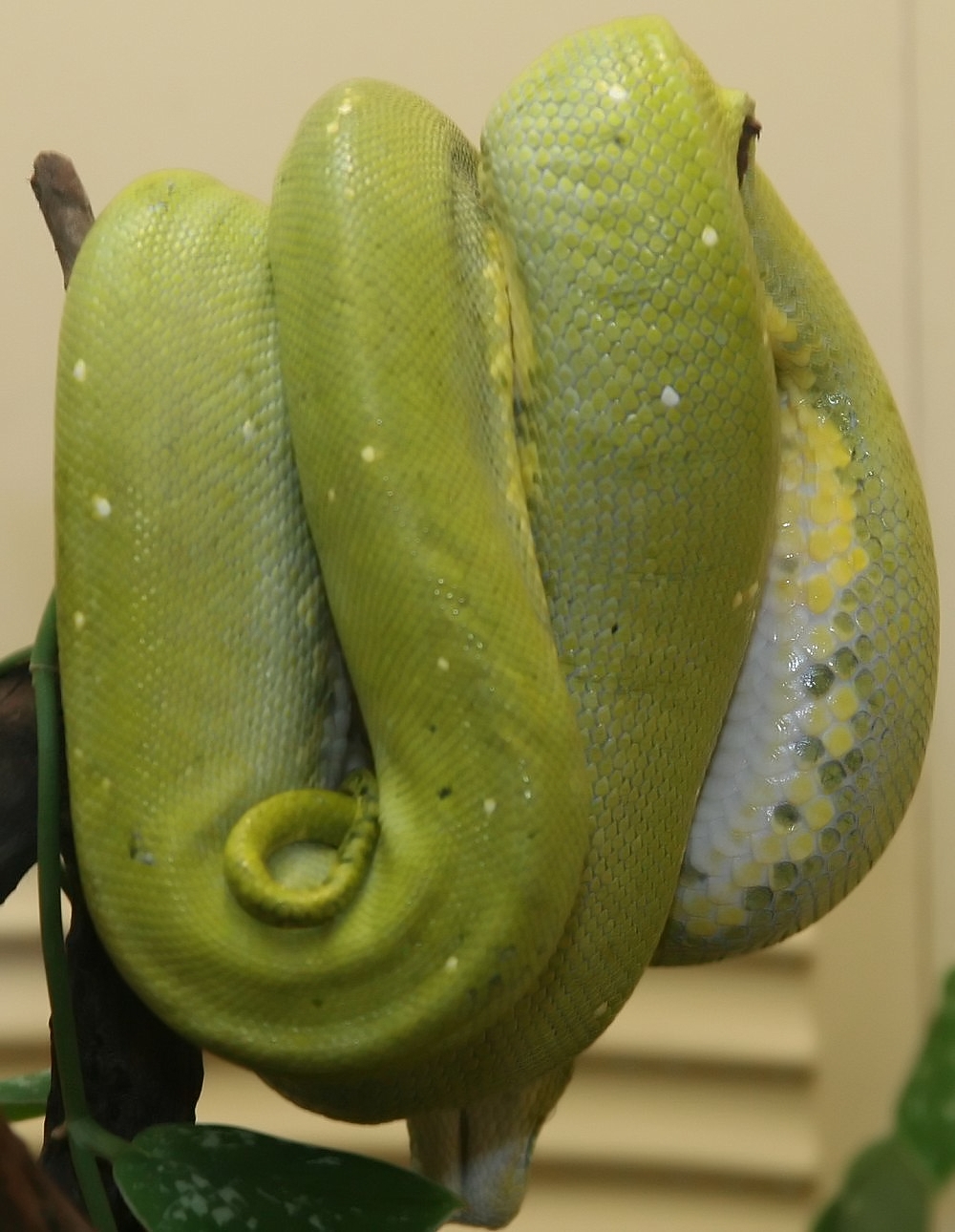
Green Tree Python (Morelia viridis) is Morelia viridis, a nonvenomous arboreal python from New Guinea, nearby islands and Australia’s Cape York Peninsula. Adults rest in symmetrical saddle coils and use heat-sensitive lip pits to detect warm prey. Juveniles hatch yellow or red before changing dramatically to green. This guide separates well-supported biology from common assumptions and covers identification, range, habitat, diet, behavior, reproduction and conservation.
Identification
Adults are bright leaf-green with a yellow, white or blue dorsal pattern that varies by locality and individual. The head is angular, eyes have vertical pupils and heat-sensing pits line the upper lips. The slender laterally compressed body ends in a prehensile tail. Hatchlings are lemon yellow, brick red or orange and develop green coloration as they grow. Adult females are usually longer and heavier, while males remain slimmer with proportionally longer tails. Color does not reliably indicate sex or locality, and accurate sexing requires expert examination.
Identification should combine body shape, markings, size, voice or movement, and location. One feature by itself can overlap with a related animal, a juvenile, or an individual in unusual light.
Photographs are most useful when they preserve scale and show several diagnostic features. Handling or repositioning a wild green tree python for identification can cause stress and is unnecessary.
Size and physical adaptations
Green Tree Python typically measures commonly 1.2–1.8 m; exceptional females approach 2.2 m and weighs males often 0.9–1.4 kg; females commonly 1.2–2.2 kg. Females have a heavier build, while the long coiled body can make field length difficult to estimate.
Its useful adaptations include prehensile tail anchors the body, heat pits detect warm prey, saddle coil supports rapid strikes, green adults blend with canopy leaves, red and yellow juveniles suit brighter edges, long recurved teeth hold prey, flexible body bridges branches. These traits work together in the animal’s normal setting rather than serving as isolated curiosities.
Published measurements may use different methods, life stages or sample locations. Comparing figures responsibly means checking what was measured rather than selecting the largest number available.
Range and distribution
The species occurs across much of New Guinea and adjacent islands, including Indonesian Papua and Papua New Guinea, plus the Aru and several satellite island groups. In Australia it is restricted to rainforest along eastern Cape York Peninsula in far northern Queensland. The native range includes Indonesia, Papua New Guinea, Australia.
A country-level map indicates broad distribution, not continuous occupation. Climate, elevation, water, vegetation, prey, breeding sites, barriers and survey effort all affect where records occur.
Records near the edge of the range deserve careful documentation because they may reflect natural movement, improved survey coverage, accidental transport or a genuine distribution change.
Habitat
Lowland tropical rainforest, lower montane rainforest, forest edge, regrowth and humid woodland from sea level to roughly 2,000 m.
Adults occupy closed-canopy forest and rest on horizontal branches, vines and tree forks. Juveniles often use lower vegetation in brighter canopy gaps and forest edges where small prey is abundant. The snake anchors with its tail, loops the body over a perch and centers the head, moving between hunting sites mainly after dark. Protecting a population therefore requires the feeding, shelter and breeding features that make a site usable, along with connections that allow movement.
Microhabitat matters. Shade, soil, current, moisture, shelter or host plants can determine whether a small area is usable even when the surrounding landscape appears suitable.
Diet and feeding
Green Tree Python is a arboreal ambush predator of small warm-blooded vertebrates. Important foods include rodents, small arboreal mammals, birds, lizards, frogs. A coiled python waits with its head hanging below the branch. Heat pits, vision and scent reveal a passing mammal or bird. The snake launches forward while the tail secures it, grips with numerous recurved teeth and wraps coils around prey until circulation stops. Juveniles take small lizards, frogs and mammals closer to the forest edge.
Diet changes with age, season, location and food supply. A dramatic prey record does not establish what most individuals eat most of the time; repeated field observations provide a stronger picture.
Feeding opportunities also create risk. An animal focused on prey may be less alert to predators, traffic or people, while contaminated prey can transfer pollutants through the food web.
Behavior and communication
Primarily nocturnal, resting motionless in a saddle coil by day. Green Tree Pythons remain still for long periods in their distinctive saddle coil, then shift perches or hunt after dark. Young animals use lower, sunnier vegetation; adults move into darker canopy. Camouflage is the first defense. A cornered snake tracks movement closely and can deliver a fast bite, though it has no venom.
Tongue flicks collect chemical cues from branches and air. Heat pits form a thermal picture of nearby prey, especially at night. Vision detects movement, and body posture signals readiness to strike. During breeding, pheromones help males locate females and close body contact guides courtship. Behavior should be interpreted in context: alarm, courtship, feeding and temperature regulation can produce very different actions from the same animal.
Daily schedules are flexible responses, not rigid rules. Weather, breeding condition, disturbance, tides or food can move activity into a different part of the day.
Reproduction and development
Mating often follows cooler seasonal conditions. Males track female scent and may refuse food while searching. Unlike the live-bearing emerald tree boa, the female lays eggs. She coils tightly around the clutch, shivers her muscles to generate heat when necessary and remains until hatching. Usually 5–25 eggs, commonly around 10–15 The brooding female protects and warms her eggs but does not feed. Hatchlings cut the shell with an egg tooth and become independent soon after emergence. Bright red or yellow juveniles hunt in lower vegetation; green spreads across the body during an ontogenetic color change as they grow and shift habitat.
Young animals face different risks and may use different microhabitats or food than adults. Breeding success depends on adult condition, suitable sites and the survival of offspring through vulnerable early stages.
Counts of eggs or young describe reproductive output, not the number expected to reach adulthood. Mortality is normally greatest during eggs, larval or juvenile stages.
Predators and ecological role
This python is a canopy predator of rodents, birds and other small vertebrates. Juveniles and adults use different forest layers and prey sizes, spreading their role from bright edges to closed canopy. Raptors and large monitor lizards prey on them. Their resemblance to South America’s emerald tree boa is a classic case of convergent evolution. Documented or likely predators include Rufous Owl, Gray Goshawk, Papuan Harrier, Crocodile Monitor, Human.
This animal is both a consumer and a food source. Its influence comes through many repeated interactions, so ecological claims should be based on measured populations rather than assumptions drawn from appearance.
Predator and prey relationships differ among places. A species can be ecologically influential without being abundant everywhere, and its role can change across its range.
Relationship with people
Green Tree Pythons draw ecotourism interest and heavy international pet demand. Wild collection, laundering and poor transport can damage populations and animal welfare. Buyers should insist on legal, traceable captive-bred stock. In habitat, never reach toward a coiled snake or remove it from a branch; observe quietly from a distance.
The species is nonvenomous, but more than one hundred recurved teeth can cause deep punctures and tearing. Do not handle wild animals. If bitten, avoid pulling against the teeth, wash the wound, control bleeding and seek medical care for deep injury or infection. Captive work requires calm tools and experienced keepers. Responsible observation means keeping an appropriate distance, avoiding capture or feeding, protecting habitat and following local wildlife or invasive-species guidance.
Wildlife guidance should come from the responsible local agency because collection rules, reporting requests and appropriate responses differ between native and introduced ranges.
Conservation
The Green Tree Python is assessed as Least Concern across a broad range, but logging, forest conversion and illegal or poorly regulated trade cause local concern. CITES Appendix II regulates international trade, and Australia strictly protects its population. The reported global trend is Probably stable overall with local losses and uncertain harvest effects.
Important pressures include deforestation, illegal collection, trade laundering, road expansion, forest fire, poor transport welfare, climate-driven habitat change. Global status can hide local decline or recovery, so current regional monitoring and habitat management remain necessary.
The most useful conservation action follows the documented pressure. Protecting breeding sites, reducing road deaths or limiting pollutants can require different tools in different populations.