
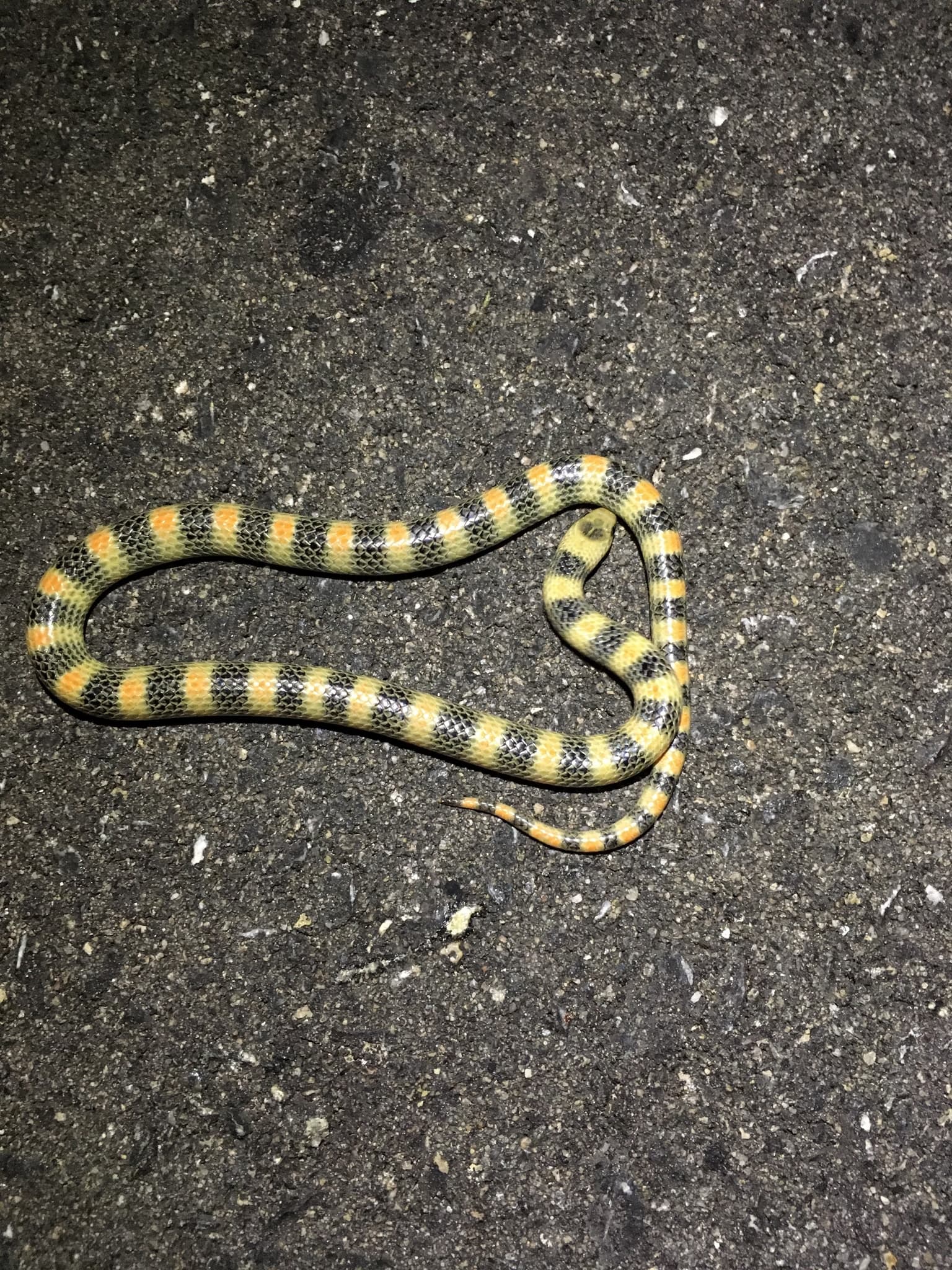
A small snake built for life under cover
The Ground Snake, Sonora semiannulata, is a small, secretive snake of western and central North America. It spends much of its life beneath stones, logs, loose bark, and surface debris, so even people who live inside its range may rarely see one. Its smooth, glossy scales and highly variable colors give it a polished appearance. Individuals may be plain tan, orange, or reddish, while others carry dark crossbands or a dark head. These patterns can look so different that early naturalists described several forms separately. Current references, including the Reptile Database account for Sonora semiannulata, treat them within one living species.
Identification and appearance
Adult Ground Snakes are slender and usually less than 50 centimeters long. The head is only slightly wider than the neck, the eyes are small, and the pupils are round. Smooth scales help the snake move through narrow spaces in soil and beneath rocks. Color is unusually variable across the range: the back may be gray, brown, tan, red, or orange, with no markings, with a black cap, or with dark bands that can be narrow or broad. The underside is generally pale and lacks the bold checkerboard pattern seen in some other harmless snakes.
Identification should use several features together. A small size and smooth scales are useful, but location, head markings, body pattern, and scale arrangement matter too. Young Kingsnakes and several other small ground-dwelling snakes may overlap in color. Observers should photograph a wild snake without handling it and consult a regional authority when an exact identification matters.
Range and habitat
The species occurs from parts of the central and western United States south into Mexico. In the United States its range includes portions of the Great Plains, Southwest, Great Basin, and California. The U.S. Fish and Wildlife Service species page confirms the accepted species identity, while regional accounts document considerable geographic variation. It occupies dry grassland, desert scrub, open woodland, rocky slopes, canyon bottoms, and other places where loose soil and cover objects create cool, humid retreats.
Ground Snakes are often associated with rocks, but they are not restricted to bare rocky ground. Leaf litter, fallen wood, burrows, and debris can provide the protected microhabitats they need. Moisture and temperature beneath these objects may be more important than the broad vegetation label. During hot or dry weather, a snake can retreat deeper into soil cracks or animal burrows and emerge when surface conditions improve.
Daily life and behavior
This snake is mostly nocturnal or active in the cooler hours around dusk and dawn, especially during warm seasons. Seasonal rains can bring it to the surface, and individuals are sometimes found crossing quiet roads at night. By day it commonly shelters under flat rocks or other cover. Its hidden routine reduces water loss and exposure to predators while placing it close to small invertebrate prey.
A Ground Snake usually relies on concealment and escape rather than confrontation. It is nonvenomous and does not pose a meaningful danger to people. When disturbed it may coil, hide its head, release musk, or try to crawl beneath the nearest cover. Its small mouth and secretive habits make defensive biting uncommon. Wild individuals should still be left where they are found because handling adds stress and can expose them to heat, dryness, or predators.
Diet and ecological role
Ground Snakes feed primarily on small invertebrates. Centipedes, spiders, scorpions, insect larvae, and other soft-bodied arthropods are reported prey, with the exact mix changing by region and availability. They search within litter and beneath cover, using tongue-flicking to gather chemical information. Small prey is swallowed whole. The narrow head and flexible jaws let the snake work in confined spaces where larger predators cannot forage efficiently.
By eating arthropods, Ground Snakes connect the invertebrate community to larger vertebrate predators. Birds, mammals, and larger snakes may eat them. Their use of the thin boundary between soil and surface makes them part of an easily overlooked food web beneath stones and woody debris. Removing rocks, logs, and litter from large areas can therefore reduce both their shelter and the prey living beside them.
Reproduction and life cycle
Ground Snakes reproduce by laying eggs. Mating generally follows seasonal activity in spring or early summer, and females place a small clutch in a protected, humid site where embryos are buffered from extreme heat and drying. Hatchlings emerge as miniature versions of adults and receive no parental care. Their tiny size allows them to exploit very small prey, but it also makes them vulnerable to dehydration and many predators.
Reliable species-wide figures for age at maturity and maximum wild lifespan are limited. Climate and elevation change the length of the active season, so development and breeding timing are unlikely to be identical everywhere. The California Department of Fish and Wildlife life-history account is useful for regional context, but local observations should not automatically be treated as universal values across the full range.
Conservation and coexistence
The Ground Snake remains widespread, although abundance is difficult to measure because individuals spend so much time hidden. Local populations can be affected by intensive land clearing, removal of natural cover, road traffic, pesticides that reduce invertebrate prey, and deliberate killing caused by fear of snakes. A lack of sightings does not necessarily mean absence; ordinary visual surveys often miss animals that live underground or beneath cover.
People can help by retaining some native vegetation, rocks, logs, and leaf litter where that is safe, reducing unnecessary pesticide use, and slowing for wildlife on warm rainy nights. Never move heavy rocks carelessly in habitat, and replace any naturally lifted cover exactly as it was found. If a Ground Snake appears near a home, giving it space and an escape route is usually enough. Its small size, nonvenomous nature, and appetite for arthropods make it a harmless native neighbor rather than a pest.