
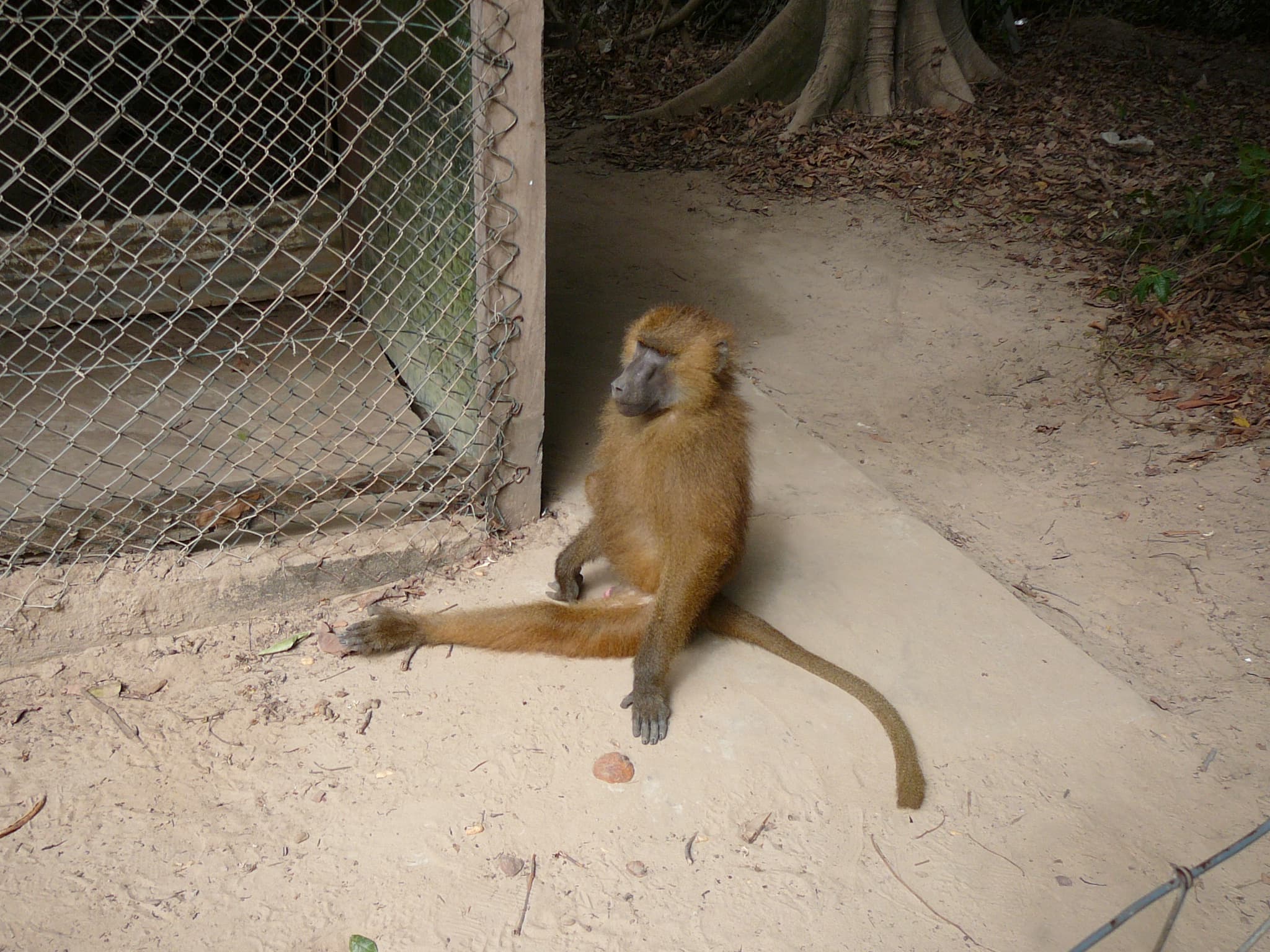
A red-brown baboon of western Africa
The Guinea baboon, Papio papio, is the westernmost and one of the least extensively studied baboon species. Its range is smaller than that of the widespread olive baboon and includes Senegal, The Gambia, Guinea, Guinea-Bissau, western Mali and southern Mauritania. It lives in a shifting mosaic of savanna, open woodland, gallery forest and farmland where reliable water and safe sleeping trees shape daily travel.
Guinea baboons belong to the Old World monkey family Cercopithecidae. They are one member of a closely related African baboon radiation whose species can meet and interbreed near range boundaries. Modern sources recognize Papio papio as a species, though older classifications sometimes combined several baboons as subspecies. This profile follows the species treatment recorded by the Mammal Diversity Database.
Appearance and identification
The coat is reddish brown, becoming redder in western populations and darker toward the east. The face is hairless and dark purple-black, with the long muzzle characteristic of baboons. Adult males grow larger than females and develop a modest mane over the neck and shoulders, although it is less dramatic than the silver mantle of a hamadryas male. Both sexes have long tails carried in an arc.
Animal Diversity Web gives a broad mass range of about 13–26 kilograms and notes that the species is small compared with many other baboons. Those figures combine sex and individual variation; males occupy the upper end. Strong limbs support terrestrial quadrupedal walking, while grasping hands and feet still permit agile climbing. Large canine teeth are especially conspicuous in adult males and serve in display as well as defense.
Habitat and daily movement
Research at Niokolo-Koba National Park in Senegal has shaped much of what scientists know. There, Guinea baboons use Sudanian and Guinean savanna, deciduous woodland, bamboo, seasonal grassland and narrow strips of gallery forest along watercourses. Permanent pools become especially important when seasonal sources dry. Tall trees and cliffs provide communal sleeping places above many ground-level threats.
The monkeys are active by day and spend much of it walking and feeding on the ground. Groups spread out while foraging, then gather around water, travel routes and sleeping sites. Seasonal fires, rainfall and fruiting cycles change where food is available. At night, many animals may share a sleeping area, making the site a social meeting point as well as protection from predators.
An adaptable omnivorous diet
Guinea baboons eat fruits, seeds, leaves, flowers, grasses, roots, bulbs and other underground plant parts. Insects, eggs and small vertebrates add animal protein when available. Their broad diet helps them cope with strong seasonal swings between green rainy-season growth and drier periods when underground foods and seeds become more important.
Powerful jaws and ridged molars crush hard plant material. Hands dig, pull and manipulate food, while cheek pouches allow an animal to gather items quickly and process them later. Baboons can also forage in cultivated fields, creating conflict where farms border habitat. Crop protection works best when it reduces access without injuring people or wildlife and when local communities help design the response.
A multi-level society
Guinea baboon society is organized in nested levels. A small reproductive unit generally contains a primary male, one or more females and their young. Several units associate as a party, and parties can combine into larger gangs or communities. This resembles the multi-level structure of hamadryas baboons, but Guinea baboon males are notably more tolerant of one another.
Male bonds are central. Males exchange ritualized greetings that can include approaches, embraces, genital touching and other highly controlled gestures. These interactions test and reinforce relationships without escalating into frequent severe fights. Males may cooperate, travel together and maintain long-term affiliations. Females retain meaningful social choices and may transfer between units, so the society cannot be understood as simple male ownership of a fixed harem.
Reproduction and infant care
Breeding can occur throughout the year. Visible changes in a female’s sexual skin signal reproductive condition. Gestation lasts about six months, and a single infant is usual. Newborn baboons cling to the mother’s belly and later ride on her back. Mothers provide milk, transport, warmth, grooming and protection through a long period of dependence.
Other group members also interact with infants. Adult males have been observed carrying and grooming young within their units, and juveniles gain experience through play and social contact. Females typically mature around four years, while males take longer to attain adult size and social standing. Long development gives young baboons time to learn foods, routes, signals and relationships in a complex society.
Predators and ecological role
Leopards are likely major predators where they overlap, and lions, hyenas, African wild dogs, large snakes and raptors may threaten baboons or their young in suitable habitats. Sleeping in trees, group vigilance, alarm calls and the defensive power of adult males reduce risk. The exact predator balance changes across the species’ fragmented range.
By eating fruit and moving seeds, Guinea baboons can influence plant regeneration. Digging for underground foods disturbs soil, while predation on insects and small animals links them to several levels of the food web. They also carry parasites and pathogens as part of natural ecosystems. Their flexibility lets them survive in modified landscapes, but dependence on water, sleeping sites and connected habitat sets limits.
Conservation and coexistence
The IUCN classifies the Guinea baboon as Near Threatened. Its restricted range makes habitat conversion, fragmentation, hunting and persecution more consequential than they would be for a broadly distributed species. Agricultural expansion can remove woodland and gallery forest while increasing crop conflict. Capture or killing for trade, food or retaliation adds pressure in some areas.
Protected areas such as Niokolo-Koba conserve important populations, but long-term survival also depends on landscapes outside park borders. Retaining watercourses, sleeping trees and habitat connections helps groups move safely. Monitoring must account for the species’ multi-level society so that counts made at one sleeping site are not mistaken for stable population totals. Guinea baboons are listed in CITES Appendix II, which regulates international trade.
Observing baboons responsibly
Wild baboons should never be fed. Feeding changes movement, increases aggression and draws animals toward roads and settlements. Visitors should keep food secured, maintain distance and follow the instructions of local guides. A baboon showing its canines, staring directly or making threat gestures needs space; running or cornering an animal can worsen the encounter.
Researchers and photographers should avoid blocking routes to water or sleeping trees. Quiet observation reveals the species’ most distinctive feature: relationships unfolding at several social levels. A troop that seems chaotic from a distance contains stable units, male friendships, maternal bonds and repeated greeting rituals that allow many individuals to coordinate without constant fighting.