
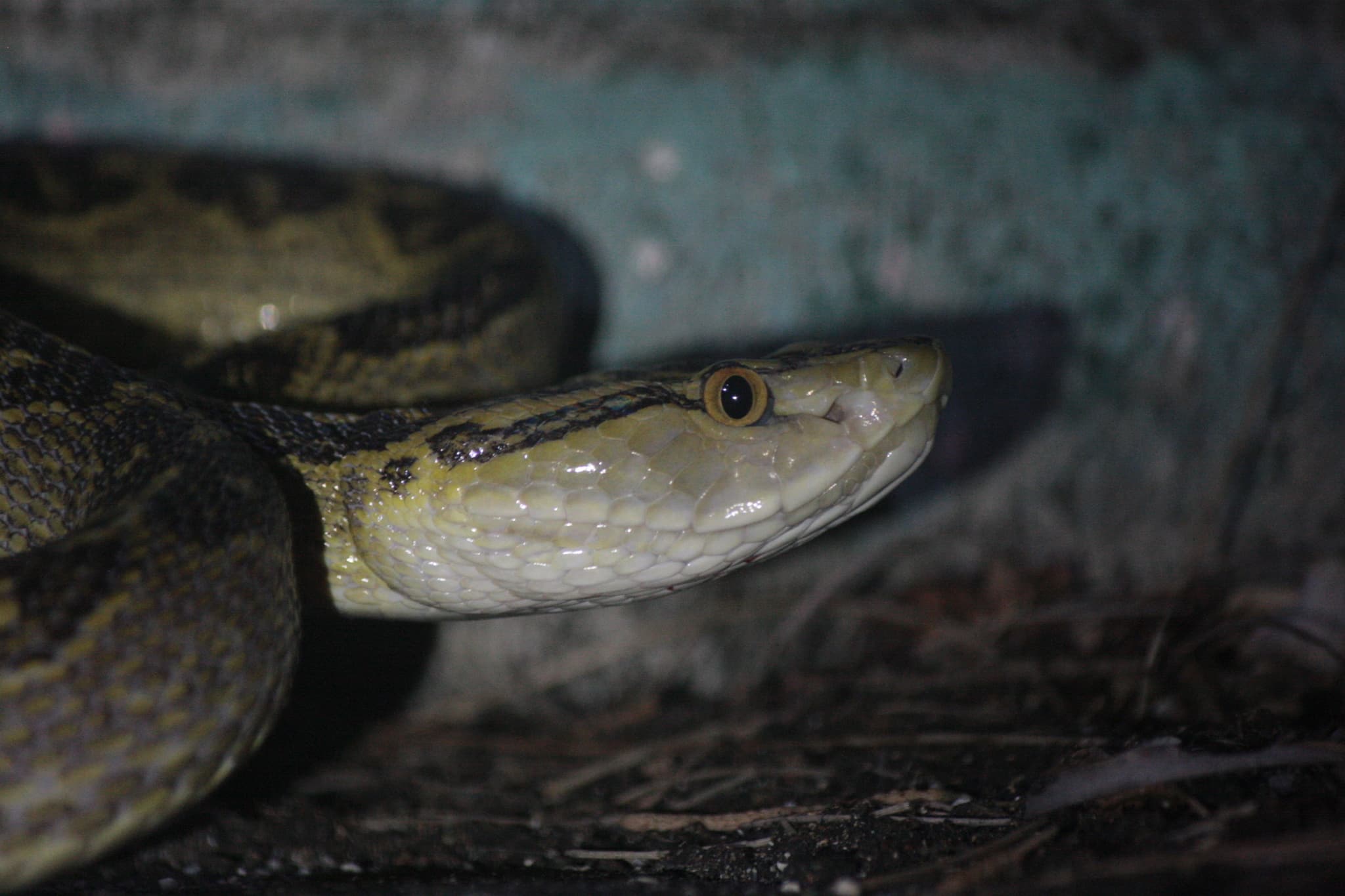
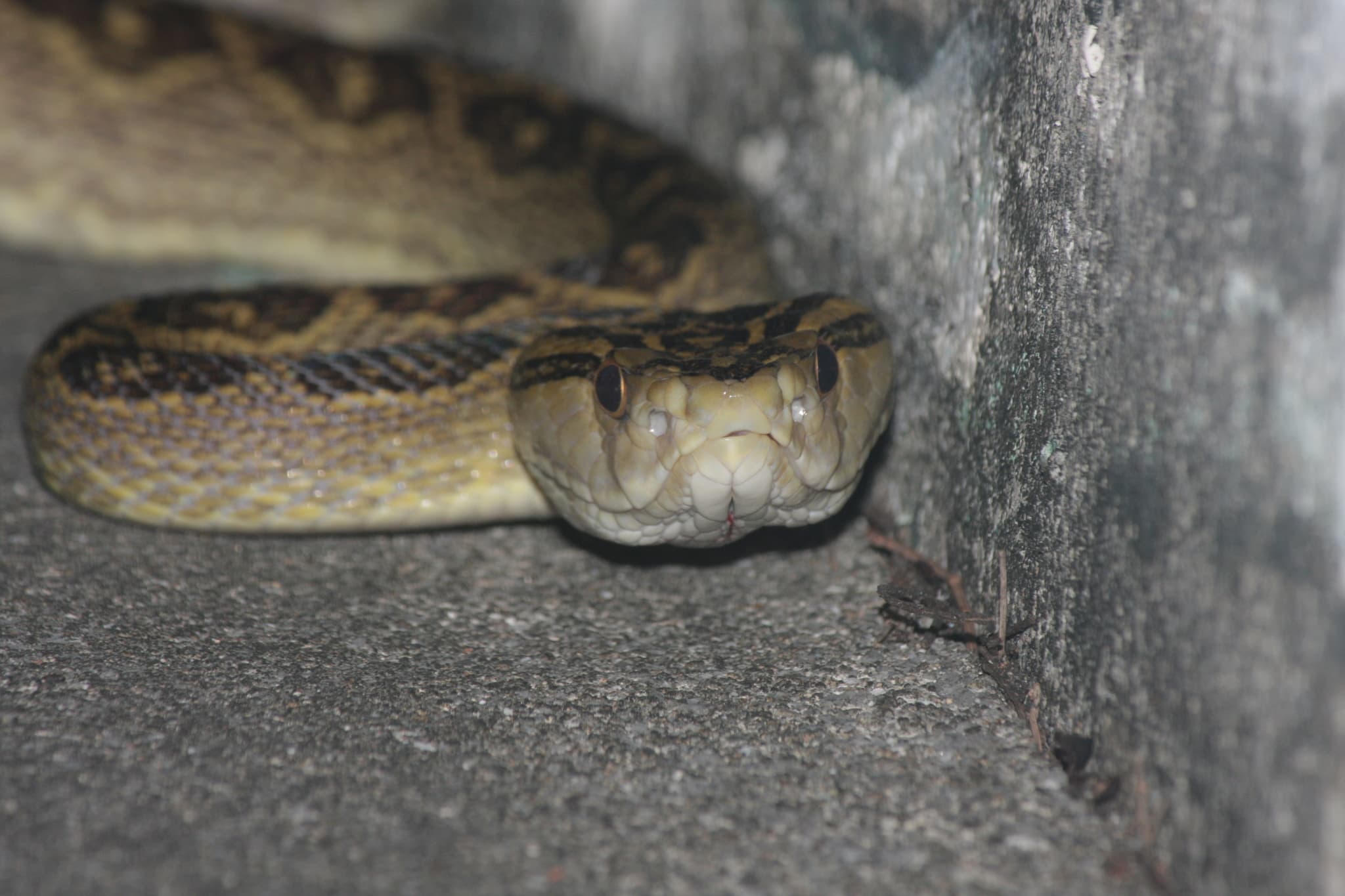
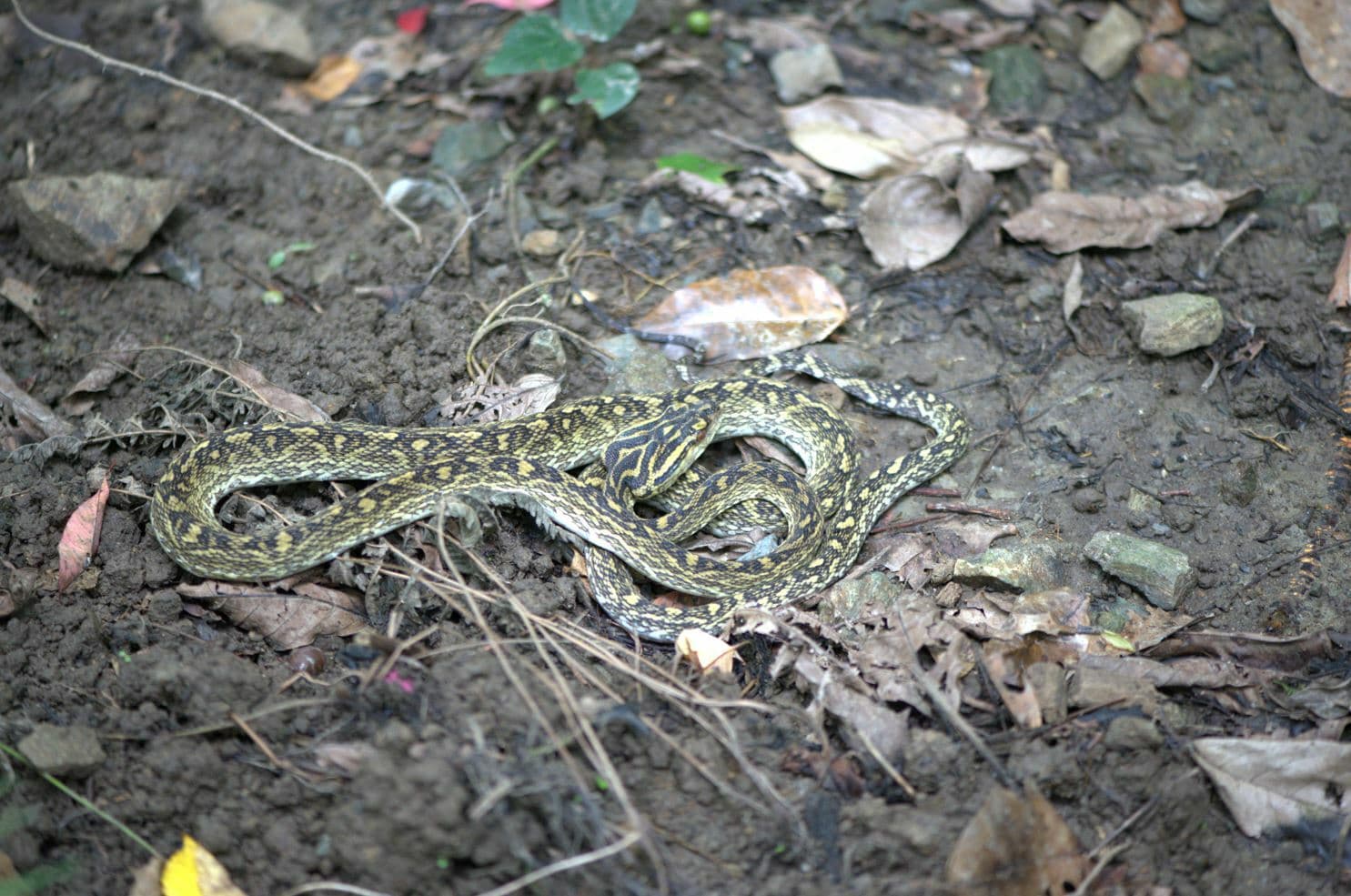
An island pit viper
The Habu Snake, Protobothrops flavoviridis, is a large venomous pit viper native to Japan’s central Ryukyu Islands. It occurs naturally on Okinawa and the Amami island groups, where warm forests, farms, stream valleys, and settlements can all provide cover and prey. “Habu” is also used loosely for several related island snakes, so scientific names matter. This profile covers P. flavoviridis, the species listed by the Reptile Database, rather than the Sakishima, Tokara, or Taiwan habus.
Identification and appearance
A Habu has a broad triangular head, a narrow neck, a heavy body, vertical pupils, and a heat-sensitive pit between each eye and nostril. The back is usually olive, tan, or brown with dark irregular blotches edged by paler markings. A dark stripe often runs behind the eye. Colors blend well with leaf litter, bark, stone, and shadow. Adults commonly exceed one meter, and exceptional individuals can approach two meters, although size varies.
The facial pits detect infrared radiation from warm animals and help the snake aim in darkness. Hinged front fangs fold against the roof of the mouth when not in use. These features identify it as a crotaline viper, but people should never approach a snake closely to inspect them. Similar island species and variable markings make distance photographs and expert identification safer than handling.
Range and habitat
The species is endemic to Japan’s Ryukyu chain, principally the Okinawa and Amami groups. The Integrated Taxonomic Information System recognizes it as Protobothrops flavoviridis, and Japan’s environmental agencies distinguish it from other native habus. Island populations have been separated long enough to show notable genetic structure, an important consideration for conservation and taxonomy.
Habitat includes subtropical evergreen forest, woodland edges, limestone country, grassland, agricultural fields, sugarcane margins, stone walls, drainage channels, and vegetated places around buildings. Moist valleys and streams support frogs and other prey. Habu Snakes may shelter in tree roots, rock crevices, burrows, ruins, or dense plants. Their ability to use altered landscapes brings them into contact with people more often than many secretive snakes.
Behavior and activity
Habus are mainly active at night, especially in warm, humid weather. By day they rest in protected sites. They can climb and may forage above ground, but much activity occurs on the forest floor, along walls, or beside waterways. A snake may remain still beside a travel route and strike passing prey, then follow the scent trail of an envenomated animal.
The Habu is not seeking people, yet it will defend itself if stepped on, cornered, or approached. Its camouflage and willingness to live near farms make accidental encounters possible. Residents reduce risk by using lights after dark, wearing sturdy footwear in vegetation, controlling rodents, clearing hiding places immediately beside buildings, and avoiding blind reaches into stone piles or thick plants.
Diet and ecological role
Habu Snakes are ambush predators of rats, mice, birds, frogs, lizards, and other suitable vertebrates. Younger snakes take smaller prey. Heat sensing, chemical tracking, and venom allow them to hunt efficiently at night. A rapid bite introduces venom, and the snake can release mobile prey rather than wrestling with it. Tongue-flicking later helps locate the animal.
As a major island predator, the Habu influences populations of rodents and other small vertebrates. It is also part of a larger food web: young snakes may be taken by birds or other predators. Human attempts to control habus by introducing mongooses created ecological problems because mongooses hunted many native animals and were active at different times from the mostly nocturnal snakes.
Reproduction and life cycle
The Habu is oviparous, meaning females lay eggs. Mating and egg laying follow seasonal cycles shaped by island temperature and rainfall. A female deposits a clutch in a protected humid site, and the young hatch fully equipped with fangs and venom. There is no prolonged parental care. Juveniles must find small prey and shelter while avoiding dehydration and predators.
Published clutch figures and growth rates vary, so a single number should not be applied to every island population. The species’ reproductive biology has also been studied because it affects encounter patterns and public-health planning. Long-term monitoring is more informative than occasional sightings when estimating local abundance.
Venom, bites, and safety
Habu venom can cause severe pain, swelling, bleeding, tissue injury, shock, and lasting disability. A suspected bite is a medical emergency. Move away from the snake, keep the person calm and still, remove rings or tight items before swelling develops, and contact emergency services immediately. Do not cut the wound, apply ice, attempt suction, use an electric shock, or apply a tight tourniquet. Local clinicians use established protocols and antivenom where indicated.
Japan has invested in antivenom, rapid transport, protective education, and research, greatly reducing deaths, but serious injuries still occur. The venomous nature of the species does not justify approaching or killing a snake. Distance protects both people and wildlife. Authorities or trained local responders should handle removal from occupied buildings.
Conservation and coexistence
The Habu remains established across much of its native range, though islands differ in habitat, development pressure, and control programs. Roads, land conversion, persecution, and indiscriminate trapping can affect local populations. Its role as a native predator should be considered alongside legitimate public-safety needs. Accurate identification also prevents harmless snakes from being killed out of fear.
Practical coexistence centers on prevention: seal gaps around buildings, manage rubbish and animal feed that attract rodents, trim dense growth next to paths, illuminate outdoor work areas, and teach children never to touch snakes. The NCBI taxonomy record and Japanese government publications provide further scientific context. Respecting the Habu as a dangerous but ecologically important native animal leads to safer decisions than panic or close confrontation.