
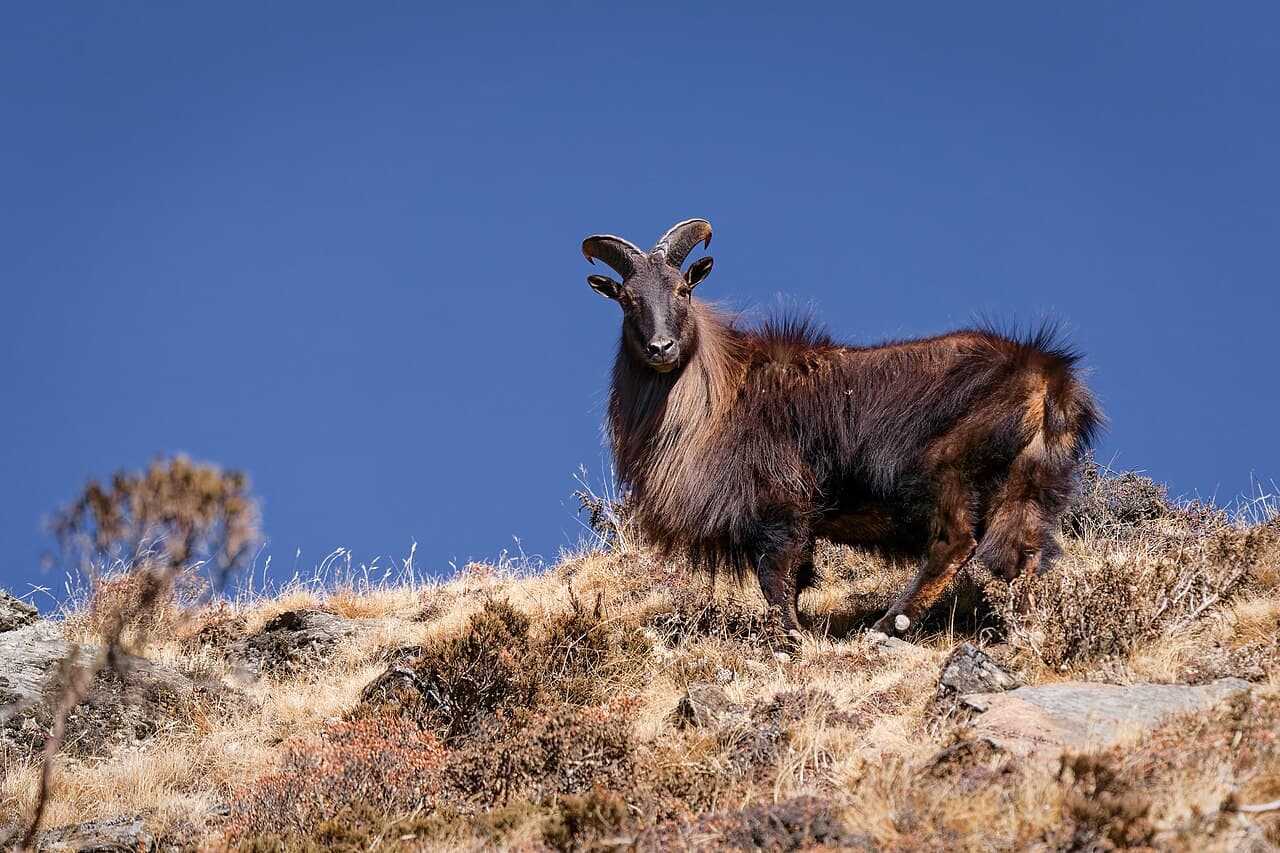
A mountain ungulate of the central Himalaya
The Himalayan tahr, Hemitragus jemlahicus, is a large goat relative adapted to steep mountain country. Its native range follows the southern Himalaya through northern India, Nepal and Bhutan and into southern Tibet. Tahr use broken cliffs, alpine grasslands, subalpine shrublands and wooded slopes, moving between elevations as snow, temperature and forage change. The species is the only living member of Hemitragus; the Nilgiri tahr and Arabian tahr are now placed in separate genera.
Himalayan tahr were also introduced for hunting outside Asia. The best-known introduced population lives in New Zealand’s Southern Alps, where the animals have become an invasive browser. That contrast is essential: the same species needs protection from hunting and habitat loss in its native range while requiring active control where it damages ecosystems that evolved without large mammalian herbivores.
Appearance and climbing adaptations
Tahr have compact bodies, relatively short legs and backward-curving horns in both sexes. Adult males are much larger than females and develop a long, dark mane over the neck and shoulders. Their winter coat becomes thick and shaggy, while summer hair is shorter. Males often look dark reddish brown; females and young animals are smaller and more uniformly brown.
The hooves combine a hard outer rim with a softer, grippy central pad. That structure helps the foot catch small irregularities on rock while maintaining traction. Strong dewclaws add support on steep slopes. A low center of gravity and powerful limbs let tahr cross terrain that would be difficult for many large mammals, but agility does not make them immune to avalanches, severe winters or falls.
Native habitat and seasonal movement
In the Himalaya, tahr use rugged slopes from forested elevations to high alpine meadows. Animal Diversity Web reports use from roughly 2,500 to 5,000 meters, with core habitat often in subalpine and alpine zones. Cliffs provide escape terrain, while nearby grasslands and shrublands supply food. Animals descend or change slope aspect when winter snow covers forage and move upward as plants emerge in warmer seasons.
Sex and age also shape habitat use. Females, kids and younger animals tend to remain in groups and favor secure terrain. Adult males often range separately outside the breeding season and may use lower elevations or different slopes. During the rut they move toward female groups. These shifting patterns mean that a single observation does not describe the species’ full annual habitat.
Diet and daily life
Himalayan tahr are herbivores that graze grasses and sedges and browse leaves, shoots and alpine herbs. The balance changes with season and local plant communities. They feed most actively when temperatures and disturbance are lower, then rest and ruminate in sheltered places. Like other bovids, they use a multi-chambered stomach and microbial fermentation to extract nutrients from fibrous vegetation.
Females and young form herds, while mature males are often solitary or gather in bachelor groups. Individuals communicate through posture, scent and vocal sounds. Vigilance is important in open mountain terrain, and group members can respond quickly to alarm. Native predators include snow leopards and common leopards, with young animals also vulnerable to other large carnivores.
Rut, birth and development
The breeding season occurs in winter. Mature males join female groups, display their size and mane, follow receptive females and compete with rivals. Horn clashes can occur, but posture and assessment reduce the need for every encounter to become a prolonged fight. Larger, older males usually gain more mating opportunities.
After a gestation of about six to seven months, females generally give birth to one kid in spring or early summer, when new plant growth improves nutrition. Twins are uncommon. Kids can stand and follow their mothers soon after birth and remain dependent on milk during their early months. Females mature earlier than males; young males may be physiologically mature before they are large enough to compete effectively in the rut.
Conservation in the native range
The IUCN assessment lists the Himalayan tahr as Near Threatened. Hunting and habitat loss have reduced or fragmented native populations, even though protected areas retain important strongholds. Roads, livestock grazing, collection of forest products and human expansion can alter the narrow bands of suitable mountain habitat. Climate change may shift alpine vegetation and snow conditions, adding uncertainty to future forage and movement.
Effective conservation protects connected elevational habitat, limits illegal hunting and involves local communities that share the landscape. Monitoring is difficult because animals occupy remote, steep terrain and visibility changes with season. Counts therefore need consistent methods and careful interpretation. A healthy introduced population elsewhere does not compensate for losses of native Himalayan populations or their ecological and genetic setting.
Why New Zealand manages tahr as invasive animals
Himalayan tahr were introduced to New Zealand in 1904. They spread through suitable areas of the central Southern Alps, where alpine plant communities had evolved without large hoofed browsers. New Zealand’s Department of Conservation reports that tahr eat snow tussocks, shrubs, mountain daisies, buttercups and other native plants. Herds also trample vegetation and compact vulnerable soils.
Heavy browsing can replace tall tussock and shrubland with short turf or bare ground, reducing food and shelter for native birds, lizards and insects. New Zealand manages tahr under a statutory control plan, combining monitoring, recreational hunting and official control. The goal is ecological protection and containment, not a judgment that the animal lacks value in its native home. Conservation status always depends on place and ecological context.
Viewing and recognizing Himalayan tahr
Wild tahr are best watched with binoculars or a long lens from a stable trail or viewpoint. Approaching across steep terrain can disturb a herd and put both people and animals at risk. Observers should avoid separating females from kids and follow local park rules. In introduced ranges, hunting and access regulations can change annually, so official agencies are the proper source for current requirements.
A long mane and heavy forequarters suggest an adult male, while females are smaller with shorter coats. Both sexes have horns, distinguishing tahr from some mountain ungulates in which only males are horned. Location alone is not enough for identification because domestic goats and other wild bovids may share mountain slopes. Photographs that show the full body, horns and coat are most useful.