
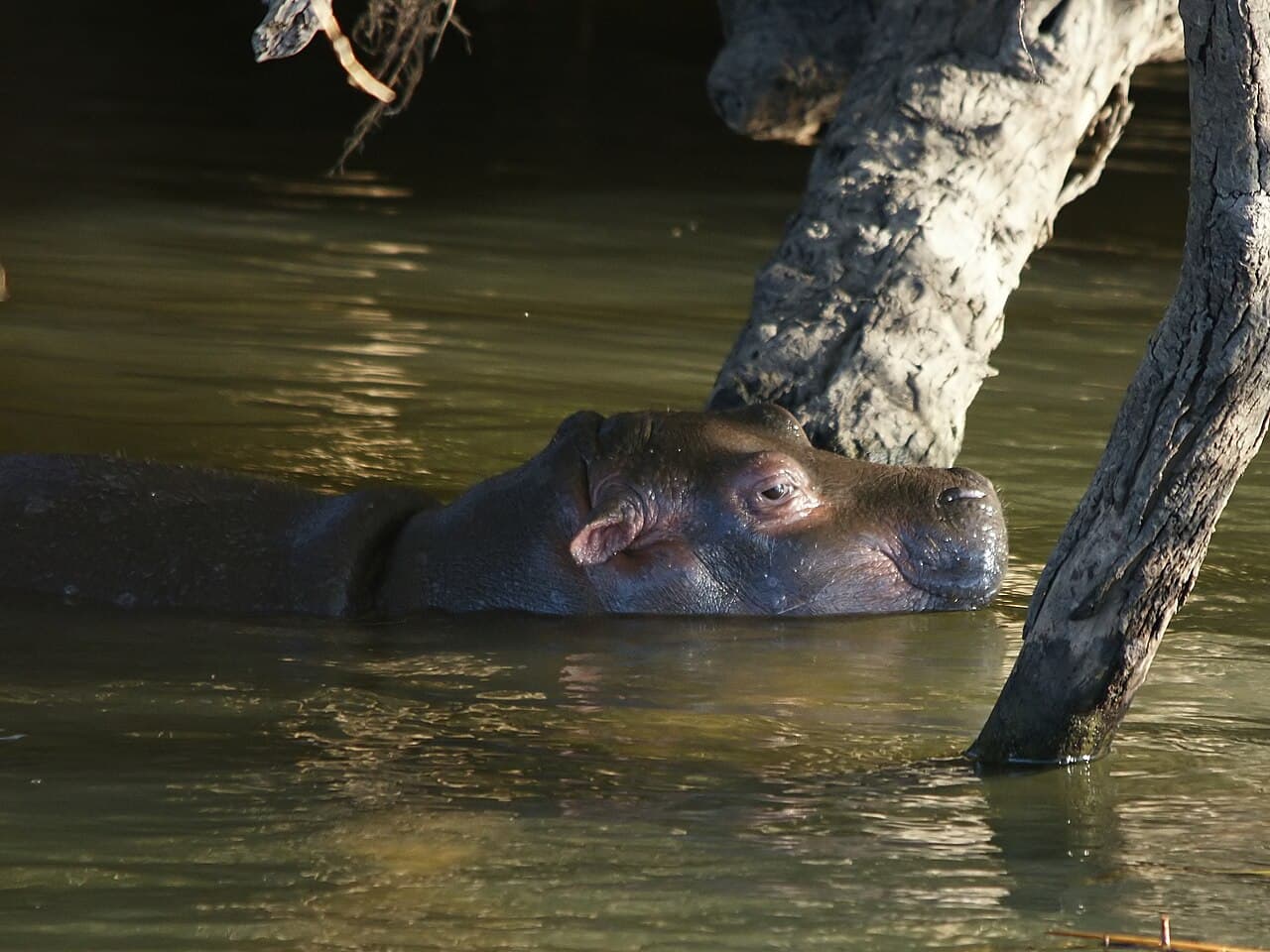
Hippopotamus (Hippopotamus amphibius) is one of the largest land mammals and the only living species in its genus. Its barrel body, short legs, high-set eyes and closable nostrils suit a life divided between freshwater and land. Hippos spend hot days resting in rivers, lakes and swamps, then emerge after sunset to graze. They are powerful, territorial around water and responsible for serious conflicts when people approach too closely or block their routes. This guide separates well-supported biology from common assumptions and covers identification, range, habitat, diet, behavior, reproduction and conservation.
Identification
A Hippopotamus has a huge barrel-shaped torso, very short pillar-like legs, a broad head and an enormous mouth. Eyes, ears and nostrils sit high on the skull so most of the body can remain submerged. The nearly hairless skin is purple-gray to slate, with pink around the eyes, ears and belly. Lower canine teeth form long self-sharpening tusks, and each foot has four webbed toes. Adult males are larger, continue growing longer and develop broader heads and larger canine tusks than females.
Identification should combine body shape, markings, size, voice or movement, and location. One feature by itself can overlap with a related animal, a juvenile, or an individual in unusual light.
Photographs are most useful when they preserve scale and show several diagnostic features. Handling or repositioning a wild hippopotamus for identification can cause stress and is unnecessary.
Size and physical adaptations
Hippopotamus typically measures About 2.9–5.1 m head and body and weighs Females often 1,300–1,500 kg; mature males commonly 1,500–3,200 kg. Exceptional captive or old males can exceed typical wild weights.
Its useful adaptations include high-set eyes, ears and nostrils allow near-total submergence, nostrils close underwater, dense bones help the body stay submerged, webbed toes spread weight on mud, skin secretion absorbs ultraviolet light and inhibits some bacteria, huge jaws and tusks defend territories, sensitive hearing works above and below water, four-chambered stomach ferments tough grass. These traits work together in the animal’s normal setting rather than serving as isolated curiosities.
Published measurements may use different methods, life stages or sample locations. Comparing figures responsibly means checking what was measured rather than selecting the largest number available.
Range and distribution
Fragmented populations remain across sub-Saharan Africa in major river, lake and wetland systems. The species has disappeared from much of its historic North African and Nile range. An introduced population persists in Colombia after captive animals escaped, creating ecological and management concerns far outside the native range. The native range includes Angola, Benin, Botswana, Burkina Faso, Burundi, Cameroon, Central African Republic, Chad, Democratic Republic of the Congo, Republic of the Congo, Côte d’Ivoire, Eswatini, Ethiopia, Gabon, Gambia, Ghana, Guinea, Guinea-Bissau, Kenya, Liberia, Malawi, Mozambique, Namibia, Niger, Nigeria, Rwanda, Senegal, Sierra Leone, Somalia, South Africa, South Sudan, Sudan, Tanzania, Togo, Uganda, Zambia, Zimbabwe.
A country-level map indicates broad distribution, not continuous occupation. Climate, elevation, water, vegetation, prey, breeding sites, barriers and survey effort all affect where records occur.
Records near the edge of the range deserve careful documentation because they may reflect natural movement, improved survey coverage, accidental transport or a genuine distribution change.
Habitat
Rivers, lakes, permanent pools, swamps and flooded grasslands with water deep enough for submergence and nearby short grass for nocturnal grazing.
Water protects the skin from heat and sun and provides a social resting place. Hippos often use the same channels, beaches and grazing paths for years, compacting banks and connecting pools. At night an individual may travel several kilometers inland to feed. During drought, crowding intensifies competition and aggression around shrinking pools. Protecting a population therefore requires the feeding, shelter and breeding features that make a site usable, along with connections that allow movement.
Microhabitat matters. Shade, soil, current, moisture, shelter or host plants can determine whether a small area is usable even when the surrounding landscape appears suitable.
Diet and feeding
Hippopotamus is a herbivore, primarily grazer. Important foods include short grasses, reeds, sedges, occasional fallen fruit, aquatic plants in small amounts, rare opportunistic animal matter. At dusk a hippo leaves water alone and follows familiar trails to grass. Broad muscular lips crop vegetation while incisors and canines serve mainly in combat rather than chewing. The cheek teeth grind plant material, and foregut fermentation extracts energy. An adult may consume roughly 25–40 kilograms of vegetation nightly, less than expected for its size because daytime inactivity conserves energy.
Diet changes with age, season, location and food supply. A dramatic prey record does not establish what most individuals eat most of the time; repeated field observations provide a stronger picture.
Feeding opportunities also create risk. An animal focused on prey may be less alert to predators, traffic or people, while contaminated prey can transfer pollutants through the food web.
Behavior and communication
Mostly nocturnal on land, resting and socializing in water through daylight. Hippos do not swim in the usual sense. Dense bodies push from the bottom, walk, bound and glide through shallow water. They can remain submerged for several minutes and surface reflexively to breathe, even while sleeping. Groups in water may contain many females and young under the tolerance of a territorial male. Feeding on land is generally solitary, but routes can overlap.
Hippos wheeze, honk, roar and bellow, with some calls carrying through both air and water. A wide yawn exposes tusks as a threat display rather than simple tiredness. Dominant males scatter dung with rapid tail movements to mark routes and boundaries. Smell, touch, splashing, jaw clashing and body position organize crowded groups. Behavior should be interpreted in context: alarm, courtship, feeding and temperature regulation can produce very different actions from the same animal.
Daily schedules are flexible responses, not rigid rules. Weather, breeding condition, disturbance, tides or food can move activity into a different part of the day.
Reproduction and development
Dominant males mate with receptive females in water. After an eight-month gestation, the mother usually gives birth to one calf in shallow water or on land near water. She separates from the group around birth and aggressively guards the young. Calves can nurse underwater by closing nostrils and folding ears, then gradually begin grazing while remaining dependent on milk. Usually one calf; twins are rare A newborn weighs roughly 25–50 kilograms and can walk, swim and surface soon after birth. It rests on the mother’s back in deeper water and nurses for many months. Young begin sampling grass within weeks but may nurse for a year or longer. Females mature earlier than males, and young males eventually leave or face dominant adults.
Young animals face different risks and may use different microhabitats or food than adults. Breeding success depends on adult condition, suitable sites and the survival of offspring through vulnerable early stages.
Counts of eggs or young describe reproductive output, not the number expected to reach adulthood. Mortality is normally greatest during eggs, larval or juvenile stages.
Predators and ecological role
Hippos act as ecosystem engineers. Paths and channels alter water flow, dung transfers land-derived nutrients into rivers and grazing changes plant structure. Moderate nutrient input can support aquatic food webs, but dense populations in low-flow pools may reduce oxygen and cause fish deaths. Lions, crocodiles and hyenas take calves, while healthy adults have few natural predators. Documented or likely predators include Lion, Nile Crocodile, Spotted Hyena, Human.
This animal is both a consumer and a food source. Its influence comes through many repeated interactions, so ecological claims should be based on measured populations rather than assumptions drawn from appearance.
Predator and prey relationships differ among places. A species can be ecologically influential without being abundant everywhere, and its role can change across its range.
Relationship with people
Hippos affect fisheries, grazing areas and water access, while people affect hippos through dams, cultivation, settlement and hunting. Conflict occurs when boats enter resting groups or people cross feeding paths after dark. Meat and canine teeth are illegally traded, with teeth sometimes substituting for elephant ivory. Tourism can support protection when boats maintain safe distances and avoid crowding.
Never approach a hippo on land or water. Keep well away from banks, calves and grazing trails, and never stand between an animal and water. Use experienced local guides, give groups a wide escape route and do not travel narrow shore paths after dark. In a boat, retreat calmly at the first sign of agitation; never feed, splash at or block a surfacing animal. Responsible observation means keeping an appropriate distance, avoiding capture or feeding, protecting habitat and following local wildlife or invasive-species guidance.
Wildlife guidance should come from the responsible local agency because collection rules, reporting requests and appropriate responses differ between native and introduced ranges.
Conservation
The IUCN lists the Hippopotamus as Vulnerable. Populations are fragmented and threatened by habitat loss, illegal and unregulated hunting for meat and teeth, drought and escalating conflict around freshwater. Protected strongholds remain, but security and trends vary greatly among countries. The reported global trend is Decreasing overall, with substantial regional variation.
Important pressures include illegal hunting for meat and teeth, loss and fragmentation of wetlands, dams and altered river flows, drought and climate change, human-wildlife conflict, pollution and agricultural expansion. Global status can hide local decline or recovery, so current regional monitoring and habitat management remain necessary.
The most useful conservation action follows the documented pressure. Protecting breeding sites, reducing road deaths or limiting pollutants can require different tools in different populations.