
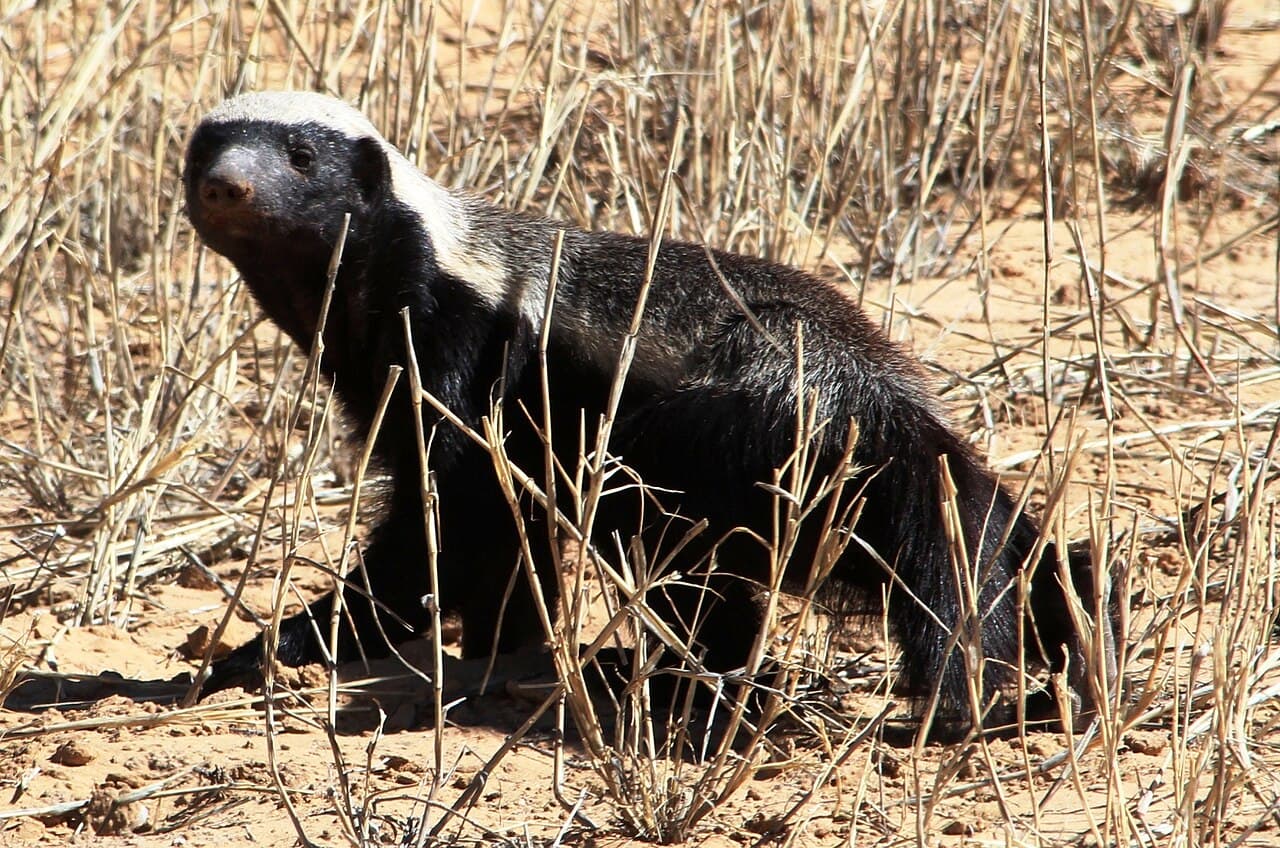
Honey Badger (Mellivora capensis) is a stocky carnivore found across Africa, southwest Asia and the Indian subcontinent. It is famous for bold defense, but its real success comes from adaptability: powerful claws excavate prey and shelter, keen smell locates food underground, and loose tough skin helps it twist when seized. Honey Badgers hunt alone over large areas and eat everything from rodents and reptiles to insect larvae and fruit. This guide separates well-supported biology from common assumptions and covers identification, range, habitat, diet, behavior, reproduction and conservation.
Identification
A Honey Badger has a low broad body, short powerful legs, a wide head, small eyes and ears, and an uneven tail. Most populations show a black underside and sides beneath a broad gray or white mantle extending from crown to tail base. Forefeet carry exceptionally long claws. The skin is thick and loose, and the anal glands can release a strong odor when the animal is threatened. Males are roughly one-third larger than females in well-studied southern African populations and develop broader heads and heavier necks.
Identification should combine body shape, markings, size, voice or movement, and location. One feature by itself can overlap with a related animal, a juvenile, or an individual in unusual light.
Photographs are most useful when they preserve scale and show several diagnostic features. Handling or repositioning a wild honey badger for identification can cause stress and is unnecessary.
Size and physical adaptations
Honey Badger typically measures About 60–77 cm head and body and weighs Females often 5–10 kg; males about 9–16 kg. Body size and mantle color vary across the species’ enormous range.
Its useful adaptations include long foreclaws excavate prey and burrows, loose thick skin allows twisting when grabbed, strong jaws crack shells and bones, keen smell locates underground prey, anal glands produce defensive odor, broad feet support rapid digging, flexible diet follows seasonal food, some resistance may reduce effects of certain snake venoms. These traits work together in the animal’s normal setting rather than serving as isolated curiosities.
Published measurements may use different methods, life stages or sample locations. Comparing figures responsibly means checking what was measured rather than selecting the largest number available.
Range and distribution
A vast but patchy native range spans most of sub-Saharan Africa, parts of North Africa, Arabia and southwest and central Asia east through Pakistan, India and Nepal. It is absent from the driest Sahara and some densely settled or intensively cultivated regions. Local occurrence can be hard to confirm because individuals are nocturnal and roam widely. The native range includes South Africa, Namibia, Botswana, Zimbabwe, Mozambique, Angola, Zambia, Malawi, Tanzania, Kenya, Uganda, Ethiopia, Somalia, Sudan, South Sudan, Chad, Niger, Nigeria, Cameroon, Central African Republic, Democratic Republic of the Congo, Republic of the Congo, Gabon, Ghana, Côte d’Ivoire, Guinea, Senegal, Gambia, Burkina Faso, Mali, Mauritania, Morocco, Algeria, Saudi Arabia, Yemen, Oman, United Arab Emirates, Iraq, Iran, Afghanistan, Pakistan, India, Nepal, Turkmenistan, Uzbekistan, Kazakhstan.
A country-level map indicates broad distribution, not continuous occupation. Climate, elevation, water, vegetation, prey, breeding sites, barriers and survey effort all affect where records occur.
Records near the edge of the range deserve careful documentation because they may reflect natural movement, improved survey coverage, accidental transport or a genuine distribution change.
Habitat
Desert, arid steppe, savanna, grassland, thorn scrub, open woodland, riparian forest and some tropical forest from sea level to high mountains.
Honey Badgers require places to dig or shelter, including sandy soil, termite mounds, rock crevices and abandoned burrows. An individual may excavate a new resting hole in minutes and use it only once. Large home ranges overlap multiple habitat types, allowing seasonal shifts between rodents, reptiles, insects, fruit and human-associated food. Protecting a population therefore requires the feeding, shelter and breeding features that make a site usable, along with connections that allow movement.
Microhabitat matters. Shade, soil, current, moisture, shelter or host plants can determine whether a small area is usable even when the surrounding landscape appears suitable.
Diet and feeding
Honey Badger is a opportunistic omnivore dominated by animal prey. Important foods include rodents, snakes and lizards, birds and eggs, insects and scorpions, frogs, carrion, bee larvae and comb, roots, bulbs and fruit. Most prey is found by scent. The badger digs rapidly into rodent burrows, tears open logs and termite mounds, overturns stones and raids nests. Strong jaws and claws subdue reptiles and crack armored prey. Bee colonies are opened for larvae and comb, while available fruit and bulbs add seasonal energy and moisture. Food is often eaten immediately rather than stored.
Diet changes with age, season, location and food supply. A dramatic prey record does not establish what most individuals eat most of the time; repeated field observations provide a stronger picture.
Feeding opportunities also create risk. An animal focused on prey may be less alert to predators, traffic or people, while contaminated prey can transfer pollutants through the food web.
Behavior and communication
Mostly nocturnal in hot or disturbed areas, with daytime activity during cool weather or where persecution is low. Adults usually travel alone, walking in a zigzag while scenting the ground. They are capable climbers and powerful diggers but spend most time searching at ground level. When cornered they growl, rush, bite and release odor; avoidance is more typical when escape is possible. Much of the “fearless” reputation comes from defensive encounters recorded after people or predators close in.
Scent is central to this wide-ranging solitary lifestyle. Anal-gland secretions, urine and feces advertise identity and reproductive condition. Mothers and cubs use grunts and close contact, while threatened animals hiss, growl and give harsh rattling calls. Posture, raised fur, open-mouth threats and short charges communicate escalating defense. Behavior should be interpreted in context: alarm, courtship, feeding and temperature regulation can produce very different actions from the same animal.
Daily schedules are flexible responses, not rigid rules. Weather, breeding condition, disturbance, tides or food can move activity into a different part of the day.
Reproduction and development
Males range widely and may mate with several females. After mating, delayed implantation may contribute to variable gestation estimates. The female gives birth in a secure underground chamber and raises the cub without help from the male. Young remain dependent for an unusually long period while learning how to dig, locate dangerous prey and travel across large ranges. Usually one cub, occasionally two The cub is born blind and sparsely furred in a burrow. Its mother moves it between dens and later brings prey before allowing it to accompany foraging trips. Dependence may last 12–16 months, providing time to learn complex prey handling. A young animal gradually increases travel distance before separating to establish its own range.
Young animals face different risks and may use different microhabitats or food than adults. Breeding success depends on adult condition, suitable sites and the survival of offspring through vulnerable early stages.
Counts of eggs or young describe reproductive output, not the number expected to reach adulthood. Mortality is normally greatest during eggs, larval or juvenile stages.
Predators and ecological role
Honey Badgers suppress rodents, reptiles and large insects while excavations aerate soil and create shelter later used by other animals. They also scavenge carrion. Large carnivores such as lions, leopards and hyenas can kill them, especially young animals, despite formidable defense. Birds sometimes follow foraging badgers to capture prey flushed from cover. Documented or likely predators include Lion, Leopard, Spotted Hyena, African Rock Python, Human.
This animal is both a consumer and a food source. Its influence comes through many repeated interactions, so ecological claims should be based on measured populations rather than assumptions drawn from appearance.
Predator and prey relationships differ among places. A species can be ecologically influential without being abundant everywhere, and its role can change across its range.
Relationship with people
Conflict centers on poultry, small livestock and beehives. Killing badgers rarely solves the problem where attractants remain. Strong elevated hives, metal hive stands, secure poultry housing and removal of carcasses reduce losses. “Badger-friendly” honey programs encourage prevention rather than persecution. Ecotourism benefits from the species’ reputation, but baiting changes natural behavior.
Give a wild Honey Badger space and an open escape route. Never corner, feed, follow into a burrow or approach a mother and cub. Secure food and small animals at night in range countries. An injured or trapped individual can inflict severe bites and claw wounds; contact trained wildlife authorities rather than attempting rescue. Responsible observation means keeping an appropriate distance, avoiding capture or feeding, protecting habitat and following local wildlife or invasive-species guidance.
Wildlife guidance should come from the responsible local agency because collection rules, reporting requests and appropriate responses differ between native and introduced ranges.
Conservation
The IUCN lists the Honey Badger as Least Concern because of its huge range and adaptability. That global category conceals local declines caused by poisoning, trapping, road mortality and persecution by poultry and bee farmers. Slow reproduction and large space needs can delay recolonization after local loss. The reported global trend is Global trend uncertain; declining or uncommon in several regional assessments.
Important pressures include poison and indiscriminate predator control, trapping for traditional use, retaliation around apiaries and poultry, road collisions, habitat fragmentation, decline of prey and den sites. Global status can hide local decline or recovery, so current regional monitoring and habitat management remain necessary.
The most useful conservation action follows the documented pressure. Protecting breeding sites, reducing road deaths or limiting pollutants can require different tools in different populations.