
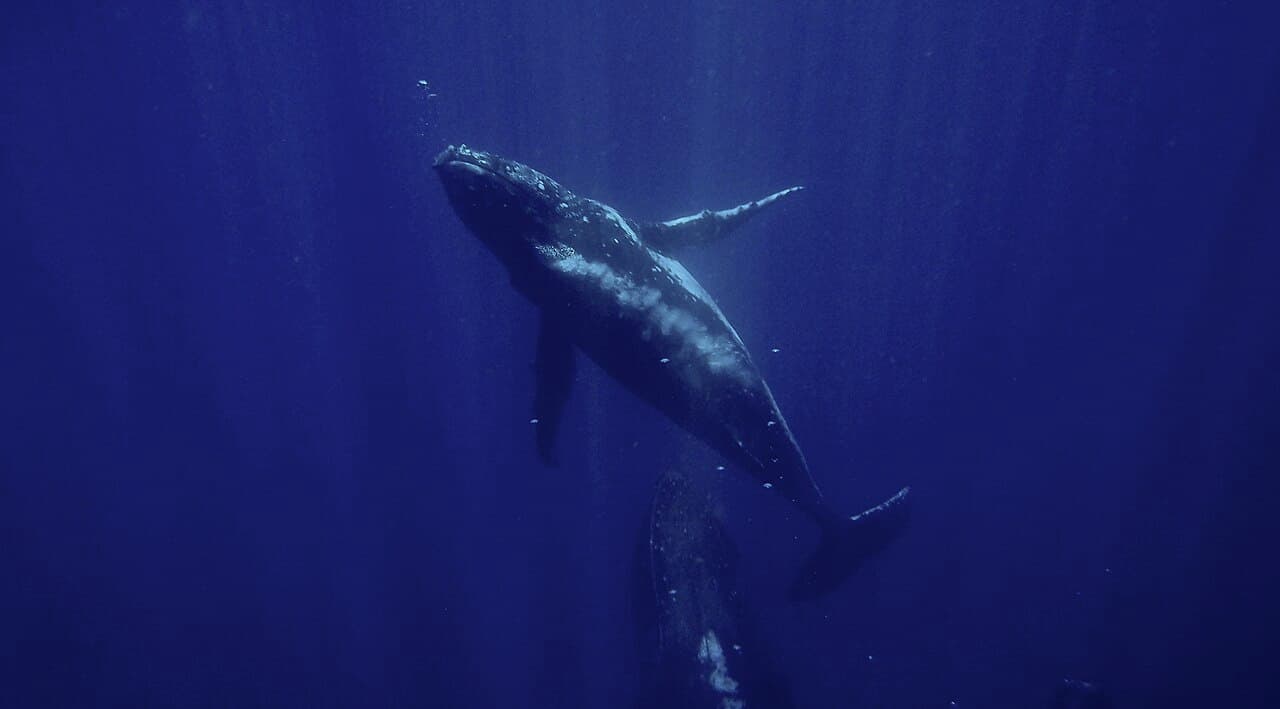
Humpback Whale (Megaptera novaeangliae) is a globally distributed rorqual with individually recognizable tail markings. This guide separates well-supported biology from common assumptions and covers identification, range, habitat, diet, behavior, reproduction and conservation.
Identification
A robust whale with extremely long pectoral fins, knobby head tubercles, a small dorsal fin on a hump and scalloped trailing edges on the tail flukes. Black-and-white fluke patterns identify individuals. Females average slightly longer than males, but the sexes otherwise look similar at sea.
Identification should combine body shape, markings, size, voice or movement, and location. One feature by itself can overlap with a related animal, a juvenile, or an individual in unusual light.
Photographs are most useful when they preserve scale and show several diagnostic features. Handling or repositioning a wild humpback whale for identification can cause stress and is unnecessary.
Size and physical adaptations
Humpback Whale typically measures typically 12–16 m and weighs roughly 25–40 metric tonnes. Adult size differs by sex and population; pectoral fins may approach one-third of body length.
Its useful adaptations include ventral throat pleats expand during lunge feeding, long pectoral fins aid maneuvering, baleen filters small prey, head tubercles contain sensory hairs. These traits work together in the animal’s normal setting rather than serving as isolated curiosities.
Published measurements may use different methods, life stages or sample locations. Comparing figures responsibly means checking what was measured rather than selecting the largest number available.
Range and distribution
All major oceans, with most populations migrating between high-latitude feeding grounds and tropical or subtropical breeding areas. The native range includes United States, Canada, Mexico, Brazil, Norway, Iceland, South Africa, Australia, New Zealand, Japan, Tonga.
A country-level map indicates broad distribution, not continuous occupation. Climate, elevation, water, vegetation, prey, breeding sites, barriers and survey effort all affect where records occur.
Records near the edge of the range deserve careful documentation because they may reflect natural movement, improved survey coverage, accidental transport or a genuine distribution change.
Habitat
Productive shelves, banks and polar feeding waters, migration corridors and warm shallow breeding regions.
Feeding whales follow dense krill and fish, while mothers use warm breeding areas where newborn calves conserve heat. Protecting a population therefore requires the feeding, shelter and breeding features that make a site usable, along with connections that allow movement.
Microhabitat matters. Shade, soil, current, moisture, shelter or host plants can determine whether a small area is usable even when the surrounding landscape appears suitable.
Diet and feeding
Humpback Whale is a carnivore and filter feeder. Important foods include krill, herring, capelin, sand lance, anchovies. It lunges through prey and strains water through baleen. Some populations cooperatively release bubbles around fish, creating a bubble net before whales rise through the concentrated school.
Diet changes with age, season, location and food supply. A dramatic prey record does not establish what most individuals eat most of the time; repeated field observations provide a stronger picture.
Feeding opportunities also create risk. An animal focused on prey may be less alert to predators, traffic or people, while contaminated prey can transfer pollutants through the food web.
Behavior and communication
Active day and night, with behavior shaped by migration and prey depth. Humpbacks breach, slap fins and flukes, travel alone or in fluid groups and gather temporarily at rich feeding sites.
Males produce long structured songs on breeding grounds; both sexes use social calls, and sound travels efficiently through water. Behavior should be interpreted in context: alarm, courtship, feeding and temperature regulation can produce very different actions from the same animal.
Daily schedules are flexible responses, not rigid rules. Weather, breeding condition, disturbance, tides or food can move activity into a different part of the day.
Reproduction and development
Courtship and mating occur mainly on winter breeding grounds where males sing and compete for access to females. One calf, usually at intervals of two to three years. undefined
Young animals face different risks and may use different microhabitats or food than adults. Breeding success depends on adult condition, suitable sites and the survival of offspring through vulnerable early stages.
Counts of eggs or young describe reproductive output, not the number expected to reach adulthood. Mortality is normally greatest during eggs, larval or juvenile stages.
Predators and ecological role
A large predator of krill and forage fish that moves nutrients between feeding depths and across ocean basins. Documented or likely predators include Killer Whale, Humans.
This animal is both a consumer and a food source. Its influence comes through many repeated interactions, so ecological claims should be based on measured populations rather than assumptions drawn from appearance.
Predator and prey relationships differ among places. A species can be ecologically influential without being abundant everywhere, and its role can change across its range.
Relationship with people
Whaling drove major declines, while international protection enabled many populations to recover. Whale watching must follow approach rules.
Keep legal vessel distance, reduce speed in whale areas and report entangled animals to trained responders. Responsible observation means keeping an appropriate distance, avoiding capture or feeding, protecting habitat and following local wildlife or invasive-species guidance.
Wildlife guidance should come from the responsible local agency because collection rules, reporting requests and appropriate responses differ between native and introduced ranges.
Conservation
Least Concern globally, though distinct populations differ greatly and some remain endangered under regional law. The reported global trend is Increasing overall with regional variation.
Important pressures include fishing-gear entanglement, vessel strikes, underwater noise, climate-driven prey shifts, disturbance. Global status can hide local decline or recovery, so current regional monitoring and habitat management remain necessary.
The most useful conservation action follows the documented pressure. Protecting breeding sites, reducing road deaths or limiting pollutants can require different tools in different populations.