
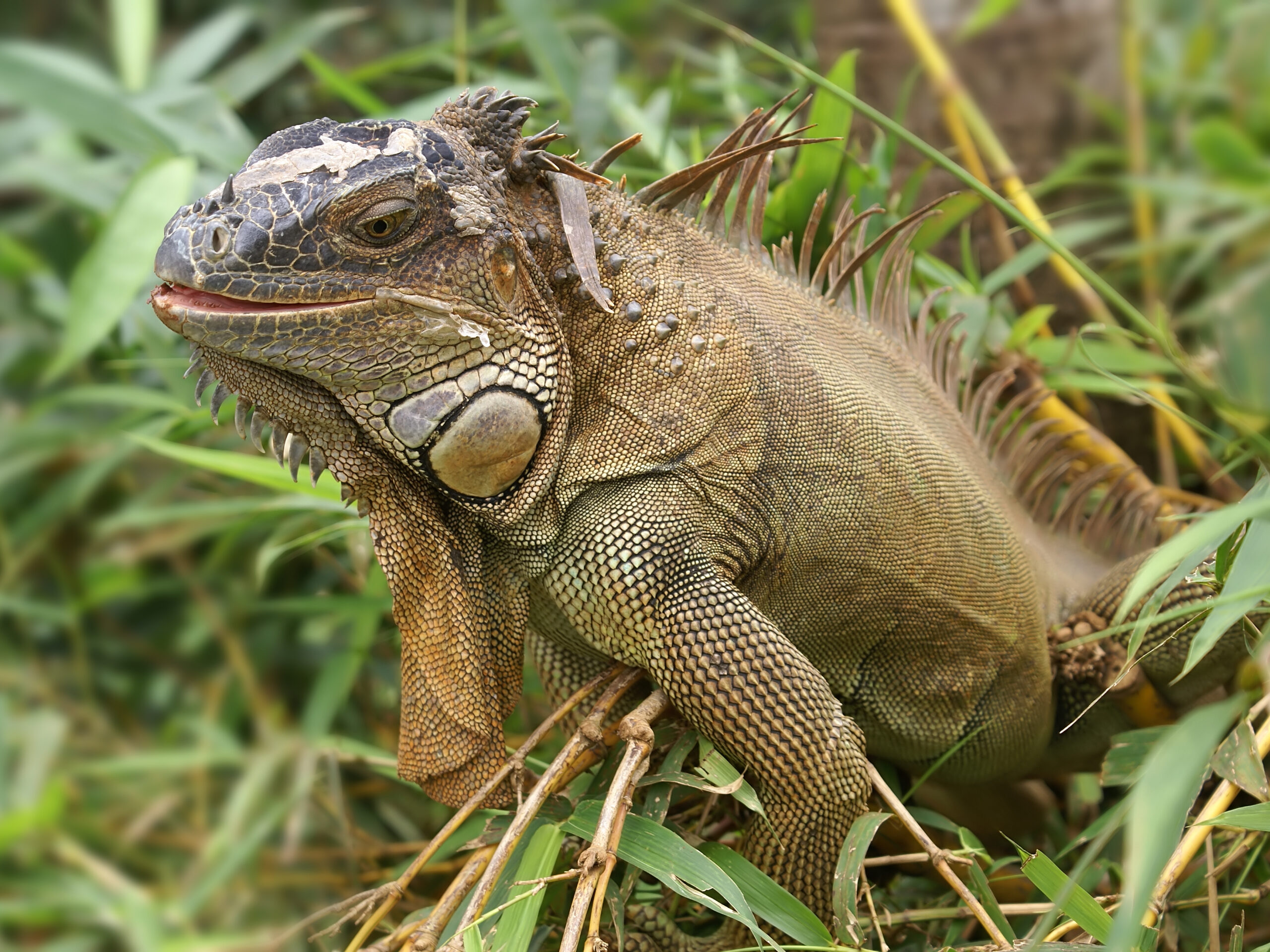
Iguana is a genus of two recognized living lizard species: the widespread green iguana (Iguana iguana) and the Critically Endangered Lesser Antillean iguana (Iguana delicatissima). Both are large, mainly plant-eating reptiles native to tropical parts of the Americas, but their ranges and conservation outlooks are very different.
The word “iguana” is also used loosely for other members of family Iguanidae, including marine iguanas, land iguanas, rock iguanas and desert iguanas. Those animals belong to other genera. This page focuses on the true iguanas in genus Iguana.
The two recognized Iguana species
- Green iguana (Iguana iguana) — native from southern Mexico through Central America into tropical South America and parts of the Caribbean; introduced in many other places.
- Lesser Antillean iguana (Iguana delicatissima) — native to a shrinking set of islands in the Lesser Antilles and assessed as Critically Endangered.
The Reptile Database currently recognizes these two species. Several island populations of the green iguana have been proposed as separate species or subspecies, but recent genetic work has challenged some splits. Taxonomy remains active, so an overview should state which authority and date it follows.
Appearance and size
True iguanas have long bodies, powerful limbs, very long tails and a row of flexible spines along the neck and back. A hanging throat flap called the dewlap is used in display and temperature control. Large scales on the cheek and beneath the ear also help identify them.
Adult green iguanas can approach 2 meters (6.6 feet) from snout to tail, although much of that length is tail. Many adults weigh around 4–6 kilograms, with large males heavier than females. Lesser Antillean iguanas are also robust but are generally smaller.
Despite the common name, green iguanas may be gray, brown, turquoise, orange or nearly black as well as green. Color changes with age, population, temperature and breeding condition. Captive breeding has produced additional color morphs, but these are not separate species.
Dewlap, dorsal spines and tail
The dewlap makes an iguana appear larger during territorial or courtship displays. Head bobs, body posture and sideways presentation communicate dominance and reproductive condition without immediate fighting. The dorsal crest adds to the animal’s outline.
A long muscular tail propels an iguana while swimming and can strike defensively. Young animals and some adults can shed part of the tail when seized. It regrows, but the replacement is supported by cartilage rather than a complete copy of the original vertebrae and is often shorter or differently colored.
Long toes and curved claws grip bark and branches. Green iguanas are strong climbers and may rest high in riverside trees, dropping into water to escape danger. Their nostrils help remove excess salts through specialized glands, sometimes producing a visible sneeze.
Range and habitat
Green iguanas occupy tropical forest, woodland, mangroves, river margins and urban vegetation from Mexico through Central America and across much of northern South America. They also occur naturally on multiple Caribbean islands. People have introduced them to Florida, Hawaii, Puerto Rico, Taiwan and other regions through escapes, releases and cargo movement.
Lesser Antillean iguanas are island specialists. Their remaining populations are fragmented across parts of the Lesser Antilles, including Dominica and several smaller islands. Habitat development, introduced predators and competition and hybridization with introduced green iguanas have caused severe losses.
A combined map shows the native range of both species, not the distribution of every lizard casually called an iguana. Introduced green iguana populations require separate marking because they can damage vegetation, burrow into infrastructure and threaten native iguanas.
Diet and feeding
Adult true iguanas are primarily herbivorous. Leaves, flowers, shoots and fruit form most of the diet. Their leaf-shaped teeth slice plant material, and microbes in an enlarged hindgut help break down fiber. Young green iguanas may consume occasional insects or other animal matter, but they do not require a meat-heavy diet.
Feeding choices change with season and plant availability. Iguanas can disperse seeds after eating fruit, while intensive browsing by introduced populations may alter local vegetation. Captive diets must supply appropriate plant variety, calcium and ultraviolet-B exposure; poor nutrition can cause metabolic bone disease.
Basking, climbing and communication
Iguanas are ectotherms, so they regulate body temperature through behavior. A typical morning begins with basking, followed by feeding and movement once muscles warm. The animal moves between sun and shade to avoid overheating.
Adult males defend display and breeding areas using head bobs, dewlap extension, body compression and chasing. Females may share feeding areas but still maintain personal space. Vision is important, and a light-sensitive organ on top of the head helps detect changes in brightness and overhead shadows.
When threatened, an iguana may freeze, flee through branches, dive into water, inflate its body, bite, scratch or strike with its tail. Most avoid close contact if an escape route is available.
Eggs and young
True iguanas lay eggs. During the breeding season, males compete for access to females. A female later digs a nest tunnel or chamber in suitable soil and deposits a clutch. Green iguana clutches often contain several dozen eggs, while number and incubation time vary with the female and environmental conditions.
The young hatch without parental care and must dig toward the surface. Hatchlings may travel and rest in groups during early life, gaining some protection through shared vigilance. Growth is rapid when food and warmth are favorable, but predators take many eggs and juveniles.
Conservation and invasive populations
Genus Iguana has no single conservation category. The green iguana remains widespread across a vast native range and is also invasive in many places. The Lesser Antillean iguana was moved to Critically Endangered on the IUCN Red List in 2018 after major range and population declines.
For the Lesser Antillean species, introduced green iguanas create two problems: competition and hybridization. Hybrids can spread green iguana genes into small native populations. Habitat loss, roads, dogs, cats, mongooses and illegal capture add pressure.
Management must therefore distinguish location and species. Protecting native green iguanas within their natural range can coexist with controlling them where they are invasive. On Lesser Antillean islands, biosecurity, rapid removal of introduced iguanas and protection of genetically intact populations are essential.
Iguanas and people
Green iguanas are common in the pet trade, but they are demanding reptiles. A hatchling grows into a large, strong animal requiring a room-sized heated enclosure, high-output ultraviolet lighting, climbing structures, humidity control, veterinary care and a carefully planned herbivorous diet.
Adults can bite, scratch and strike with the tail. Reptiles may carry Salmonella without appearing ill, so careful hygiene is necessary. Abandoned pets should never be released. Ownership rules vary, and some regions prohibit green iguanas because of their invasive impact.