
A tortoise patterned like dry-country light
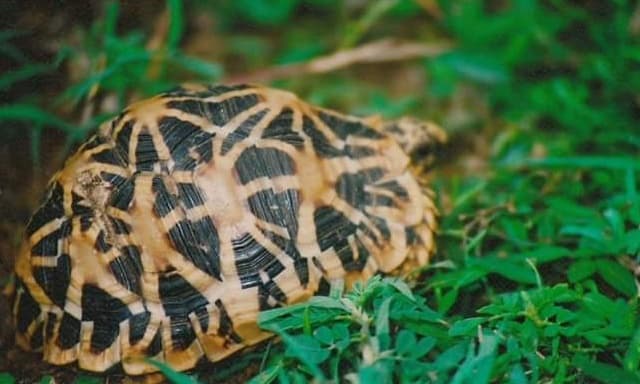
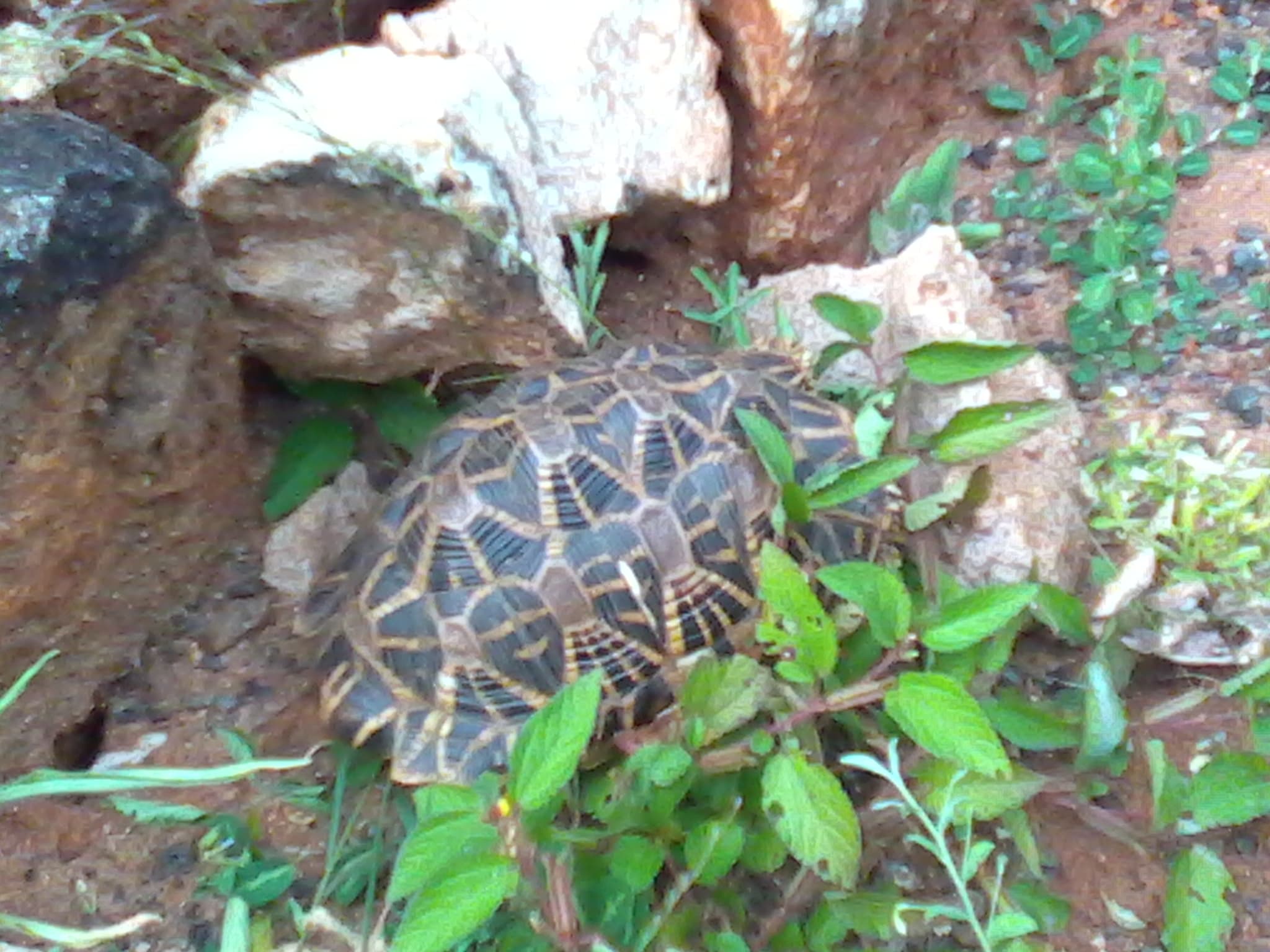
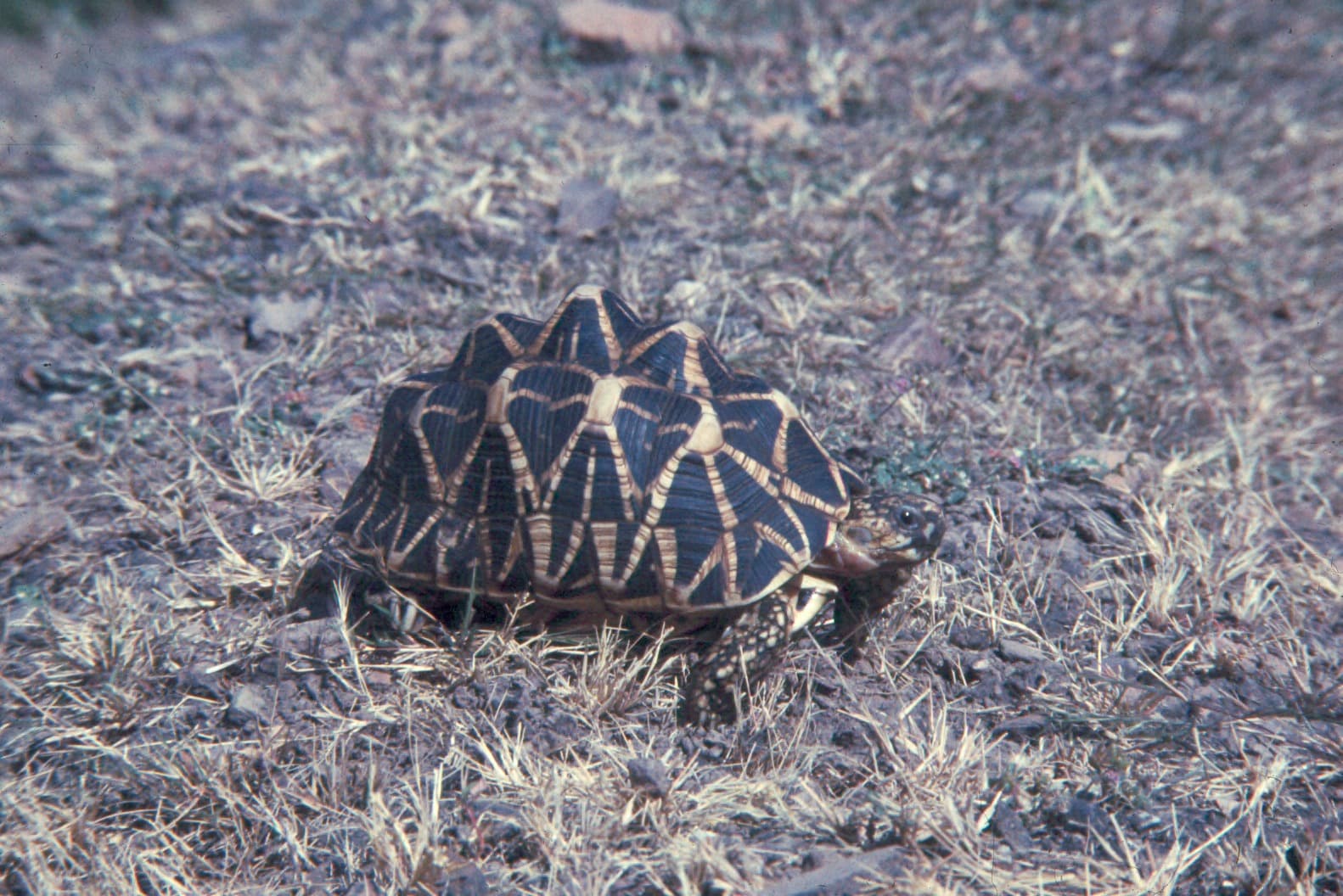
The Indian Star Tortoise (Geochelone elegans) is a living land tortoise native to Pakistan, India, and Sri Lanka. Its dark, high-domed shell is crossed by yellow or cream rays that spread from the center of each scute. Seen close up, the pattern is bold. In broken grass, thorn scrub, leaf litter, and alternating sun and shade, those lines interrupt the animal’s outline and work as camouflage. The species is sometimes called simply the star tortoise, although that name can cause confusion with other patterned tortoises.
This profile treats Geochelone elegans as a species, following the Reptile Database. Modern specialist checklists may recognize geographic subspecies, but everyday field identification and conservation reporting usually concern the species as a whole. It belongs to Testudinidae, the family of fully terrestrial tortoises.
Shell, size, and identification
The carapace is strongly domed, and individual scutes may become raised into gentle pyramids. Pale rays cross a brown or nearly black background, while the head and legs are yellowish, tan, or brown with darker scales. Unlike a box turtle, the Indian Star Tortoise does not have a hinged lower shell that closes around the body. When alarmed, it draws its head and limbs beneath the shell and relies on the hard dome for protection.
Females are usually larger and broader than males. A specialist account from the IUCN/SSC Tortoise and Freshwater Turtle Specialist Group gives typical maximum straight carapace lengths of about 32 centimeters for females and 26 centimeters for males, while noting exceptional larger animals. Adult males tend to have longer, thicker tails and a more concave plastron. Size varies with region, age, food, and condition, so a single length should not be treated as universal.
Range and seasonal habitat
The natural range is divided across the Indian subcontinent. Populations occur in southeastern Pakistan, western and peninsular India, and Sri Lanka. The tortoise occupies arid and semi-arid scrub, grassland, dry forest, coastal scrub, desert margins, agricultural fields, hedgerows, and plantations. That breadth does not mean every landscape is equally secure. Intensive cultivation, roads, fire, clearing, and collection can turn apparently suitable country into a fragmented network.
Activity follows heat and rain. During dry, hot periods, animals often forage around dawn and dusk and shelter through the harshest hours. Monsoon rain softens the ground, produces fresh plant growth, and allows longer periods of movement, feeding, courtship, and nesting. In unusually cold or dry conditions, individuals may remain inactive in shelter, but the species does not follow one identical seasonal schedule across its entire range.
Diet and daily ecology
Indian Star Tortoises are chiefly herbivorous grazers and browsers. They take grasses, low herbaceous leaves, flowers, fallen fruit, and succulent vegetation. Occasional animal material has been reported, but it does not make the species a regular predator. A tough beak clips vegetation, while the slow terrestrial lifestyle suits scattered, fibrous food.
Most adults are solitary. They navigate using sight, smell, ground contact, and remembered shelter or feeding sites. The shell pattern is useful when the animal pauses among straw-colored stems and dark soil. Tortoises also move nutrients through the landscape in their droppings and may disperse some seeds after eating fruit. Their pace is slow, yet seasonal movements between shade, forage, water, and nesting soil can be ecologically important.
Courtship, nesting, and young
Breeding activity commonly rises around rainy periods. Males may follow females and compete with other males by ramming, shoving, and trying to overturn them. A female selects workable soil, may wet it with stored water, and excavates a nest with her hind legs. She deposits eggs, replaces the soil, and leaves; there is no parental care after the nest is sealed.
Clutch size, number of clutches, and incubation time vary with female size, locality, temperature, and moisture. Development can take several months, and hatchlings emerge with a fully formed shell pattern. Young tortoises face predation from birds, monitor lizards, mongooses, and other animals. Females generally take longer than males to reach maturity, making the removal of breeding females especially damaging to a population.
Vulnerable and heavily trafficked
The IUCN Red List assessment classifies the Indian Star Tortoise as Vulnerable and reports a decreasing population. Its ornate shell has created intense demand in the international pet trade. Tortoises are collected from the wild, hidden in luggage or shipments, and transported in crowded conditions where stress, dehydration, injury, and death are common. The specialist conservation account identifies it as one of the most frequently confiscated tortoises in illegal global commerce.
The species is listed in CITES Appendix I, which sharply restricts international commercial trade in wild specimens. Habitat degradation compounds collection pressure. Conservation therefore requires protection of dry scrub and grassland, enforcement against trafficking, community cooperation, and careful veterinary and genetic planning when confiscated animals are rehabilitated. Releasing seized tortoises without knowing their origin can mix distinct populations, spread disease, or place them in unsuitable habitat.
Living safely alongside star tortoises
A wild Indian Star Tortoise is not a souvenir or an easy low-maintenance pet. People who encounter one should avoid handling, buying, moving, or releasing it on their own. An animal crossing a road may need help only when immediate traffic danger makes intervention necessary, and local wildlife authorities should guide any rescue. Captive care requires expert control of temperature, ultraviolet light, humidity, space, diet, and health; incorrect conditions can cause severe shell and bone disease.
The most useful response to suspected trafficking is to document what can be observed safely and contact the relevant wildlife agency. Buyers can reduce demand by refusing animals without clear lawful provenance. The same shell that attracts collectors evolved as protection and camouflage in South Asian landscapes; keeping the species in those landscapes is the central conservation goal.