
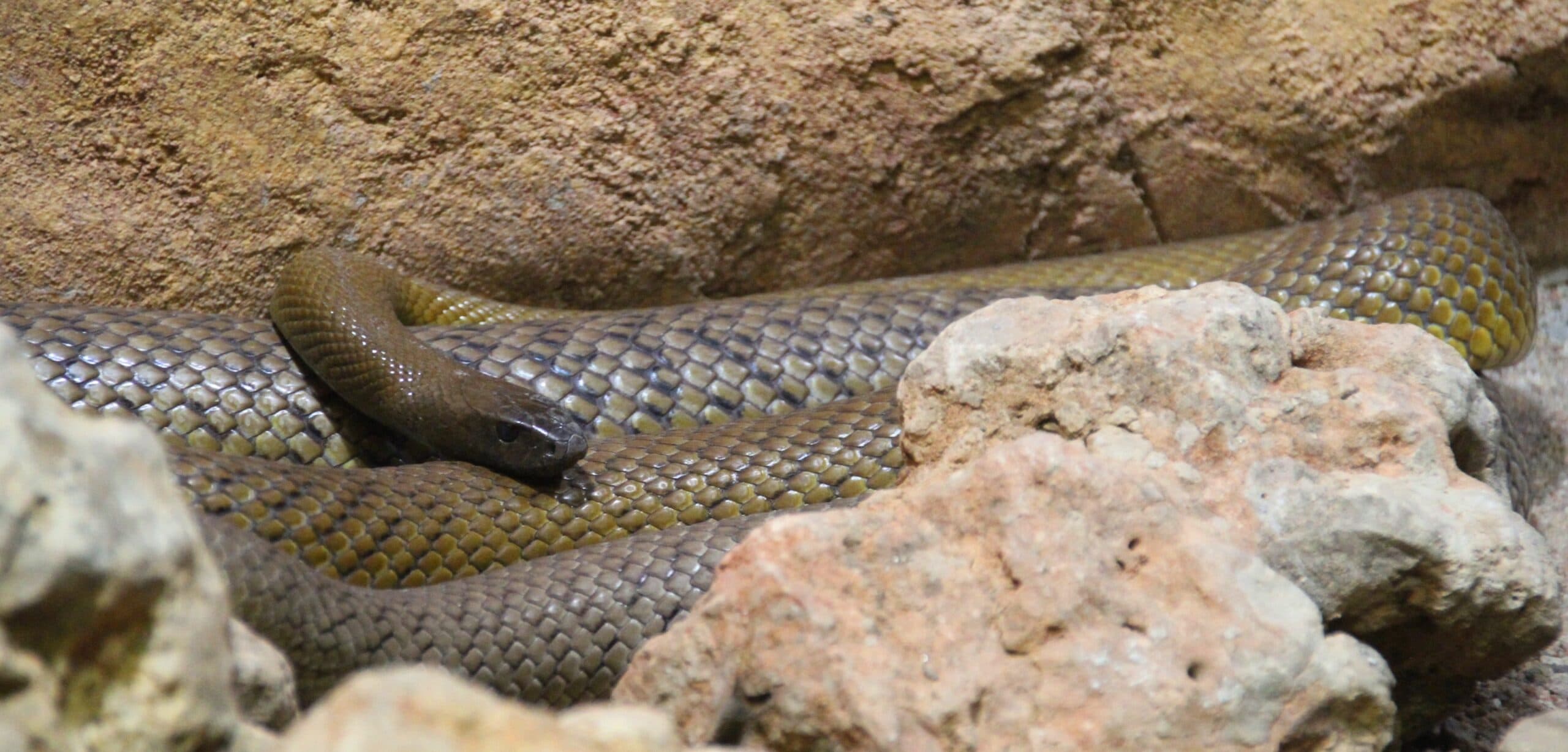
Inland Taipan (Oxyuranus microlepidotus) is a large elapid snake of the Channel Country in inland Australia. It shelters in deep soil cracks, mammal burrows and crevices across sparsely vegetated floodplains. Its exceptionally potent venom is adapted to subdue mammals quickly, but the species is remote, secretive and seldom encountered. Venom potency and human danger are different questions: every suspected bite is an emergency, while actual encounters remain rare. This guide separates well-supported biology from common assumptions and covers identification, range, habitat, diet, behavior, reproduction and conservation.
Identification
The body is robust, the neck narrower than the deep rectangular head and the eyes large with round pupils. Dorsal color ranges from pale fawn and yellow-brown to dark chocolate, with many scales edged darkly to produce a broken herringbone effect. The head and neck are often much darker than the body. The underside is yellowish with orange blotches. Individuals commonly become darker in cool months and paler in summer. Males and females have broadly overlapping body size and color. Tail proportions and reproductive anatomy allow specialists to determine sex, but visual sexing in the field is unreliable and unsafe.
Identification should combine body shape, markings, size, voice or movement, and location. One feature by itself can overlap with a related animal, a juvenile, or an individual in unusual light.
Photographs are most useful when they preserve scale and show several diagnostic features. Handling or repositioning a wild inland taipan for identification can cause stress and is unnecessary.
Size and physical adaptations
Inland Taipan typically measures average total length about 2 m, with a maximum recorded near 2.5 m and weighs large adults can weigh several kilograms, but dependable wild mass ranges are limited. The largest reliably reported female had a snout-to-vent length of 170 cm; total length includes the tail and varies among individuals.
Its useful adaptations include highly potent venom rapidly disables mammal prey, fixed front fangs deliver venom, large eyes support active prey search, seasonal color change aids temperature control, robust body enters deep clay fissures, fast repeated bites overcome dangerous rodents, chemical tracking locates prey in burrows. These traits work together in the animal’s normal setting rather than serving as isolated curiosities.
Published measurements may use different methods, life stages or sample locations. Comparing figures responsibly means checking what was measured rather than selecting the largest number available.
Range and distribution
Primarily the Channel Country of southwestern Queensland and northeastern South Australia. Historical records exist farther southeast, but modern confirmed occurrence is concentrated in remote arid floodplains and must not be mapped as all of inland Australia. The native range includes Australia.
A country-level map indicates broad distribution, not continuous occupation. Climate, elevation, water, vegetation, prey, breeding sites, barriers and survey effort all affect where records occur.
Records near the edge of the range deserve careful documentation because they may reflect natural movement, improved survey coverage, accidental transport or a genuine distribution change.
Habitat
Deep cracking-clay and cracking-loam floodplains, dry channels, sparse chenopod shrubland and adjacent gibber, dunes or rocky ground where secure cracks and burrows exist.
Clay fissures are central to this snake’s life. They provide stable temperature, refuge from predators and direct access to rodents using the same underground network. Snakes also shelter in mammal burrows and eroded crevices. After rain, floodplain productivity and rodent numbers rise, changing feeding opportunity, while drought can make prey scarce for long periods. Protecting a population therefore requires the feeding, shelter and breeding features that make a site usable, along with connections that allow movement.
Microhabitat matters. Shade, soil, current, moisture, shelter or host plants can determine whether a small area is usable even when the surrounding landscape appears suitable.
Diet and feeding
Inland Taipan is a specialized mammal predator. Important foods include long-haired rats, house mice, small native rodents, dasyurids, other small mammals. The Inland Taipan searches cracks and burrows for warm-blooded prey, often cornering a rodent in confined space. It delivers several rapid bites and may hold on because its venom acts quickly. Strong specialization follows the dramatic rise and fall of inland rodent populations, so feeding frequency and movement change across wet and dry years.
Diet changes with age, season, location and food supply. A dramatic prey record does not establish what most individuals eat most of the time; repeated field observations provide a stronger picture.
Feeding opportunities also create risk. An animal focused on prey may be less alert to predators, traffic or people, while contaminated prey can transfer pollutants through the food web.
Behavior and communication
Mainly diurnal in mild weather, with surface activity shifting to cooler periods as temperatures rise. Despite the name Fierce Snake, an undisturbed Inland Taipan is generally shy and avoids conflict. It spends much time concealed and may flee into cracks when detected. A cornered individual can defend itself with speed and repeated strikes. Remote habitat, low human density and secretive behavior explain why bites are rare, not any weakness of the venom.
A forked tongue transfers scent particles to the vomeronasal organ, helping the snake follow prey and potential mates. Vision assists active hunting. Courtship uses scent, alignment and touch, while defensive posture and rapid movement warn a close threat. The snake also detects vibration traveling through soil. Behavior should be interpreted in context: alarm, courtship, feeding and temperature regulation can produce very different actions from the same animal.
Daily schedules are flexible responses, not rigid rules. Weather, breeding condition, disturbance, tides or food can move activity into a different part of the day.
Reproduction and development
Mating occurs during the warmer part of the year. Males may follow female scent and compete through ritualized body wrestling rather than venom use. Females lay eggs in a protected underground chamber, abandoned burrow or deep crack where temperature and moisture are buffered. Commonly about 11–20 eggs, with variation among females Hatchlings emerge fully formed and venomous, then begin taking small mammals appropriate to their size. They receive no parental feeding. Juveniles grow rapidly when rodents are abundant but face drought, predation and exposure when moving between cracks.
Young animals face different risks and may use different microhabitats or food than adults. Breeding success depends on adult condition, suitable sites and the survival of offspring through vulnerable early stages.
Counts of eggs or young describe reproductive output, not the number expected to reach adulthood. Mortality is normally greatest during eggs, larval or juvenile stages.
Predators and ecological role
Inland Taipans are major predators of native and introduced rodents during population booms. They convert short pulses of floodplain productivity into predator biomass and in turn may be taken by large raptors or monitor lizards. Their reliance on soil structure shows that conservation involves intact cracking-clay processes as well as visible vegetation. Documented or likely predators include Wedge-Tailed Eagle, Brown Falcon, Perentie, Mulga Snake, Feral Cat.
This animal is both a consumer and a food source. Its influence comes through many repeated interactions, so ecological claims should be based on measured populations rather than assumptions drawn from appearance.
Predator and prey relationships differ among places. A species can be ecologically influential without being abundant everywhere, and its role can change across its range.
Relationship with people
Most people will never encounter this snake because its core range is remote and sparsely populated. Field workers, pastoral staff and wildlife researchers should wear protective footwear, use lights at night and avoid reaching into cracks or burrows. Only trained licensed professionals should identify or move a snake. Venom research has improved understanding of blood clotting, nerve action and antivenom.
In Australia, call Triple Zero immediately after any suspected bite. Keep the person lying still, apply a firm pressure-immobilisation bandage over the bite and along the whole limb, splint it and wait for emergency transport. Do not wash the bite site, cut or suck the wound, apply ice or a tourniquet, or allow the person to walk. Responsible observation means keeping an appropriate distance, avoiding capture or feeding, protecting habitat and following local wildlife or invasive-species guidance.
Wildlife guidance should come from the responsible local agency because collection rules, reporting requests and appropriate responses differ between native and introduced ranges.
Conservation
The species is generally treated as Least Concern because it occupies a large remote region and faces no single range-wide threat known to be causing rapid decline. It is naturally uncommon and difficult to survey, so local abundance and drought effects remain uncertain. The reported global trend is Unknown to stable overall, with strong natural fluctuation in prey and detection.
Important pressures include road mortality, deliberate killing, habitat disturbance near channels, feral predators, extreme drought, climate-driven heat change, illegal collection. Global status can hide local decline or recovery, so current regional monitoring and habitat management remain necessary.
The most useful conservation action follows the documented pressure. Protecting breeding sites, reducing road deaths or limiting pollutants can require different tools in different populations.