
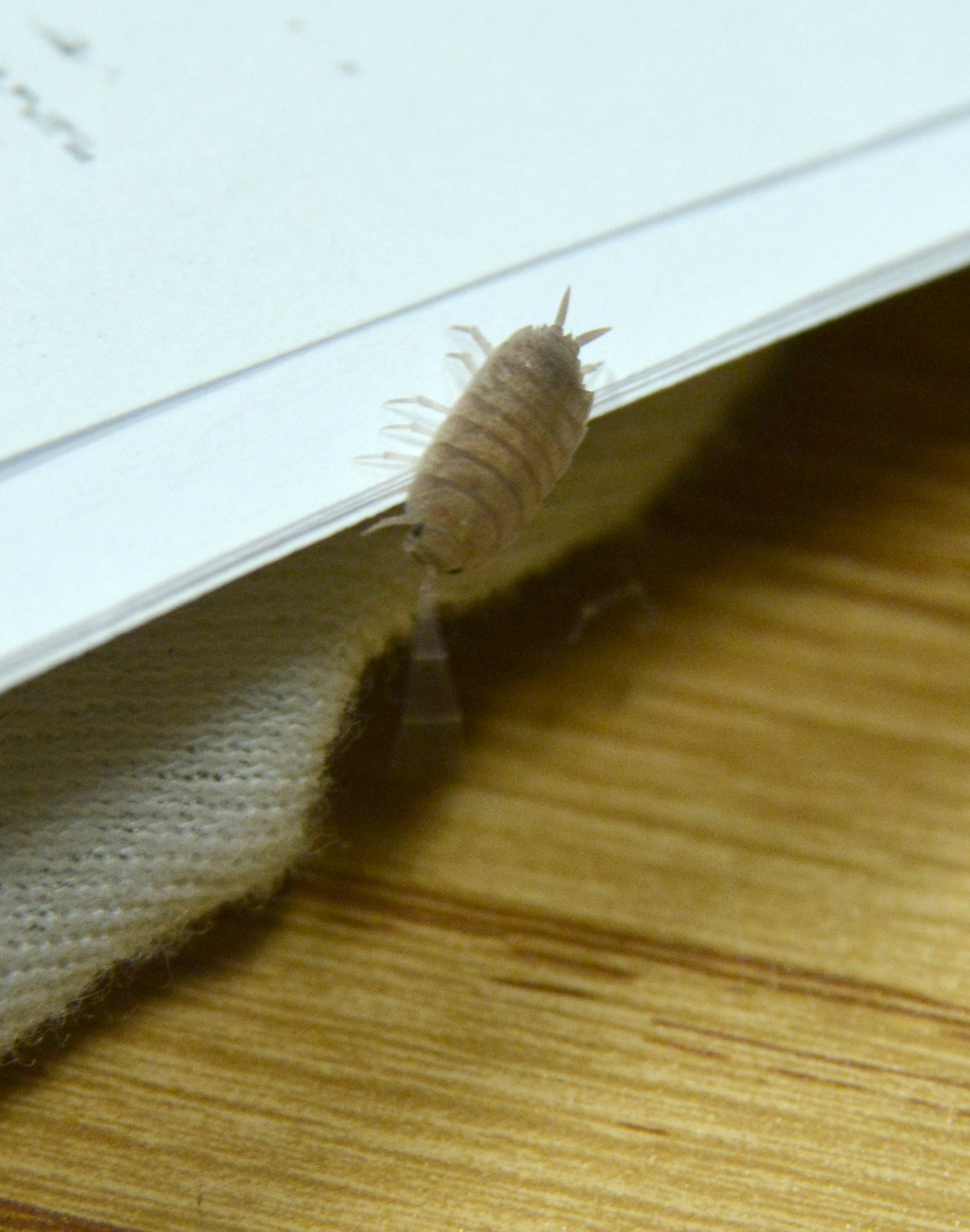
Isopods are crustaceans in the order Isopoda. The group includes familiar woodlice and pill bugs on land, water lice in freshwater, thousands of seafloor species, fish parasites and deep-sea giants in the genus Bathynomus. An isopod is therefore not an insect and not one species with a single size, diet or habitat.
The World Marine, Freshwater and Terrestrial Isopod Crustaceans database listed more than 11,000 accepted marine and non-marine species in September 2026. New descriptions and taxonomic revisions keep that total moving. Despite their diversity, isopods share a segmented body, a rigid exoskeleton and seven pairs of broadly similar walking legs in the typical adult form.
Isopod classification
Isopods are arthropods, crustaceans and members of class Malacostraca, the class that also contains crabs, lobsters, shrimp and amphipods. Within the superorder Peracarida, females brood developing young in a pouch beneath the body. The order name combines Greek roots meaning “equal” and “foot,” referring to the similar-looking walking legs.
Major lineages occupy strikingly different environments. Oniscidea contains the terrestrial woodlice. Asellota is especially diverse in the sea but also includes freshwater forms. Cymothoida includes free-living predators and parasites, while Epicaridea contains parasites of other crustaceans. Giant isopods belong to the marine family Cirolanidae.
The featured photograph shows a terrestrial pill bug in family Armadillidiidae. It is a representative member of Isopoda, not a picture of the entire order and not a giant deep-sea isopod.
Body structure and identification
A typical isopod is flattened from top to bottom and protected by a series of overlapping exoskeletal plates. The body has a head region, a thorax or pereon with seven main segments, and an abdomen or pleon. Adults usually carry seven pairs of walking legs called pereopods. Two pairs of antennae are present, although the first pair can be small in land-dwelling species.
Appendages under the rear of the body, called pleopods, originally function in swimming and gas exchange. Terrestrial isopods retain modified pleopods that must stay moist to work effectively. This is why woodlice commonly shelter under bark, stones, logs and leaf litter and become active when humidity rises.
Size spans several orders of magnitude. Many soil and marine species measure only a few millimeters. Common woodlice are often around 5–20 millimeters long. At the opposite extreme, some giant Bathynomus exceed 30 centimeters. A single “isopod size” would conceal most of the order’s diversity.
Where isopods live
Isopods occur worldwide, including polar seas, the deep ocean, coasts, rivers, lakes, groundwater, caves, forests, deserts, gardens and buildings. Most evolutionary diversity is aquatic, but terrestrial woodlice are among the few crustacean groups that have become fully established on land.
Marine isopods crawl across sediment, hide in reefs and algae, bore into wood, swim above the bottom or live on other animals. Deep-sea species occur beyond sunlight, where temperatures are low and food can be scarce. Freshwater forms inhabit streams, ponds, caves and underground aquifers.
Land isopods need humid refuges because their respiratory surfaces lose water easily. They often emerge at night or after rain. A few lineages have adaptations for dry habitats, but even desert woodlice rely on burrows, social behavior or sheltered microclimates to conserve moisture.
Food and feeding roles
Many terrestrial isopods are detritivores. They chew dead leaves, decaying wood, fungi and microbes, fragmenting plant material and returning nutrients to soil food webs. Their droppings are further processed by microorganisms. They do not “create” decomposition alone, but they accelerate physical breakdown.
Free-living aquatic isopods may graze, scavenge, filter small particles or hunt other invertebrates. Giant isopods are largely seafloor scavengers that feed on animal material reaching the bottom and may also take slow prey. Food arrives unpredictably in the deep sea, so these animals can endure long gaps between meals.
Parasitic isopods feed on fish or other crustaceans. Some attach to skin or gills, some occupy a fish’s mouth, and epicarideans live on or inside crustacean hosts. These specialized relationships should not be generalized to pill bugs: the woodlouse beneath a garden log is a decomposer, not a fish parasite.
Movement, rolling and defense
Most isopods walk using coordinated movements of their seven leg pairs. Aquatic species may also swim with pleopods. Long antennae sample the surroundings through touch and chemical cues, especially in dark soil, caves or the deep ocean.
Pill bugs in several terrestrial families can roll into a ball, a behavior called conglobation. The hardened plates shield the softer underside and reduce exposed surface area, helping defend against predators and water loss. Sowbugs and many other isopods cannot form a complete ball.
Other defenses include hiding, clinging to surfaces, burrowing, remaining motionless or using a tough exoskeleton. Some marine species swim away. The group is prey for spiders, beetles, centipedes, amphibians, reptiles, birds, fish and mammals.
Reproduction and the brood pouch
Female isopods brood eggs and embryos in a ventral pouch called a marsupium. Plates called oostegites usually form its walls. In terrestrial species the pouch contains fluid, allowing early development to occur in a protected aquatic environment even though the mother lives on land.
Young leave the pouch as mancae. A manca resembles a small adult but initially lacks the final pair of walking legs. It adds that pair during later molts. Growth requires periodic shedding of the rigid exoskeleton.
Terrestrial isopods often molt in two stages: the rear half of the exoskeleton is shed before the front half. This biphasic molt limits the time the entire body is soft and vulnerable. Breeding season, brood size, development time and lifespan depend on lineage and environmental conditions.
Giant isopods are one specialized branch
“Isopod” and “giant isopod” are not interchangeable. Giant isopods are species of Bathynomus adapted to deep marine habitats. The Natural History Museum reports that the largest species can exceed 30 centimeters and live hundreds of meters below the surface.
Large eyes and long antennae help them detect their surroundings in dim water, while hooked leg tips provide grip on the seabed. Their slow metabolism and scavenging life suit an environment where large food falls are irregular. These traits do not describe small terrestrial pill bugs or freshwater water lice.
Conservation and environmental importance
There is no single conservation status for Isopoda. The order includes more than 11,000 accepted species distributed around the planet. Some are widespread, while cave, groundwater, island or deep-sea endemics may have extremely small ranges and limited population information.
Local threats include habitat destruction, wetland drainage, groundwater extraction, pollution, pesticides, invasive species and climate-driven drying. Deep-sea mining and other seabed disturbance may affect poorly known marine communities before their species are fully documented.
Isopods can also serve as environmental indicators. Scientists study terrestrial species in soil ecology and contamination research, while aquatic communities can reflect habitat and water conditions. Conservation decisions must be based on the individual species and ecosystem rather than the order as a whole.
Isopods in gardens and captive cultures
Woodlice in gardens generally feed on damp, decaying organic material. Large numbers indoors often indicate persistent moisture and nearby shelter rather than an attack on people. Reducing leaks and damp hiding places is usually more useful than broad pesticide treatment.
Terrestrial isopods are also kept in naturalistic enclosures and bioactive terrariums. Different species need different moisture gradients, ventilation, temperature, calcium and food. Captive cultures should not be released outdoors because even a harmless-looking species may become established outside its native range or carry organisms into local habitats.