
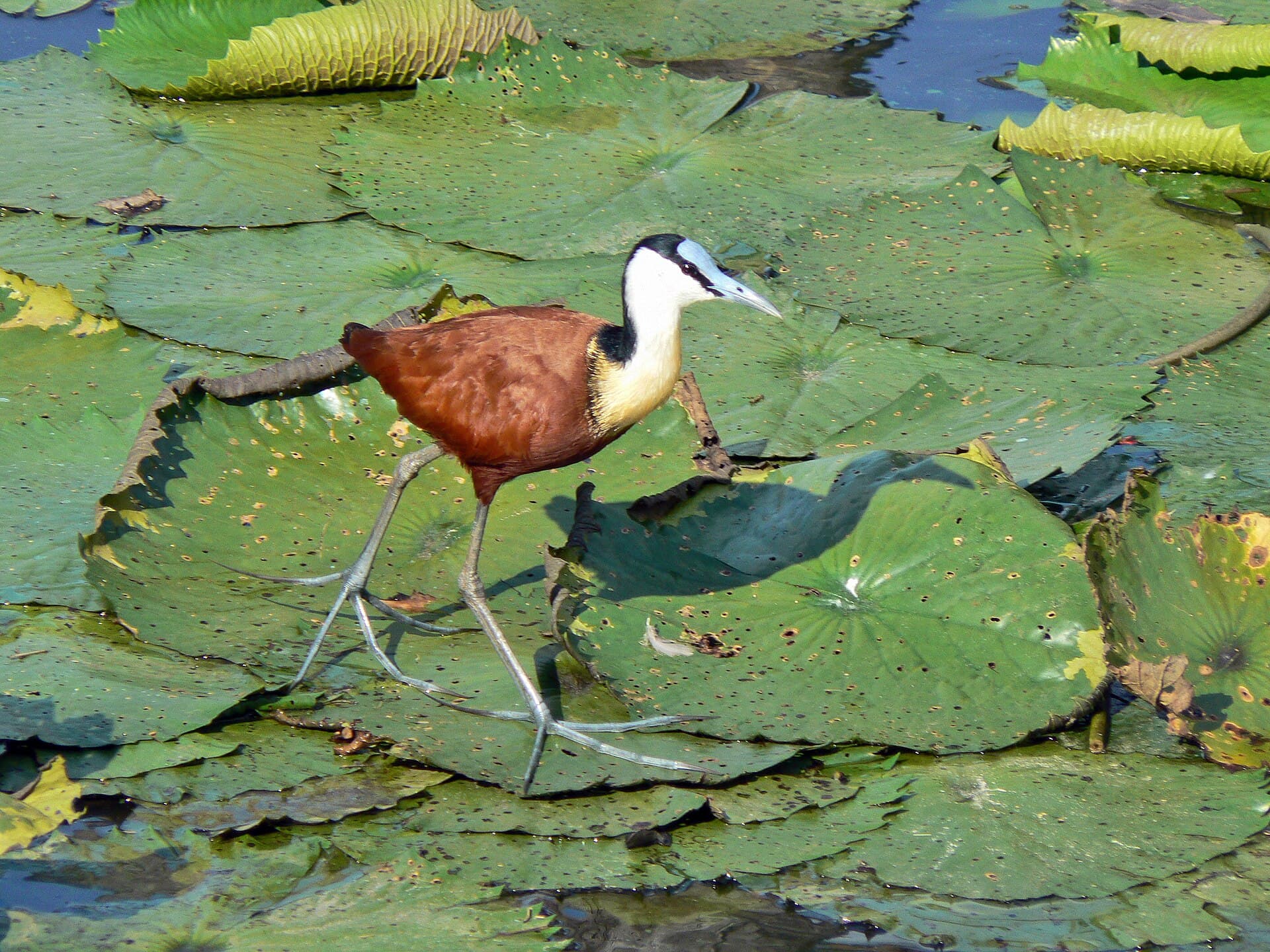
Jacanas are eight living species of tropical wetland birds in the family Jacanidae. Their extremely long toes spread body weight across floating leaves, earning them names such as lily-trotter, lotus bird and Jesus bird. They do not literally walk on water; they step across water lilies and other floating or emergent vegetation.
Jacanas are also known for an unusual breeding system. In several well-studied species, females defend territories that contain multiple males, while each male builds a nest, incubates a clutch and cares for the chicks. This role reversal is striking, but details differ among the eight species and local conditions.
The eight living jacana species
- Pheasant-tailed jacana (Hydrophasianus chirurgus) of southern and eastern Asia.
- Bronze-winged jacana (Metopidius indicus) of South and Southeast Asia.
- Comb-crested jacana (Irediparra gallinacea) of New Guinea, northern Australia and nearby islands.
- African jacana (Actophilornis africanus) across much of sub-Saharan Africa.
- Madagascar jacana (Actophilornis albinucha) of Madagascar.
- Lesser jacana (Microparra capensis) in scattered African wetlands.
- Northern jacana (Jacana spinosa) from Mexico and the Caribbean through Central America.
- Wattled jacana (Jacana jacana) across much of tropical South America.
The IOC World Bird List recognizes these eight species in six genera. “Jacana” therefore names a family, not one bird with a single size, range or conservation status. The featured photograph shows an African jacana.
Long toes and lily-pad walking
A jacana’s toes and claws can look enormous compared with its body. When the bird places them on a broad leaf, its weight spreads across a larger area and the vegetation is less likely to sink. The toes also bridge gaps between leaves and help grip stems.
This adaptation works best on dense floating vegetation. A leaf may still dip below the surface, and jacanas can swim when necessary. Chicks of several species dive or submerge to hide from danger, leaving only the bill near the surface.
Appearance and size
Jacanas are small to medium-sized waders with rounded bodies, relatively short bills, long legs and extraordinarily long toes. Many adults have chestnut, black, white, gold or bronze plumage. Several species carry a colorful frontal shield or fleshy wattle near the bill.
Females are commonly larger than males, sometimes substantially so. Pheasant-tailed jacanas develop long tail feathers in breeding plumage, while lesser jacanas are much smaller and more delicately built. One set of measurements cannot represent the whole family.
Range and wetland habitat
Jacanas live in tropical and subtropical regions of Africa, Madagascar, southern and eastern Asia, Australasia, the Caribbean, Central America and South America. No living species is native to Europe or Antarctica.
They favor shallow freshwater wetlands with broad floating or emergent plants: lakes, ponds, marshes, floodplains, slow rivers, swamps and rice fields. Water-level changes can expose feeding areas or destroy nest support, so seasonal rainfall strongly shapes movement and breeding.
Most species are resident or make local movements as wetlands fill and dry. The pheasant-tailed jacana is the major exception, with northern populations migrating between breeding and nonbreeding areas.
Diet and feeding
Jacanas pick insects, spiders, snails, worms, small crustaceans and other invertebrates from leaves, stems and the water surface. They also consume seeds and other plant material. The exact balance changes among species, sites and seasons.
A feeding bird steps deliberately over vegetation, turning leaves or probing around stems with its bill. Its long toes give access to food beyond the solid shoreline, reducing competition with some other wading birds.
Territories and mating systems
Many jacanas have a polyandrous system in which one female mates with and defends access to several males. A large female territory may overlap the smaller territories of multiple males. Females can be aggressive toward rivals, using calls, displays and physical confrontations.
Polyandry is not a slogan for every bird in every season. Territory quality, population density, adult survival and local sex ratios affect pairings. Some individuals form monogamous pairs, and breeding systems are less completely documented in rarer species.
Nest, eggs and parental care
The male usually builds a fragile platform of floating plant material. A typical clutch contains about four eggs, though clutch size differs. Eggs are often glossy and boldly marked, helping break up their outline among wet leaves.
Males perform most or all incubation in the best-studied polyandrous species. San Diego Zoo gives a family incubation range of roughly 22–28 days. If vegetation shifts or water rises, a male may move eggs short distances or rebuild support beneath them.
Chicks hatch covered in down and can walk and feed soon afterward. The father guards them, gives alarm calls and leads them through vegetation. A remarkable male behavior is carrying chicks tucked beneath the wings, with their legs sometimes hanging visibly below his body.
Predators and wetland risks
Eggs and chicks are vulnerable to snakes, turtles, fish, birds and mammals. Adults use alarm calls, distraction and aggressive defense, while chicks freeze, hide or dive. Sudden changes in water level can flood nests or leave them exposed.
Wetland drainage, vegetation removal, pollution, invasive aquatic plants and disturbance affect habitat quality. Agricultural wetlands such as rice fields can provide habitat, but pesticide exposure and rapid water management may create risks.
Conservation status
Jacanidae has no single IUCN category. Each of the eight species is assessed separately. Several are widespread, while the Madagascar jacana has a restricted range and faces greater concern. Family pages should never display one status as if it applied equally to every member.
Protecting shallow wetlands, maintaining natural water cycles, limiting pollution and preserving diverse native vegetation benefit jacanas and many other waterbirds. Surveys are especially important for species with patchy distributions or limited population information.