
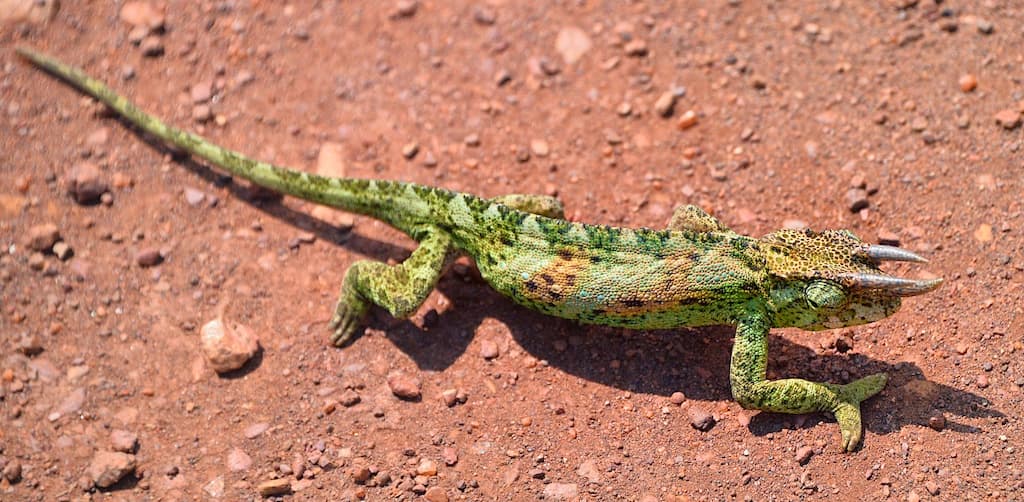
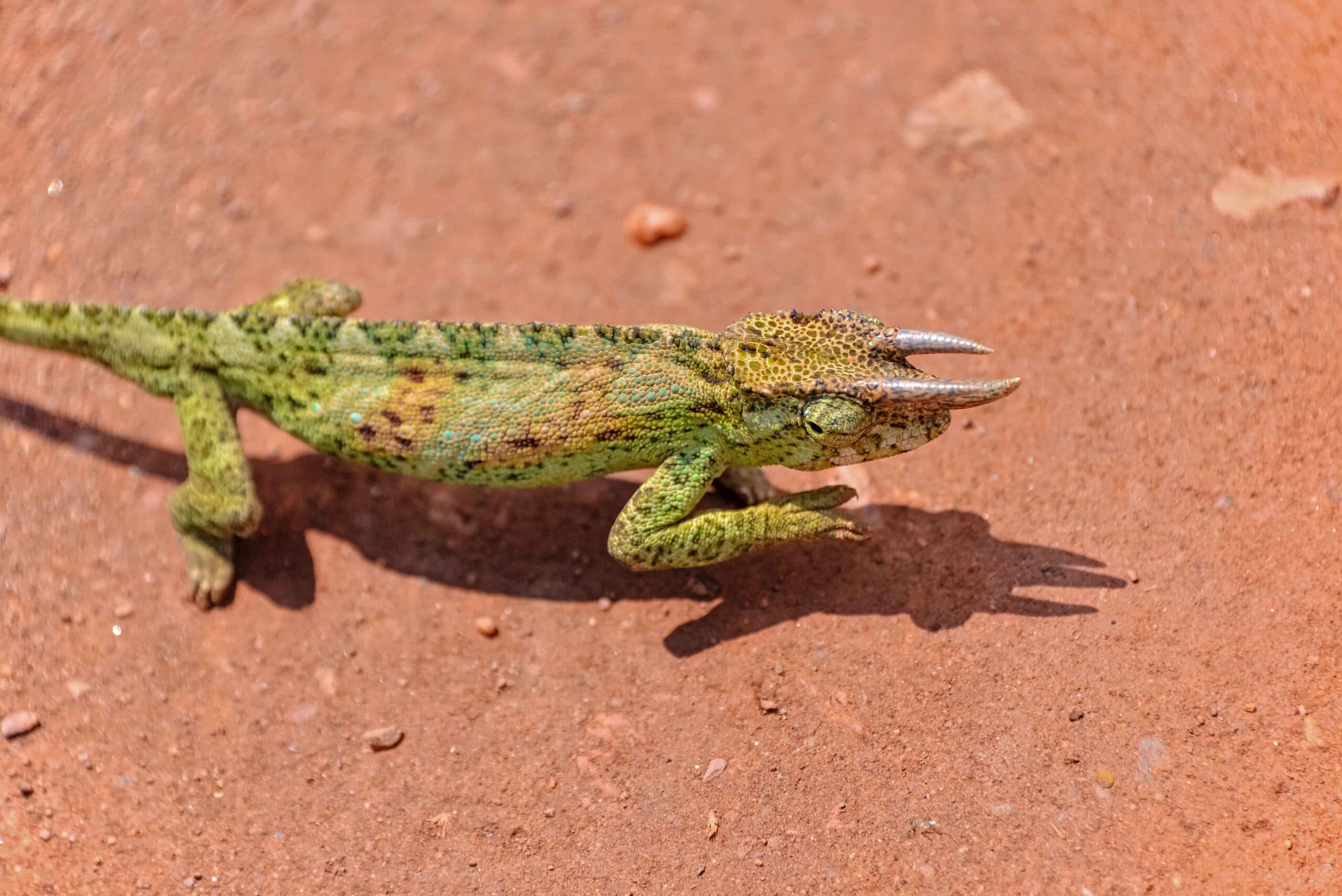
A mountain chameleon with a remarkable silhouette
Jackson’s Chameleon (Trioceros jacksonii) is a living East African lizard best known for the three forward-pointing horns carried by many adult males. Those horns create a miniature triceratops-like outline, but this animal is a modern chameleon, not a relic from prehistory. It belongs to Chamaeleonidae and shares the family’s independently moving eyes, grasping feet, prehensile tail, laterally compressed body, and rapidly projecting tongue. The species occurs naturally in cool, humid uplands of Kenya and Tanzania, while people have introduced it to several places outside that range, most famously Hawaii.
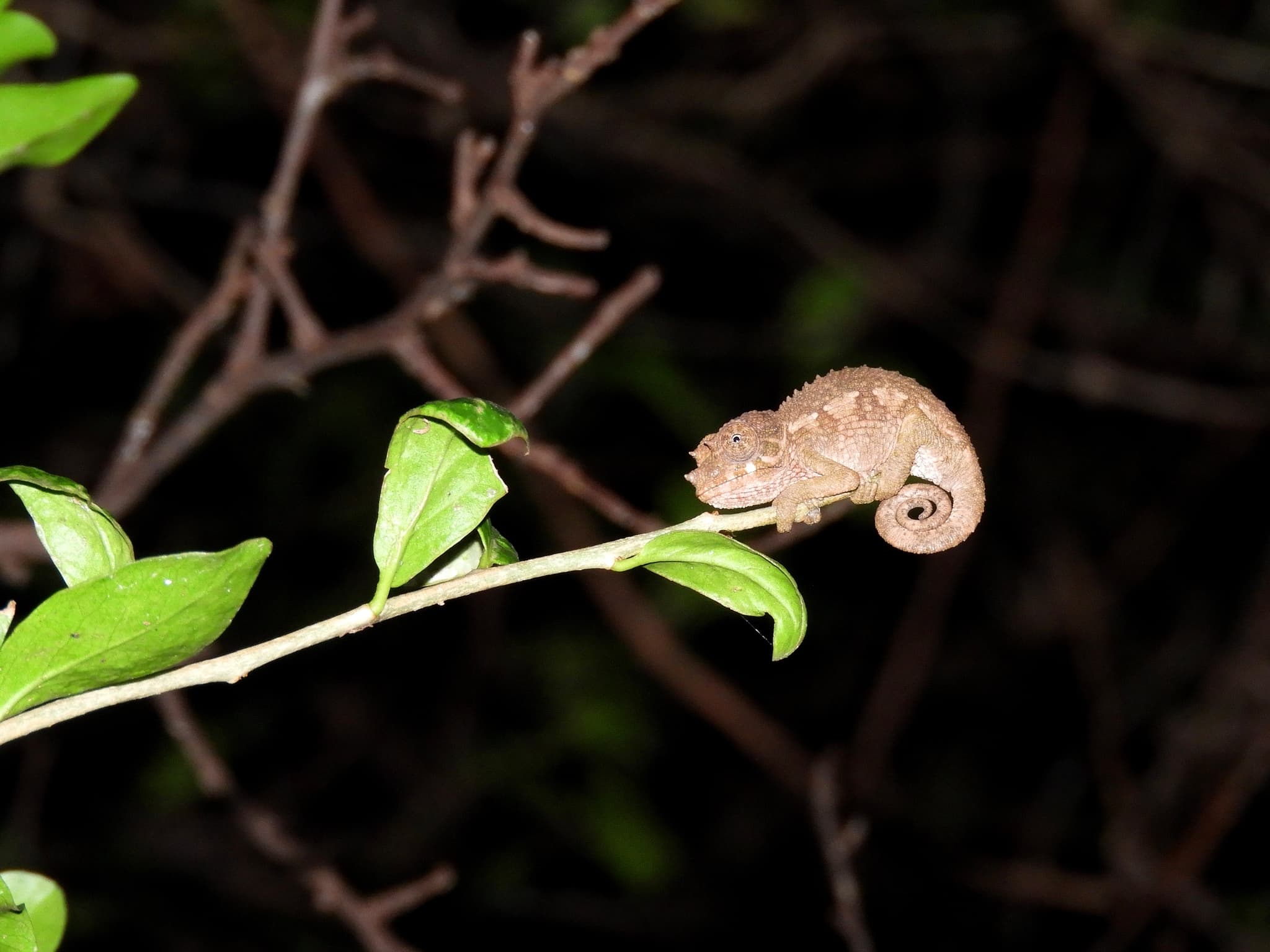
This profile covers the species as a whole. The Reptile Database recognizes three subspecies: T. j. jacksonii, T. j. merumontanus, and T. j. xantholophus. Horn size and body size vary among them, and females may have reduced horns or none at all. That variation matters when identifying photographs: a hornless individual can still be a Jackson’s Chameleon.
Body form, horns, and color
An adult male usually carries one horn on the snout and a pair above the eyes. These bony, keratin-covered structures are used mainly in contests with other males. Rivals display, push, and sometimes try to dislodge one another from branches. Females generally have much smaller horns, and some appear hornless. A serrated crest runs along the back, while the tail coils tightly around twigs as a fifth point of support.
Jackson’s Chameleons are often green, but individuals can shift through olive, yellow-green, brown, gray, and darker tones. Color change does not simply copy the background. Temperature, light, health, stress, courtship, and social signals all affect the skin’s appearance. The turret-shaped eyes can scan different directions before both aim toward prey. Zygodactyl feet group the toes into opposing bundles, giving the animal a firm grip on narrow vegetation.
Native range and preferred habitat
The native range lies in East Africa, principally the highlands of Kenya and northern Tanzania. Jackson’s Chameleons favor moist montane forest, forest edges, thickets, hedges, gardens, and other places with layered shrubs or small trees. They are arboreal and usually move slowly through vegetation rather than spending long periods on open ground. Cool nights, regular moisture, and access to leaves that catch rain or dew suit their physiology.
Introduced populations are well established in Hawaii. The Hawaii Invasive Species Council explains that animals released through the pet trade have spread in forested and residential areas and can prey on native invertebrates, including rare snails. Introduced records also exist in parts of the continental United States, but presence does not make the species native. Moving chameleons between islands or releasing pets can enlarge ecological damage and is restricted by local rules.
Hunting and diet
This chameleon is primarily an ambush predator of invertebrates. It advances with a rocking gait, pauses, and watches with mobile eyes. Once a target is judged to be within range, the animal anchors its feet and tail, aligns both eyes, opens its mouth, and launches a sticky-tipped tongue. The strike can be completed in a fraction of a second. Insects and other arthropods dominate the diet, although a large individual may take small vertebrates when an opportunity arises.
Rather than drinking from a bowl in the wild, Jackson’s Chameleons commonly lap droplets from leaves after rain or condensation. Their slow movement helps them remain inconspicuous, but it does not mean they are inactive. They patrol feeding routes, defend useful perches, bask when conditions allow, and retreat into foliage when heat, predators, or rivals become threatening.
Daily behavior and communication
Jackson’s Chameleons are mainly active by day and usually solitary. Visual signals carry much of their social information. An animal may flatten its body, brighten or darken, expose its flank, gape, bob, or sway. A male approaching another male can trigger an escalating display and horn-to-horn shoving. Courtship also depends on posture and color, while a female that is unreceptive can respond aggressively.
At night the lizard sleeps on vegetation, often becoming paler. Its grip and coiled tail reduce the chance of falling. Birds and snakes are likely predators in the native range, and introduced mammals can add pressure elsewhere. Camouflage, slow deliberate movement, a narrow body profile, and the ability to move around a branch all help the chameleon avoid detection.
Reproduction and development
Unlike many chameleons that lay eggs, Jackson’s Chameleon gives birth to live young. More precisely, embryos develop inside membranes within the female, and newborns emerge enclosed in thin sacs that they quickly break. A litter can contain roughly a dozen to several dozen young, with size influenced by the female, subspecies, and conditions. Newborns are independent and begin hunting tiny invertebrates soon after birth.
Pregnancy lasts for several months. Females can store sperm, so one mating may contribute to later litters. Young chameleons face dehydration, temperature extremes, and predators, and only some survive to maturity. Growth and reproductive timing vary across the species’ elevational range, which is one reason a single rigid schedule should not be applied to every wild population.
Conservation, invasion, and responsible observation
The species is listed in CITES Appendix II, meaning international trade is controlled to prevent commerce from threatening wild populations. It is also assessed globally as Least Concern, but that category does not remove local concerns about habitat change or collection. Trade should come from legal, traceable sources, and wild animals should be left where they are.
Outside East Africa, the conservation question is different. In Hawaii, Jackson’s Chameleons are invasive predators. They consume insects and snails that evolved without them, and collecting or transporting animals is regulated. A well-intentioned release can establish a population, spread disease, and harm native species. Anyone who encounters one should follow local wildlife guidance rather than moving it.
Observe wild chameleons without touching, posing, or crowding them. Their feet and tail are adapted for branches, and forced handling causes stress. A respectful photograph shows the animal in place, preserves its escape route, and avoids breaking vegetation. These simple choices protect both the chameleon in its native habitat and vulnerable wildlife where it has been introduced.