
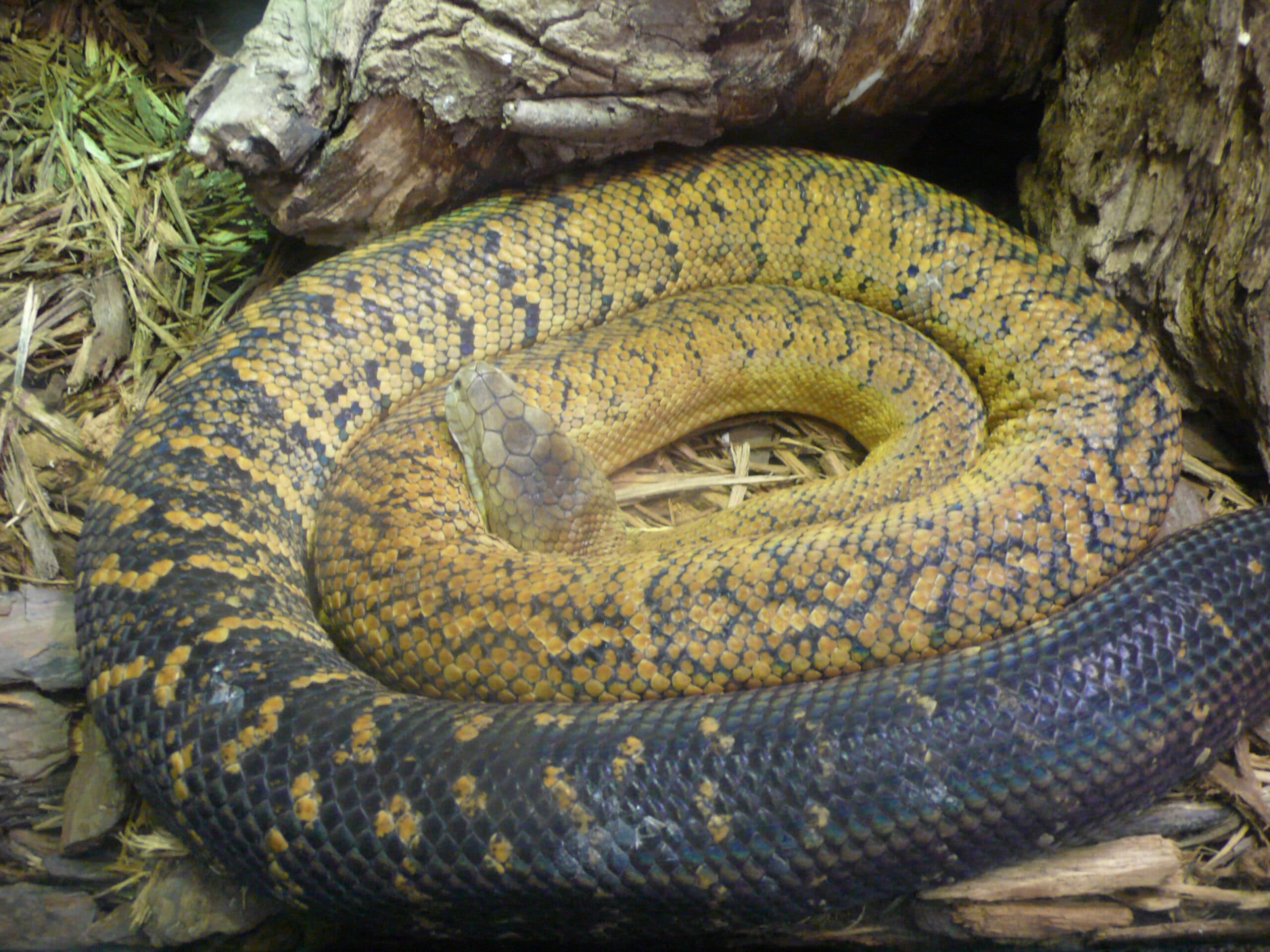
Jamaica’s largest native land predator
The Jamaican Boa (Chilabothrus subflavus) is a living, nonvenomous snake found naturally nowhere outside Jamaica. It is also called the yellow snake, Jamaican yellow boa, or nanka. The species belongs to the family Boidae and kills prey by constriction. Adults can become large and powerfully built, yet their ecological role is easily misunderstood: rather than threatening people, they hunt rats, bats, birds, and other small animals in forests and wooded landscapes.
Older references place the species in Epicrates, so the name Epicrates subflavus still appears in photographs and historical research. Current taxonomic sources, including ITIS and the Reptile Database, accept Chilabothrus subflavus. It is a distinct species and no subspecies are currently recognized.
Color, size, and identification
Jamaican Boas change markedly as they grow. Young snakes tend to be golden or tan with darker crossbands and blotches. Mature individuals can develop dark brown to nearly black areas, especially toward the rear, while yellow, orange, or olive markings remain along the body. Under suitable light the smooth scales can show an iridescent sheen. This combination of warm color and dark pattern explains the familiar name “yellow snake.”
The head is distinct from the neck, the body is muscular, and the pupils are vertical. Heat-sensitive pits along the lips help the boa detect warm prey in darkness. Adults commonly reach well over 1.5 metres, and exceptional animals approach or exceed 2 metres. Females tend to grow larger and heavier than males. Size reports vary among studies, so a single maximum should be treated cautiously.
Range and habitat across Jamaica
The species is endemic to Jamaica, including some nearby coastal islets. It occupies a surprisingly broad range of habitats where cover and prey remain available: wet and dry forest, limestone woodland, caves, rocky country, mangrove edges, plantations, and wooded farmland. Individuals may shelter in tree hollows, rock crevices, caves, or dense vegetation by day.
Habitat does not need to be untouched, but fragmentation makes movement riskier. Roads, settlements, and cleared land divide forests into smaller patches. Boas entering farms or villages are more likely to be killed, struck by vehicles, or attacked by dogs. Protecting connected woodland and safe cave systems therefore matters even where some agriculture remains.
Nocturnal hunting and diet
Jamaican Boas are mainly nocturnal and crepuscular. They climb well, travel on the ground, and investigate caves. A hunting snake may wait beside a regular animal route or actively search through branches and crevices. Once it seizes prey, it wraps muscular coils around the animal and constricts until circulation stops, then swallows the prey whole.
Documented foods include rodents, bats, birds, and lizards. Cave entrances can offer particularly rich feeding opportunities because bats leave along predictable flight paths. Juveniles take smaller prey than adults. By consuming introduced rats as well as native animals, the boa occupies a high trophic position and can influence several parts of Jamaica’s food web.
Behavior, senses, and daily shelter
The snake relies on chemical cues gathered by its forked tongue, vision, vibration, and heat-sensitive facial pits. These senses work together in dim forest and cave conditions. Jamaican Boas usually avoid confrontation with people. A cornered or captured snake may hiss, strike, or bite, but it has no venom. Leaving it an escape route is safer for both the animal and the observer.
Young boas are often more arboreal, using shrubs and trees to find birds and lizards. Large adults still climb but may spend more time on the ground. Their strong bodies and prehensile tails provide support among branches. They are generally solitary outside courtship, and a resting coil should not be mistaken for inactivity: the snake conserves energy between feeding opportunities.
Reproduction and growth
Like other boas, the Jamaican Boa gives birth to live young rather than laying an external clutch of eggs. Mating is seasonal, and males locate receptive females using chemical cues. Embryos develop inside the female for several months. Litter size varies with female size and condition, and newborns are independent from birth.
Young snakes must quickly find small prey and secure hiding places. Growth depends on food, temperature, and health. Females invest heavily in reproduction and may not breed every year. Long life and relatively slow population replacement can make adult mortality especially damaging, because animals killed before reproducing are not rapidly replaced.
Conservation status and threats
The Jamaican Boa is classified as Vulnerable and is protected under Jamaican wildlife law. It is also listed in CITES Appendix I, which places strict controls on international commercial trade. Major pressures include forest loss and fragmentation, road mortality, deliberate killing, illegal collection, and predation by introduced mammals. Mongooses, cats, dogs, and pigs can kill young snakes or disturb shelter sites.
Fear remains a serious threat. People sometimes mistake the boa for a dangerous snake even though Jamaica has no native dangerously venomous land snake. Education, rapid response for snakes found near homes, and protection of forest corridors can reduce needless deaths. Captive assurance populations support conservation planning, but they cannot replace secure habitat and tolerant communities in Jamaica.
Living safely alongside the boa
A wild Jamaican Boa should be observed from a respectful distance. Do not pick it up, pin it, or pose it for photographs. Keep dogs away, give the snake room to leave, and contact Jamaican wildlife authorities or a trained local responder if it is trapped in a building or exposed to traffic. Never move a boa to another part of the island without official guidance.
The species is valuable precisely because it is a native predator. Protecting it also protects Jamaican forests, caves, bats, and many smaller animals that share the same habitat. Accurate identification and calm coexistence turn an encounter from a source of fear into evidence that an ancient island ecosystem still functions.