
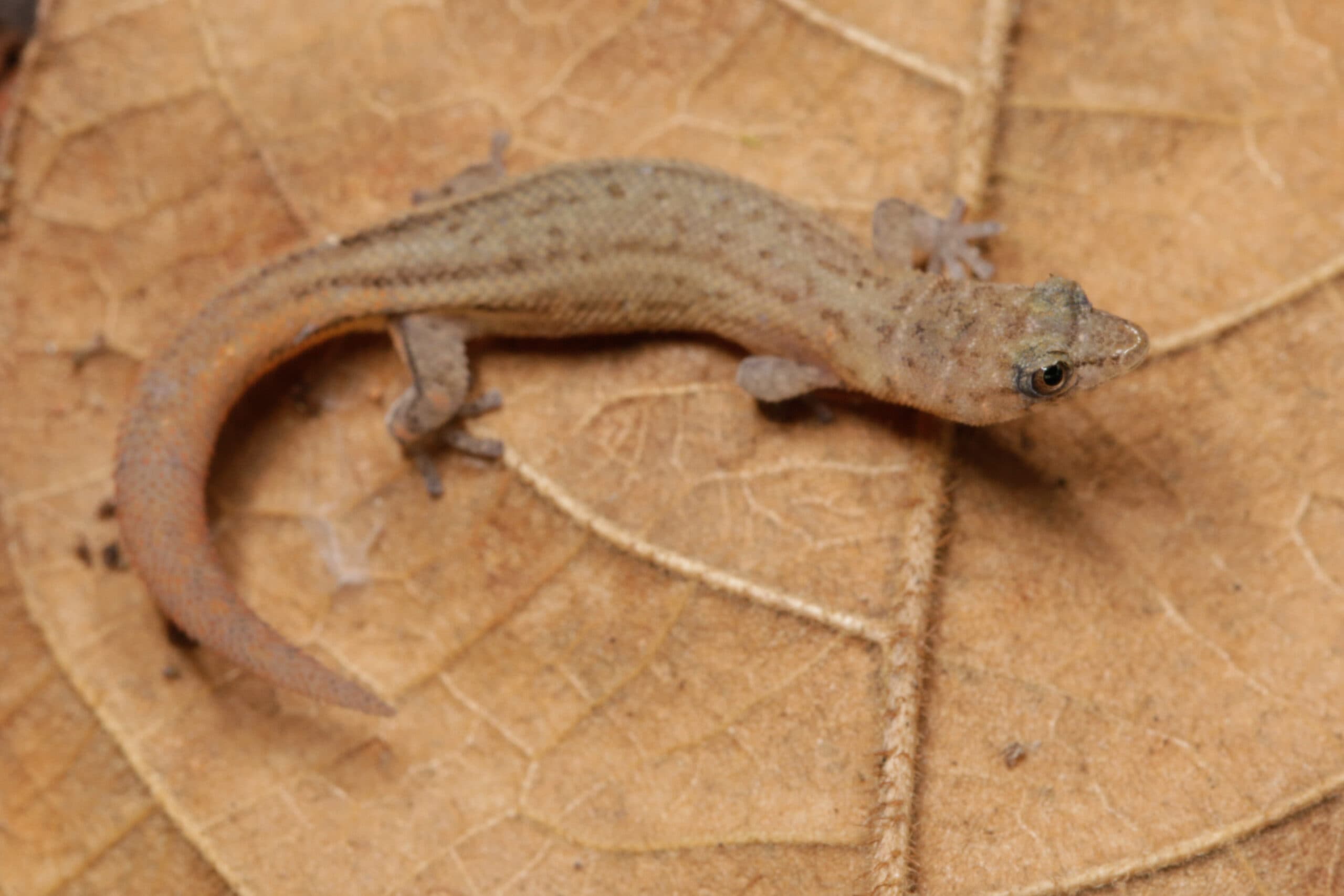
Jaragua Dwarf Gecko (Sphaerodactylus ariasae) is one of the smallest known amniote vertebrates. Adults occupy dry-forest leaf litter on the Barahona Peninsula and Beata Island, yet their tiny bodies make them vulnerable to heat and water loss. The species is locally common, protected within Jaragua National Park and currently assessed as Least Concern, but its global range is exceptionally small. This guide separates well-supported biology from common assumptions and covers identification, range, habitat, diet, behavior, reproduction and conservation.
Identification
This gecko has a compact body, short limbs, a pointed snout and round pupils. Adults are brown to rusty tan with darker mottling that breaks up the outline against dry leaves. The head bears small scales and subtle pale marks, while the tail may show faint bands. Because several Sphaerodactylus species occur on Hispaniola, confident identification requires locality plus diagnostic scale and pattern characters rather than body size alone. Females average slightly larger than males in the original species series; sex is difficult to judge without close specialist examination.
Identification should combine body shape, markings, size, voice or movement, and location. One feature by itself can overlap with a related animal, a juvenile, or an individual in unusual light.
Photographs are most useful when they preserve scale and show several diagnostic features. Handling or repositioning a wild jaragua dwarf gecko for identification can cause stress and is unnecessary.
Size and physical adaptations
Jaragua Dwarf Gecko typically measures adult snout-to-vent length about 14–18 mm and weighs about 0.13 g for a typical adult. Measurements normally exclude the tail. The species is among the smallest known reptiles, but individuals and measuring methods vary.
Its useful adaptations include extremely small body allows use of narrow litter spaces, cryptic brown pattern matches fallen leaves, adhesive toe structures aid climbing over rough surfaces, tail can be shed to distract a predator, eyes support visually guided daytime foraging, behavioral use of shade limits overheating, eggs are placed in protected humid microhabitats. These traits work together in the animal’s normal setting rather than serving as isolated curiosities.
Published measurements may use different methods, life stages or sample locations. Comparing figures responsibly means checking what was measured rather than selecting the largest number available.
Range and distribution
Known only from the extreme southwest of the Dominican Republic, including the southern Barahona Peninsula and nearby Beata Island. The IUCN assessment estimated an extent of occurrence of roughly 86 square kilometres. Records fall within and around Jaragua National Park, and the species is not native to any other country. The native range includes Dominican Republic.
A country-level map indicates broad distribution, not continuous occupation. Climate, elevation, water, vegetation, prey, breeding sites, barriers and survey effort all affect where records occur.
Records near the edge of the range deserve careful documentation because they may reflect natural movement, improved survey coverage, accidental transport or a genuine distribution change.
Habitat
Dry limestone forest, xeric scrub and forest patches where leaf litter accumulates over karst rock.
Individuals shelter and forage beneath fallen leaves, small stones, bark and other cover that preserves a cool, humid boundary layer. Shade pockets and litter depth are important because such a small reptile exchanges heat and water rapidly with its surroundings. Disturbed sites can still support the gecko where litter and cover remain, but broad maps cannot show the tiny humid refuges it actually uses. Protecting a population therefore requires the feeding, shelter and breeding features that make a site usable, along with connections that allow movement.
Microhabitat matters. Shade, soil, current, moisture, shelter or host plants can determine whether a small area is usable even when the surrounding landscape appears suitable.
Diet and feeding
Jaragua Dwarf Gecko is a tiny invertebrate predator. Important foods include springtails, mites, small insects, minute spiders, insect larvae, other leaf-litter arthropods. Direct field diet data are limited, so prey lists should be understood as the kinds of suitably small arthropods taken by dwarf sphaerodactyl geckos rather than a complete quantified menu. The gecko searches visually through litter and makes short lunges at prey. Its minute gape restricts it to animals that larger lizards often overlook, placing it in a fine-scale food web among fungi, decomposers and litter predators.
Diet changes with age, season, location and food supply. A dramatic prey record does not establish what most individuals eat most of the time; repeated field observations provide a stronger picture.
Feeding opportunities also create risk. An animal focused on prey may be less alert to predators, traffic or people, while contaminated prey can transfer pollutants through the food web.
Behavior and communication
Primarily active by day within shaded leaf litter, with activity constrained by heat and dryness. The Jaragua Dwarf Gecko lives at ground level and usually remains concealed beneath cover. It moves in short bursts, pauses to scan and can slip into cracks too narrow for most predators. When threatened it may flee deeper into litter or shed its tail. Individuals are not known to form stable social groups, and encounters probably center on feeding areas, shelter and reproduction.
Species-specific communication has not been studied in detail. Like related geckos, it probably relies on close-range visual posture, scent and touch. Chemical cues can identify conspecifics and reproductive condition, while body position helps regulate encounters in confined litter spaces. Claims about calls or elaborate displays would require direct observation. Behavior should be interpreted in context: alarm, courtship, feeding and temperature regulation can produce very different actions from the same animal.
Daily schedules are flexible responses, not rigid rules. Weather, breeding condition, disturbance, tides or food can move activity into a different part of the day.
Reproduction and development
The species is oviparous, but detailed breeding-season and courtship studies are scarce. Female sphaerodactyl geckos typically produce a single proportionally large, hard-shelled egg and may lay repeated clutches when conditions are favorable. The egg must be placed in a protected site where temperature and humidity remain suitable. No parental care has been documented after laying. Usually one egg, following the typical pattern for Sphaerodactylus The embryo develops in a shelled egg hidden in litter or a crevice. A hatchling emerges as a tiny independent version of the adult and must immediately find minute prey while avoiding dehydration and predators. Direct studies are needed to document growth rate, clutch frequency and seasonal timing for this species.
Young animals face different risks and may use different microhabitats or food than adults. Breeding success depends on adult condition, suitable sites and the survival of offspring through vulnerable early stages.
Counts of eggs or young describe reproductive output, not the number expected to reach adulthood. Mortality is normally greatest during eggs, larval or juvenile stages.
Predators and ecological role
The gecko transfers energy from minute arthropods to larger litter predators and is part of the diverse endemic reptile community of southwestern Hispaniola. Its presence shows that dry forest is not uniformly dry: small patches beneath leaves can retain the moisture needed by tiny vertebrates. Because its entire range is compact, wildfire, litter removal or severe habitat change could affect a substantial share of the species even though it remains locally common. Documented or likely predators include Small Snakes, Larger Lizards, Ground-foraging Birds, Spiders, Human.
This animal is both a consumer and a food source. Its influence comes through many repeated interactions, so ecological claims should be based on measured populations rather than assumptions drawn from appearance.
Predator and prey relationships differ among places. A species can be ecologically influential without being abundant everywhere, and its role can change across its range.
Relationship with people
The species was named in honor of Dominican conservationist Yvonne Arias. Its discovery drew attention to the lower size limit of land vertebrates and to the biological importance of Jaragua National Park. Responsible research uses permits and minimizes litter disturbance because turning cover can expose animals and eggs to sun and drying.
This tiny gecko is harmless to people. Observe without collecting, digging through litter or removing cover. Replace any accidentally moved leaf or stone exactly as found, clean footwear to avoid moving organisms between sites and follow Dominican protected-area rules. Photographs with a scale are more useful than handling. Responsible observation means keeping an appropriate distance, avoiding capture or feeding, protecting habitat and following local wildlife or invasive-species guidance.
Wildlife guidance should come from the responsible local agency because collection rules, reporting requests and appropriate responses differ between native and introduced ranges.
Conservation
The IUCN assessed Sphaerodactylus ariasae as Least Concern because it was locally common, appeared stable, tolerated some disturbance and occurred in Jaragua National Park. The assessment also notes the very small range and calls for better information on distribution, abundance and trends. The reported global trend is Stable in the most recent IUCN assessment, though current monitoring is limited.
Important pressures include wildfire in dry forest, clearing and habitat conversion, loss of shaded leaf litter, climate-driven heat and drought, illegal collection, very restricted global range. Global status can hide local decline or recovery, so current regional monitoring and habitat management remain necessary.
The most useful conservation action follows the documented pressure. Protecting breeding sites, reducing road deaths or limiting pollutants can require different tools in different populations.