
Home/Animals/Arachnida/Joro Spider
Species profileIUCN: NE

Joro Spider

Trichonephila clavata

A large East Asian orb-weaver whose golden webs now also occur across parts of the eastern United States.

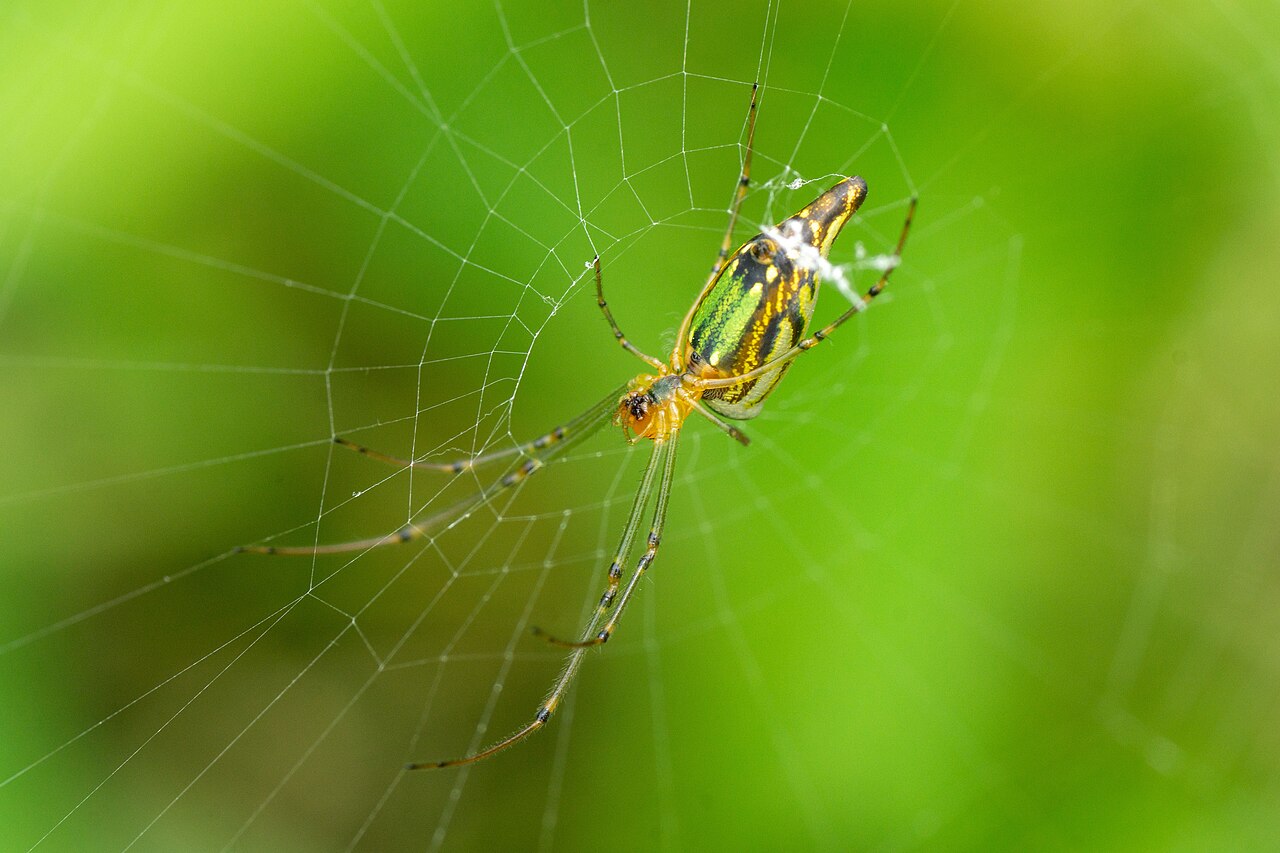
Adult female Joro spider resting at the center of her web
Ummigarba / Wikimedia Commons / CC BY-SA 4.0
🌐 Read in Language:

⚡ At a Glance

Species profile
Also Known As
Jorō spider
Diet Category
Insectivore
Activity Rhythm
Web-based ambush predator
Wild Lifespan
One annual generation; adults die after the autumn breeding season in the documented U.S. range
Typical Weight
No dependable standard adult mass is available
Conservation Status
NE
💡 Key Biological Insight: Tiny spiderlings disperse on wind-carried silk, but adult Joro spiders do not fly

🌳 Scientific Taxonomy Hierarchy

The Joro spider is a golden orb-weaver in the family Araneidae and genus Trichonephila.

KingdomAnimalia
PhylumArthropoda
ClassArachnida
OrderAraneae
FamilyAraneidae
GenusTrichonephila
SpeciesTrichonephila clavata

Distinguishing Anatomical Features

  • ✓Adult females have a yellow and blue-gray banded abdomen with red markings below
  • ✓Long black legs carry yellow-orange bands
  • ✓Females construct large golden orb webs with surrounding barrier silk
  • ✓Adult males are much smaller and less colorful than females

📏 Physical Measurements

Total LengthFemale body up to about 1 in; leg span up to about 4 in
Body WeightNot well standardized
Tail LengthNot applicable
WingspanNot applicable
Top SpeedNo dependable maximumThe species primarily waits in an orb web rather than pursuing prey over distance.

🎨 Appearance & Distinctive Markings

YellowBlue-grayBlackRedOrangeSilver

Skin / Covering: Chitinous exoskeleton with fine hairs

Sexual Dimorphism: Females are dramatically larger and more brightly colored than males.

🗺️ Geographic Distribution & Habitat

Native to East Asia and introduced to the United States, where verified records continue to expand.

Forest edges, gardens, parks, roadsides and built environments with open gaps suitable for large orb webs.

Country-level distribution map

Native rangeIntroduced range
FijiTanzaniaWestern SaharaCanadaUnited States — Introduced rangeKazakhstanUzbekistanPapua New GuineaIndonesiaArgentinaChileCongo - KinshasaSomaliaKenyaSudanChadHaitiDominican RepublicRussiaBahamasFalkland IslandsNorwayGreenlandFrench Southern TerritoriesTimor-LesteSouth AfricaLesothoMexicoUruguayBrazilBoliviaPeruColombiaPanamaCosta RicaNicaraguaHondurasEl SalvadorGuatemalaBelizeVenezuelaGuyanaSurinameFranceEcuadorPuerto RicoJamaicaCubaZimbabweBotswanaNamibiaSenegalMaliMauritaniaBeninNigerNigeriaCameroonTogoGhanaCôte d’IvoireGuineaGuinea-BissauLiberiaSierra LeoneBurkina FasoCentral African RepublicCongo - BrazzavilleGabonEquatorial GuineaZambiaMalawiMozambiqueEswatiniAngolaBurundiIsraelLebanonMadagascarPalestinian TerritoriesGambiaTunisiaAlgeriaJordanUnited Arab EmiratesQatarKuwaitIraqOmanVanuatuCambodiaThailandLaosMyanmar (Burma)Vietnam — Native rangeNorth KoreaSouth Korea — Native rangeMongoliaIndia — Native rangeBangladeshBhutanNepal — Native rangePakistanAfghanistanTajikistanKyrgyzstanTurkmenistanIranSyriaArmeniaSwedenBelarusUkrainePolandAustriaHungaryMoldovaRomaniaLithuaniaLatviaEstoniaGermanyBulgariaGreeceTürkiyeAlbaniaCroatiaSwitzerlandLuxembourgBelgiumNetherlandsPortugalSpainIrelandNew CaledoniaSolomon IslandsNew ZealandAustraliaSri LankaChina — Native rangeTaiwan — Native rangeItalyDenmarkUnited KingdomIcelandAzerbaijanGeorgiaPhilippinesMalaysiaBruneiSloveniaFinlandSlovakiaCzechiaEritreaJapan — Native rangeParaguayYemenSaudi ArabiaCyprusMoroccoEgyptLibyaEthiopiaDjiboutiUgandaRwandaBosnia & HerzegovinaNorth MacedoniaSerbiaMontenegroKosovoTrinidad & TobagoSouth Sudan
Highlighted countries are recorded profile locations, not precise biological range boundaries.Map boundaries: Natural Earth

💡 Did You Know?

  • 💡Golden orb silk intercepts flying insects
  • 💡Barrier silk helps protect the central orb
  • 💡Egg sacs protect embryos through winter
  • 💡Spiderlings use ballooning silk for dispersal

🌿 Conservation Status & Threats

IUCN: NE — NE

“The species has not been evaluated on the IUCN Red List.”

Population TrendUnknown globally; expanding in its introduced U.S. range
Wild Population EstimateNo global population estimate is available.

⚠️ Major Threats to Joro Spider

  • •Broad-spectrum pesticide exposure
  • •Local habitat alteration
  • •Killing driven by misinformation

🔄 Life Cycle & Reproduction

Wild vs. Captivity Lifespan Comparison

🌿 In the WildApproximately one year in its annual U.S. life cycle
🏠 In Captivity (with veterinary care)Not established as a standard companion species
Clutch / Litter SizeSeveral hundred eggs may be enclosed in one silk-covered sac
Incubation / GestationEggs overwinter and hatch in spring in the documented southeastern U.S. cycle
Fledging / WeaningSpiderlings disperse after emerging from the egg sac
Sexual MaturityLate summer to early autumn
Mating SystemMales court females on or near the female web
Nesting / Den TypeSilk-covered egg sac attached to a sheltered surface

🦅 Behavior & Field Ecology

Insectivore

🌐 Ecological Food Web & Relationships: Predator of flying insects and prey for birds and other insectivores.

Social Group SizeUsually one adult female per central orb, with nearby webs possible
Activity RhythmWeb-based ambush predator by day and night
Feeding StrategyInsectivore

🥩 Primary Prey & Preferred Diet

✓ Moths✓ Flies✓ Beetles✓ Wasps✓ True bugs

📢 Communication & Territorial Signals

  • Web vibrations during prey detection
  • Courtship vibrations
  • Chemical cues

🐾 Wild Temperament & Traits

• Shy• Reluctant to bite• Web-oriented

🤝 Human Interaction & Pet Advisory

⚠️ Strictly Wild Species
🚫

Can You Keep a Joro Spider as a Pet?

Best observed in the wild rather than handled.

Domestication StatusWild and not domesticated
Danger to HumansLow medical significance
Economic & Ecotourism RoleEcological research, public education and citizen-science value.

⚠️ Behavioral Risk Factors & Wildlife Safety

  • A defensive bite is possible if the spider is trapped or handled, but extension sources describe bites as uncommon and venom as not medically important

🌐 Ecological Food Web & Relationships

🦅 Natural Predators (3)

Insect-eating birdsAves
Predatory waspsHymenoptera
LizardsSquamata

🧬 Related Species (2)

Golden Silk Orb-WeaverTrichonephila clavipesRelated native orb-weaver in the southeastern United States
Australian Golden Orb-WeaverTrichonephila edulisRelated golden orb-weaver

The Joro spider (Trichonephila clavata) is a large orb-weaver native to East Asia and introduced to the United States. Adult females are unmistakable at close range: their long black legs carry yellow-orange bands, while the cylindrical abdomen shows yellow and blue-gray bands above and a red marking below. Their impressive size and broad golden webs attract attention, but reliable extension guidance does not classify them as a medical danger to people.

How to identify a Joro spider

Adult females may reach about 25 mm (1 inch) in body length, with a leg span approaching 10 cm (4 inches). The upper abdomen is brightly patterned in yellow and blue-gray, the underside has a conspicuous red area, and the cephalothorax appears silver or gold because it is covered in fine hairs. Mature males are much smaller and less colorful, with a brown body and longitudinal markings. Juveniles also lack the full adult female pattern.

Size and color should be considered together. The native golden silk orb-weaver, Trichonephila clavipes, also builds large golden webs in the southeastern United States. Joros usually show distinct abdominal bands and may persist later into cool autumn weather. Photographs of both the upper and lower surfaces, plus the web and location, help specialists confirm a record.

Native and introduced range

The species is native to East Asia, including areas of China, Japan, Korea, Taiwan, and neighboring parts of the region. The University of Georgia records its first confirmed United States detection in northeastern Georgia in 2014. Established populations subsequently spread through parts of the Southeast and into additional eastern states.

Range reports change as people submit observations and researchers verify them. A single photographed spider outside the established range does not automatically prove a breeding population. The University of Georgia’s Joro Watch project and EDDMapS collect location records that help scientists map expansion.

Habitat and web

Joro spiders occupy forest edges, gardens, parks, roadsides, and built environments that offer attachment points for their webs. They often span gaps between trees, shrubs, utility structures, porches, and other supports. Their three-dimensional web system includes a large central orb surrounded by irregular barrier silk.

The silk can appear golden in sunlight. Large webs are strong enough to persist in exposed places and sometimes overlap with webs of other individuals. High local abundance can make a walkway or porch inconvenient, but the spider does not damage wood, buildings, or vegetation by feeding on them.

What Joro spiders eat

Joros are predators of flying and jumping arthropods that become trapped in the web. Moths, flies, beetles, wasps, true bugs, and other insects can be taken. The spider detects vibrations, approaches the prey, restrains it with silk, and uses venom during feeding.

Claims that Joros will control a major pest should be treated cautiously. They may catch individual invasive insects, including brown marmorated stink bugs or spotted lanternflies, but opportunistic web predation is not the same as population control. Their ecological effects in North America remain an active research question.

Life cycle and reproduction

In the southeastern United States, young spiders emerge in spring and grow through repeated molts during summer. Mature males appear before the much larger females reach full size. Males enter or remain near female webs and use carefully patterned vibration during courtship.

Females mature in late summer or early autumn and produce silk-covered egg sacs later in the season. A sac can contain several hundred eggs. Adults die as cold weather arrives, while the protected eggs overwinter and hatch the following spring. This produces one main generation per year in the introduced range documented by extension specialists.

How young Joro spiders disperse

Small spiderlings can release silk that catches moving air and carries them away, a common spider behavior called ballooning. News descriptions sometimes turn this into “flying spiders,” but Joros have no wings and adults do not fly. Ballooning mainly concerns tiny, lightweight young.

Natural dispersal is only part of their spread. Egg sacs or spiders may also be transported unintentionally on vehicles, cargo, outdoor equipment, and other objects. Checking movable outdoor items before long-distance travel can reduce accidental transport.

Are Joro spiders dangerous?

Joro spiders possess venom because it helps them subdue prey, but venomous does not mean dangerous to humans. Penn State Extension describes them as reluctant to bite and says their venom is weak and not medically important to people. A spider may defend itself if pressed against skin or trapped, so handling is unnecessary.

If a suspected bite causes significant pain, widespread swelling, breathing difficulty, or another severe reaction, seek medical advice. Those precautions apply to many stings and bites and do not mean Joros are aggressive. Most encounters can be managed by simply leaving the web alone or moving around it.

Ecological impact in North America

Joros are introduced in the United States, but researchers are still measuring their effects. Possible questions include competition with native orb-weavers, changes in insect predation, and whether birds or other predators incorporate Joros into their diets. Presence alone does not establish that a species is causing measurable ecological harm.

The careful answer is therefore neither “completely harmless to ecosystems” nor “certainly devastating.” Long-term surveys and experiments are needed. Reporting observations provides better evidence than repeating estimates about where the spider might eventually live.

Managing a web around a home

A web that does not obstruct people can be left in place. The spider will capture insects and its annual life cycle ends naturally. When a web blocks a doorway or other necessary route, remove it with a long broom or relocate the spider without touching it. Repeated removal early in web construction may encourage rebuilding elsewhere.

Broad insecticide spraying is rarely a good first response. It can kill non-target insects and spiders while offering only temporary relief. Seal gaps, reduce unnecessary night lighting near entrances, and remove webs from essential access points. Follow local extension advice if numbers create a specific management problem.

How to report a sighting

Take clear photographs without handling the spider. Record the date and precise location, and include an object for scale only when it can be placed safely. Submit the observation through Joro Watch, EDDMapS, or the reporting system recommended by your state extension service. Do not move a specimen to demonstrate the sighting.

Sources

❓ Frequently Asked Questions

Answers to frequently asked questions verified against peer-reviewed zoological research.

No serious medical danger is recognized. They are reluctant to bite, and extension specialists describe their venom as weak and not medically important to people.