
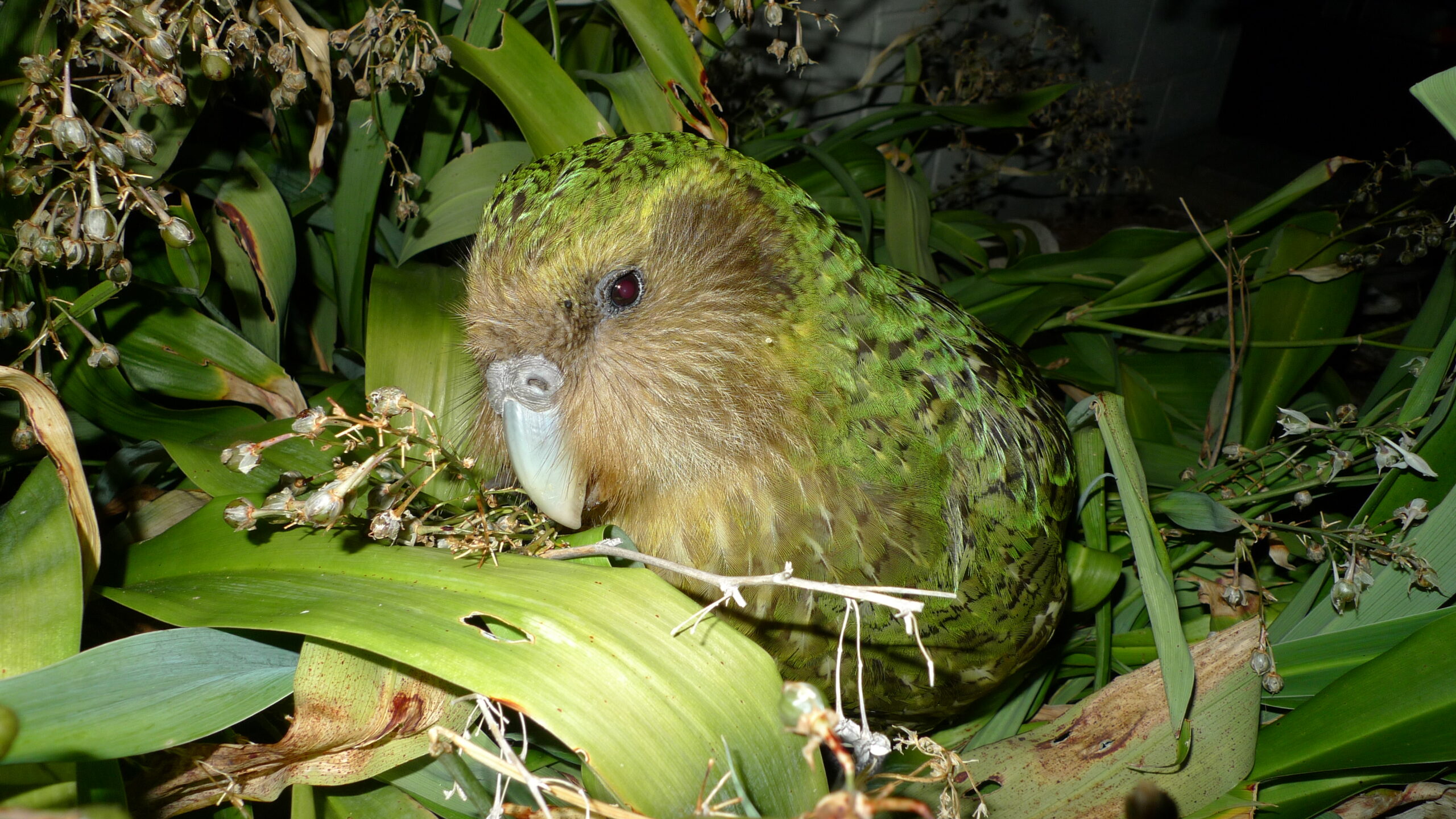
Kakapo (Strigops habroptilus) is a large moss-green parrot found only in Aotearoa New Zealand. It cannot fly, searches for plants at night and is the only known parrot with a lek mating system. Introduced mammalian predators nearly eliminated the species, but close cooperation among Ngāi Tahu, conservation staff, scientists and volunteers has rebuilt the managed population to 325 birds in 2026. This guide separates well-supported biology from common assumptions and covers identification, range, habitat, diet, behavior, reproduction and conservation.
Identification
A kakapo is a bulky, round parrot with soft yellow-green plumage mottled in black and brown, a pale owl-like facial disc, strong gray feet and a large ivory-colored bill. The wings and tail are short relative to its heavy body. Fine whisker-like feathers surround the bill. Males are noticeably larger and heavier than females. Males are substantially larger and heavier than females and develop especially large thoracic air sacs for booming displays.
Identification should combine body shape, markings, size, voice or movement, and location. One feature by itself can overlap with a related animal, a juvenile, or an individual in unusual light.
Photographs are most useful when they preserve scale and show several diagnostic features. Handling or repositioning a wild kakapo for identification can cause stress and is unnecessary.
Size and physical adaptations
Kakapo typically measures About 58–64 cm and weighs Females often 1.4–2.5 kg; males can reach about 4 kg. Body mass varies with sex, season, age and supplementary feeding; kakapo is the heaviest living parrot.
Its useful adaptations include powerful legs support long-distance walking and climbing, strong claws climb tall forest trees, mottled plumage camouflages birds on the forest floor, facial feathers help sense nearby objects at night, a finely ridged bill strips nutrients from fibrous plants, low-frequency booms carry over long distances. These traits work together in the animal’s normal setting rather than serving as isolated curiosities.
Published measurements may use different methods, life stages or sample locations. Comparing figures responsibly means checking what was measured rather than selecting the largest number available.
Range and distribution
Kakapo once occupied forests, shrublands and alpine areas across New Zealand’s main islands. The surviving population is intensively managed on predator-free offshore islands and within protected fenced sanctuaries. Sites have included Whenua Hou/Codfish Island, Pukenui/Anchor Island, Te Kākahu-o-Tamatea/Chalky Island, Hauturu-o-Toi/Little Barrier Island and trial or sanctuary locations chosen by the recovery programme. The native range includes New Zealand.
A country-level map indicates broad distribution, not continuous occupation. Climate, elevation, water, vegetation, prey, breeding sites, barriers and survey effort all affect where records occur.
Records near the edge of the range deserve careful documentation because they may reflect natural movement, improved survey coverage, accidental transport or a genuine distribution change.
Habitat
Native forest and regenerating shrubland on predator-free islands and fenced sanctuaries.
Kakapo travel on the ground along habitual tracks, shelter by day in dense vegetation, cavities or beneath roots, and forage after dark from the forest floor into tree canopies. Strong feet and claws allow them to climb rimu and other tall trees, while their wings provide balance and can support short controlled glides rather than powered flight. Protecting a population therefore requires the feeding, shelter and breeding features that make a site usable, along with connections that allow movement.
Microhabitat matters. Shade, soil, current, moisture, shelter or host plants can determine whether a small area is usable even when the surrounding landscape appears suitable.
Diet and feeding
Kakapo is a strict herbivore. Important foods include rimu fruit, native fruits and seeds, leaves and shoots, fern fronds, roots and tubers, bark, pollen and flowers. A kakapo crops plants with its bill and feet. When browsing tough leaves, it may draw a blade through the bill, crush it against the ridged upper mandible and suck out nutrients, leaving a fibrous crescent-shaped chew. Food use changes with season and place. Females depend strongly on energy-rich rimu fruit to feed chicks in major breeding years, and carefully controlled supplementary food supports selected birds.
Diet changes with age, season, location and food supply. A dramatic prey record does not establish what most individuals eat most of the time; repeated field observations provide a stronger picture.
Feeding opportunities also create risk. An animal focused on prey may be less alert to predators, traffic or people, while contaminated prey can transfer pollutants through the food web.
Behavior and communication
Nocturnal; rests during daylight and forages from dusk through the night. Kakapo are mostly solitary but maintain overlapping home areas and communicate with loud calls. They walk several kilometres, climb trees and freeze against vegetation when threatened. This stillness and camouflage once worked against native visual predators but provides little protection from scent-hunting cats, rats and stoats.
Males gather loosely at display sites and excavate shallow bowls linked by trimmed tracks. From a bowl, a male inflates his air sac and produces deep booms every few seconds, followed at times by metallic chings that help a female locate him. Birds also give loud skraarks and other contact, alarm and territorial calls. Behavior should be interpreted in context: alarm, courtship, feeding and temperature regulation can produce very different actions from the same animal.
Daily schedules are flexible responses, not rigid rules. Weather, breeding condition, disturbance, tides or food can move activity into a different part of the day.
Reproduction and development
Kakapo are lek breeders. Males advertise from display arenas but provide no parental care. Females may walk long distances to select a mate, then nest alone in a hollow tree, rock cavity, root shelter or similar protected site. Breeding is irregular and usually triggered by heavy fruiting of rimu or other key trees, often at intervals of two to four years. Usually 1–4 eggs, occasionally reported up to 5 The female incubates and leaves at night to feed. Newly hatched chicks are helpless and require warmth and frequent meals. Chicks fledge at roughly ten weeks, although the mother may continue feeding them for months. Recovery teams use remote nest monitoring, health checks, egg fostering, supplementary feeding or hand rearing when needed.
Young animals face different risks and may use different microhabitats or food than adults. Breeding success depends on adult condition, suitable sites and the survival of offspring through vulnerable early stages.
Counts of eggs or young describe reproductive output, not the number expected to reach adulthood. Mortality is normally greatest during eggs, larval or juvenile stages.
Predators and ecological role
Historically, kakapo browsed plants across a wide range of elevations and dispersed some native fruits and seeds. Its feeding leaves distinctive plant chews and helps move nutrients through forest habitat. Today every bird is valuable to population recovery, and managers must balance food, genetics, disease control, nesting success and the limited capacity of predator-free habitat. Documented or likely predators include Stoat, Feral Cat, Polynesian Rat, Ship Rat.
This animal is both a consumer and a food source. Its influence comes through many repeated interactions, so ecological claims should be based on measured populations rather than assumptions drawn from appearance.
Predator and prey relationships differ among places. A species can be ecologically influential without being abundant everywhere, and its role can change across its range.
Relationship with people
Kakapo is a taonga species to Ngāi Tahu. Its recovery is a partnership that combines mātauranga, field care, telemetry, veterinary work, genetics, supplementary feeding, nest monitoring and strict island quarantine. The public cannot visit kakapo in their protected habitats; support is best given through reputable conservation programmes and biosecurity compliance.
Do not attempt to locate or approach kakapo habitat without authorization. Predator-free islands use strict quarantine to prevent rodents, disease organisms, seeds and insects from arriving on people, equipment, food or aircraft. Responsible observation means keeping an appropriate distance, avoiding capture or feeding, protecting habitat and following local wildlife or invasive-species guidance.
Wildlife guidance should come from the responsible local agency because collection rules, reporting requests and appropriate responses differ between native and introduced ranges.
Conservation
Kakapo is Critically Endangered internationally and classified Nationally Critical in New Zealand. The official population reached 325 birds on 1 September 2026 after 90 chicks from the 2026 season became independent enough to join the tally. All birds still depend on predator-free habitat and active management, so the numerical gain does not remove the species from danger. The reported global trend is Increasing under intensive conservation management.
Important pressures include introduced mammalian predators, low genetic diversity and infertility, disease including aspergillosis, limited predator-free habitat, irregular breeding tied to mast fruiting, low egg fertility and hatching success. Global status can hide local decline or recovery, so current regional monitoring and habitat management remain necessary.
The most useful conservation action follows the documented pressure. Protecting breeding sites, reducing road deaths or limiting pollutants can require different tools in different populations.
