
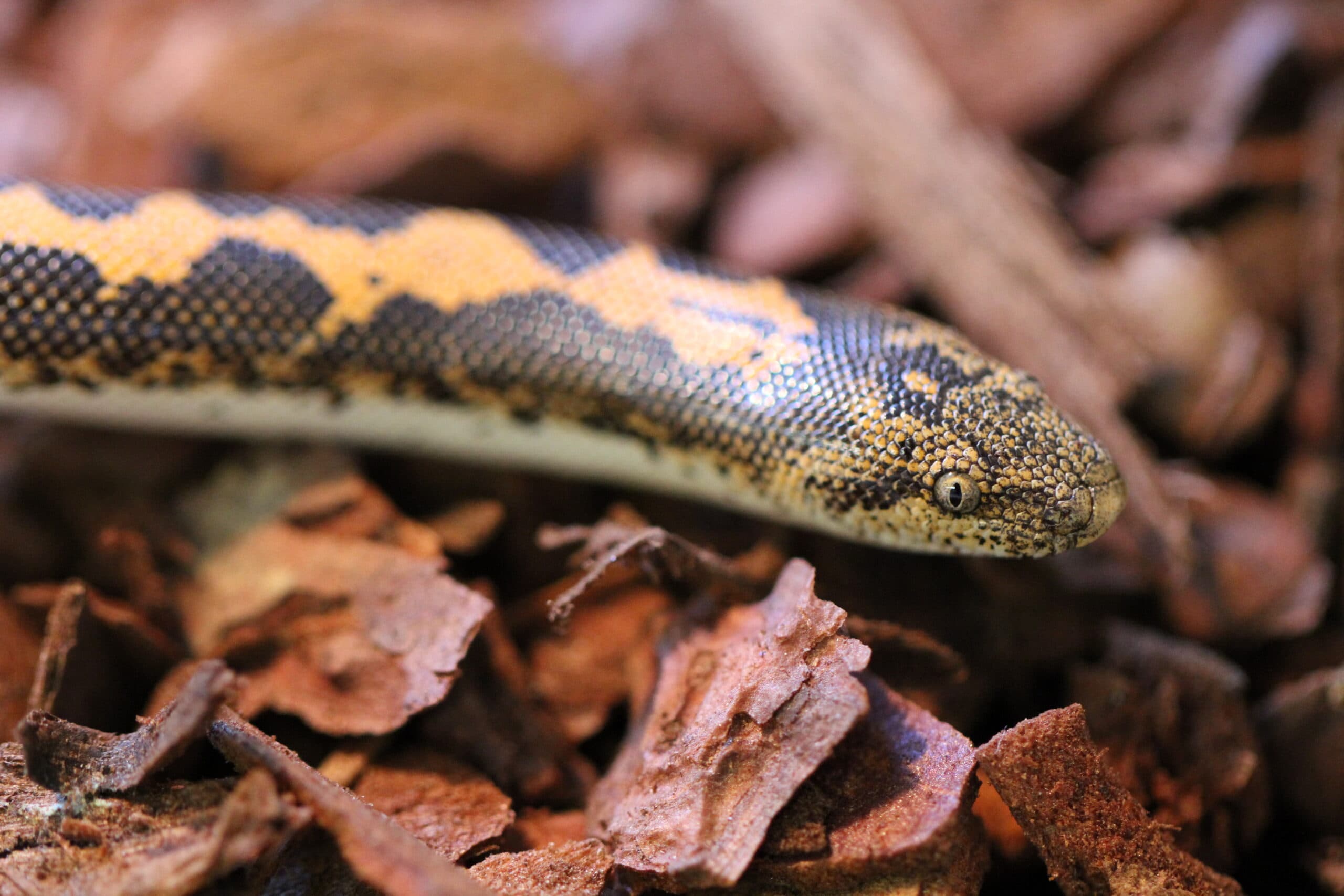
The Kenyan Sand Boa (Eryx colubrinus) is a compact, heavy-bodied snake built for moving through loose soil rather than racing across open ground. Its small eyes, wedge-shaped head, smooth scales, and short tail suit a life spent largely beneath sand or friable earth. Despite its familiar common name, the species ranges far beyond Kenya through parts of northeastern Africa. It is a living, nonvenomous member of the family Erycidae and is assessed as Least Concern, although its population trend is unknown.
Identity and classification
Eryx colubrinus belongs to a lineage commonly called sand boas. The Integrated Taxonomic Information System places it in the family Erycidae, while the Reptile Database provides the current species account and synonymy. Two subspecies are generally recognized: the nominate Eryx colubrinus colubrinus and Eryx colubrinus loveridgei. Older sources and animal collections may use the combination Gongylophis colubrinus, so readers can encounter both genus names in photographs and historical literature. This profile uses Eryx, following current database treatment.
The head is narrow and not strongly separated from the neck. A reinforced, shovel-like snout helps the snake press into loose substrate, while the eyes sit high on the head and can remain useful when much of the body is buried. The body is cylindrical and muscular, ending in a short, blunt tail. Color varies across the range and between individuals, but orange, tan, yellow, or brown areas commonly contrast with darker brown blotches. The belly is pale.
Range and habitat
The IUCN assessment records the species across a broad belt of northeastern Africa, including Chad, Djibouti, Egypt, Eritrea, Ethiopia, Kenya, Niger, Somalia, Sudan, and Tanzania. Reports from Yemen are uncertain and should not be treated as a confirmed part of the native range without stronger evidence. The snake occurs from sea level to roughly 1,500 metres and may form isolated local populations where appropriate soil occurs.
Its habitat is more varied than the word “sand” suggests. Records span savanna, shrubland, grassland, desert, open woodland, and some human-modified terrestrial settings. The important feature is often the ground itself: loose, diggable soil that allows the snake to conceal most of its body. Leaf litter, soft earth, and sandy patches can all provide cover. This close dependence on substrate helps explain why populations may be patchy even inside the species’ large geographic range.
Burrowing adaptations
A Kenyan Sand Boa typically advances below the surface by pushing its head and body through loose material. The smooth, tightly fitted scales reduce snagging, and the compact body supplies force in confined spaces. Burying offers several benefits at once. It hides the snake from predators, provides a concealed position from which to seize prey, and buffers the animal from the strongest swings in surface temperature and dryness.
The snake is not an earthworm-like tunnel builder. It usually displaces loose material around its body, leaving little open passage behind. When waiting to hunt, it may remain almost completely covered with only the eyes or snout exposed. This strategy conserves energy and makes camouflage as important as pursuit speed. The blunt tail can resemble the head at a glance, which may also confuse an attacker focusing on the exposed end of the body.
Diet and hunting
Kenyan Sand Boas are carnivores that take small vertebrates. Rodents are important prey for larger individuals, while young snakes may eat small lizards and very small mammals. The boa relies on concealment and a rapid strike at close range. It holds prey with its jaws, wraps muscular coils around it, and constricts. Constriction disrupts circulation quickly; the snake does not crush bones as a primary method and does not use venom.
Ambush hunting matches a habitat where prey may pass along the surface or move through shallow burrows. Chemical information collected by tongue-flicking helps the snake sample its surroundings. Its activity can shift with temperature, but it is often most active in the evening, at night, or during cooler periods. Long hidden intervals are normal for an animal whose survival depends on remaining unseen.
Reproduction and life cycle
Like many boas, Eryx colubrinus gives birth to live young rather than laying an external clutch of eggs. Fertilization is internal, and embryos develop inside the female before birth. Litter size varies with the female’s size, age, nutrition, and condition, so a single fixed number would be misleading. The newborns are independent and already equipped to burrow and capture appropriately small prey.
Most of the species’ life is solitary. Adults come together to mate, but they do not form lasting groups or provide extended parental care. Growth depends strongly on food availability and local conditions. Reliable wild longevity and age-at-maturity estimates are limited, and figures from captivity should not be presented as if they describe every wild population.
Ecological role and human encounters
As a predator of small mammals and reptiles, the Kenyan Sand Boa links ground-dwelling prey to larger predators that may eat snakes. Its concealed lifestyle means it can be present without being frequently observed. In agricultural or pastoral landscapes, consumption of rodents may provide a modest ecological benefit, although the snake should not be treated as a substitute for habitat-sensitive pest management.
The species is nonvenomous and generally poses little danger to people who leave it alone. A frightened or restrained snake can bite defensively, as almost any snake can, but its small size and secretive behavior make serious encounters unlikely. Wild animals should not be captured or handled. The international pet trade includes captive-bred Kenyan Sand Boas, yet responsible care requires legal sourcing, suitable temperature gradients, secure housing, appropriate substrate, and veterinary support.
Conservation
The IUCN Red List assesses Eryx colubrinus as Least Concern because of its wide distribution and lack of evidence for a rapid range-wide decline. That category does not mean every local population is secure. The assessment lists the overall population trend as unknown, and the species’ association with particular soils can leave colonies vulnerable to localized land conversion, intensive disturbance, road construction, or collection.
Good conservation decisions depend on protecting representative habitats across the range and improving field data on distribution and abundance. Correct identification also matters because older names and similar-looking sand boas can complicate records. Observations should document locality without exposing sensitive collecting sites, and photographs should avoid disturbing buried animals. Maintaining connected patches of suitable ground will help preserve both the snake and the small-animal communities on which it depends.