
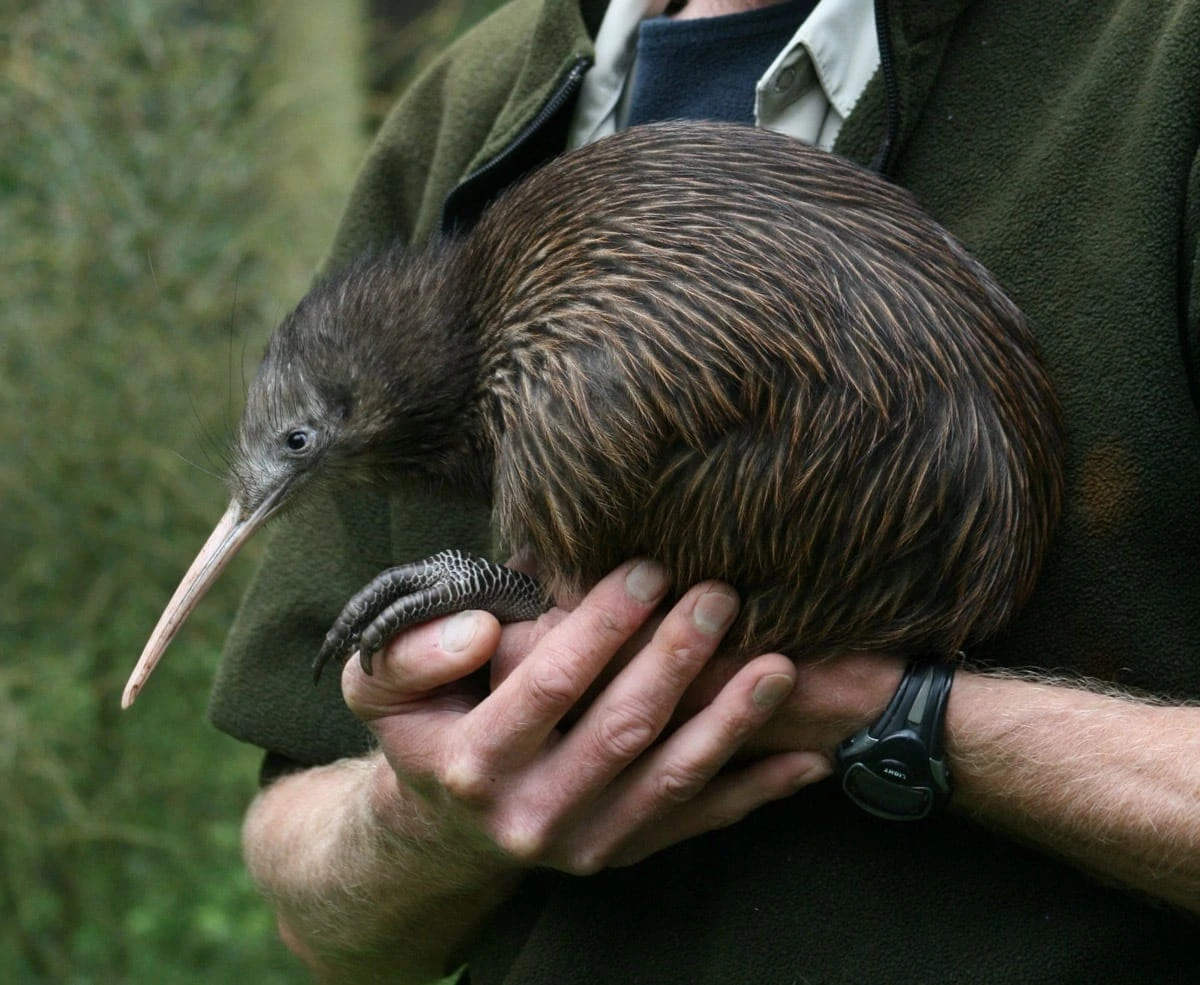
Kiwi birds are five living species of flightless, mostly nocturnal birds found only in New Zealand. Together they make up the genus Apteryx, the only living genus in the family Apterygidae and order Apterygiformes. “Kiwi” therefore names a group rather than one species, which is why size, egg laying, habitat and conservation status should not be reduced to a single set of numbers.
With shaggy hair-like feathers, strong legs, tiny hidden wings and nostrils near the tip of a long bill, kiwi look and behave unlike most familiar birds. They are also culturally important: kiwi are taonga to Māori and have become a national symbol of New Zealand.
The five living kiwi species
- North Island brown kiwi (Apteryx mantelli) lives in separated populations across the North Island.
- Great spotted kiwi or roroa (Apteryx haastii) is the largest kiwi and occurs in upland areas of the South Island.
- Little spotted kiwi (Apteryx owenii) is the smallest species. It disappeared from the mainland historically but survives on predator-managed islands and fenced sanctuaries.
- Rowi (Apteryx rowi) has its natural stronghold around Ōkārito on the South Island’s West Coast, with conservation populations established elsewhere.
- Tokoeka or southern brown kiwi (Apteryx australis) includes geographically distinct Haast, Fiordland and Rakiura forms.
Older sources may combine, split or name some forms differently. A careful kiwi profile should state which species or regional form a figure describes.
What does a kiwi bird look like?
Kiwi have rounded bodies covered in loose feathers without the smooth, interlocking appearance of a flying bird’s contour plumage. Their wings are extremely reduced and hidden beneath the feathers. They lack a visible external tail, and their dense bones and powerful legs suit a life spent walking, digging and defending territory on the ground.
The bill is long and slightly curved. Unusually for a bird, the external nostrils lie close to its tip. Sensory pits near the bill tip help kiwi detect small movements and vibrations in soil and leaf litter. Bristle-like feathers around the face provide additional tactile information in darkness.
Size varies by species and sex. Little spotted kiwi may weigh under 1 kilogram, while large female great spotted kiwi can exceed 3 kilograms. Females are generally larger and have longer bills than males. Presenting a single “kiwi weight” hides this variation.
Where kiwi birds live
Kiwi are endemic to New Zealand. Different species and managed populations occur across the North Island, South Island, Rakiura/Stewart Island, offshore islands and fenced mainland sanctuaries. They use native forest, scrub, tussock grassland, subalpine terrain, wetlands, plantation forest and rough farmland where shelter and food are available.
Most kiwi rest by day in burrows, hollow logs or dense vegetation and forage after dark. Rakiura tokoeka are a notable exception because they may also be active during daylight. Kiwi do not migrate over long distances, but individuals can maintain and patrol sizeable territories.
Diet and foraging
Kiwi probe soil, moss and leaf litter for earthworms, insect larvae, beetles, spiders and other invertebrates. They also eat fallen fruit, seeds and some plant material. Diet differs with habitat, species, season and local food supply, so “omnivore” is more accurate for the genus than a narrow insect-only label.
Smell is important, but kiwi do not forage by smell alone. Touch-sensitive structures at the bill tip help them locate prey below the surface. Small holes left by probing are a common sign of kiwi activity.
Calls, territories and social behaviour
Kiwi are often described as solitary, yet this oversimplifies their social lives. Many adults form long-term breeding pairs and defend territories using calls, scent and physical aggression. Male and female calls differ and can carry through forest at night.
Family behaviour also varies. Rowi juveniles may remain near their family, and Fiordland and Rakiura tokoeka can live in family groups whose older offspring help with incubation. These exceptions matter because they show why one life-cycle template does not fit all five species.
Kiwi eggs and reproduction
Kiwi are famous for laying very large eggs relative to the female’s body mass. The exact proportion varies by species and individual. Most species usually lay one egg in a nesting attempt, while North Island brown kiwi may lay two. Breeding timing and the number of clutches also differ.
Incubation is mainly or entirely performed by the male in several kiwi species. Rowi pairs share incubation, and some tokoeka family groups include helpers. Incubation is long for a bird, generally around 70–90 days depending on species and conditions.
Chicks hatch fully feathered with a large internal yolk reserve. They begin leaving the nest and finding their own food within days rather than being fed by their parents. That early independence does not make them safe: small chicks are extremely vulnerable to introduced predators.
How long do kiwi birds live?
Kiwi are slow-growing and long-lived. New Zealand’s Department of Conservation gives a broad lifespan of about 25–50 years. Actual survival depends on species, location and predator management. Dogs can sharply reduce adult survival, while stoats kill many young birds before they grow large enough to defend themselves.
Conservation status and population
There is no meaningful single conservation status for “the kiwi bird” because the page covers five species and multiple regional forms. New Zealand threat classifications range from recovering or conservation dependent to nationally endangered or nationally critical. International IUCN categories also differ by species and may not match New Zealand’s national system.
The Department of Conservation estimates roughly 70,000 kiwi remain across all species. This is a rounded group estimate, not a synchronized census. DOC also warns that unmanaged populations can decline by as much as about 2% per year, while predator-controlled populations can grow.
Stoats are a major cause of chick mortality on the mainland. Dogs can kill adult kiwi even without biting hard because the birds lack the protective flight-muscle structure of many other birds. Ferrets, cats, vehicle strikes, habitat change and the risks faced by very small isolated populations add further pressure.
How kiwi conservation works
Conservation combines trapping and poisoning introduced predators, dog control, habitat protection, fenced sanctuaries, predator-free islands, monitoring and community-led management. More than 90 community and iwi-led groups protect kiwi habitat alongside government programmes.
Operation Nest Egg removes vulnerable eggs or very young chicks, raises the birds in protected conditions and returns them when they are large enough to resist many stoat attacks. This is intensive work and does not replace landscape-scale predator control, but it has helped small populations recover.
Kiwi birds and people
Kiwi are protected wildlife and are not pets. Their nocturnal behaviour, territorial needs, specialist diet and conservation status require professional management. Visitors should use approved viewing facilities, keep dogs away from kiwi habitat and follow local access rules.
The word “Kiwi” is also used informally for New Zealanders, reflecting the bird’s place in national identity. For Māori, the relationship is deeper than a mascot: kiwi are taonga with cultural, spiritual and historical significance, and tangata whenua are essential partners in recovery work.
Frequently asked kiwi bird questions
Can kiwi birds fly?
No. All five living kiwi species are flightless and have extremely reduced wings hidden beneath their feathers.
Is kiwi one species?
No. “Kiwi” covers five recognized living species in the genus Apteryx.
Are kiwi birds nocturnal?
Most are mainly nocturnal, but activity varies. Rakiura tokoeka are well known for feeding during daylight as well as at night.
What do kiwi birds eat?
They eat earthworms, insect larvae and other invertebrates, along with fruit, seeds and some plant material.
Are kiwi birds endangered?
Threat status varies among species and regional forms. Some populations are recovering under intensive management, while others remain highly threatened.