
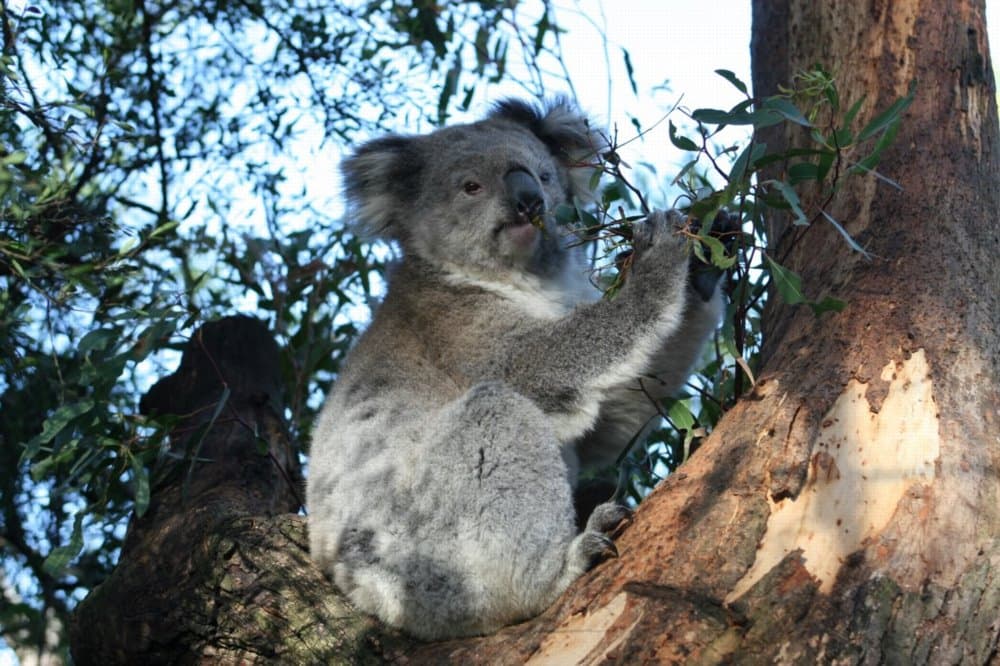
Koala (Phascolarctos cinereus) is the sole living member of the family Phascolarctidae and one of Australia’s most recognizable mammals. It is a marsupial rather than a bear. Koalas spend most of their time in eucalyptus trees, where they rest to conserve energy and selectively browse leaves. Their strong hands, rough pads and sharp claws support climbing, while a long digestive tract and specialized microbes help process a difficult diet. This guide separates well-supported biology from common assumptions and covers identification, range, habitat, diet, behavior, reproduction and conservation.
Identification
Koalas have a compact body, large rounded head, prominent black nose, fluffy ears and dense gray to brown fur with a pale chest. The tail is vestigial and not visible. Each forefoot has two digits opposed to the other three, giving a strong grip. On each hind foot the second and third toes are fused for grooming, while the large first toe opposes the others. Adult males are usually larger, have broader heads and develop a conspicuous scent gland on the chest. Females have a pouch and are generally lighter.
Identification should combine body shape, markings, size, voice or movement, and location. One feature by itself can overlap with a related animal, a juvenile, or an individual in unusual light.
Photographs are most useful when they preserve scale and show several diagnostic features. Handling or repositioning a wild koala for identification can cause stress and is unnecessary.
Size and physical adaptations
Koala typically measures About 60–85 cm and weighs Adults about 4–14 kg, varying with sex and latitude. Southern koalas are generally larger and have thicker, darker fur than northern animals.
Its useful adaptations include opposable digits grip branches, rough hand and foot pads improve traction, sharp curved claws support climbing, dense fur insulates and cushions the rump, large cecum supports microbial fermentation, low metabolic rate conserves energy, strong sense of smell helps assess leaves, specialized liver enzymes process plant chemicals. These traits work together in the animal’s normal setting rather than serving as isolated curiosities.
Published measurements may use different methods, life stages or sample locations. Comparing figures responsibly means checking what was measured rather than selecting the largest number available.
Range and distribution
Native to eastern and southeastern mainland Australia, from Queensland through New South Wales and the Australian Capital Territory into Victoria and southeastern South Australia. Koalas also occur on several islands, sometimes after historical introductions. Distribution is patchy because suitable food trees and connected woodland are unevenly available. The native range includes Australia.
A country-level map indicates broad distribution, not continuous occupation. Climate, elevation, water, vegetation, prey, breeding sites, barriers and survey effort all affect where records occur.
Records near the edge of the range deserve careful documentation because they may reflect natural movement, improved survey coverage, accidental transport or a genuine distribution change.
Habitat
Eucalyptus forests, open woodlands, riparian corridors and scattered feed trees in rural and urban landscapes.
A Koala home range contains favored food and shelter trees linked by ground routes. The animals often reuse particular trees, but must descend to move between isolated patches. Riparian trees and shaded gullies can provide cooler refuges during heat. Habitat quality depends on tree species, leaf moisture and chemistry, canopy cover, rainfall, disease and safe connections across roads and developed land. Protecting a population therefore requires the feeding, shelter and breeding features that make a site usable, along with connections that allow movement.
Microhabitat matters. Shade, soil, current, moisture, shelter or host plants can determine whether a small area is usable even when the surrounding landscape appears suitable.
Diet and feeding
Koala is a herbivore. Important foods include eucalyptus leaves, leaves of selected related trees, occasional bark or soil. Koalas choose among many eucalyptus species but typically rely on a small local set of preferred food trees. They smell and sample foliage, favoring leaves with a workable balance of water, protein, fiber and defensive chemicals. An adult may eat roughly half a kilogram of leaves daily. Powerful cheek teeth shear leaves before microbes in the enlarged hindgut ferment the fiber.
Diet changes with age, season, location and food supply. A dramatic prey record does not establish what most individuals eat most of the time; repeated field observations provide a stronger picture.
Feeding opportunities also create risk. An animal focused on prey may be less alert to predators, traffic or people, while contaminated prey can transfer pollutants through the food web.
Behavior and communication
Mostly nocturnal and crepuscular, with long resting periods to conserve energy. Koalas are usually solitary, though neighboring home ranges overlap and individuals communicate through scent and sound. They rest wedged in forks or along branches and become more active after dusk. Movement increases during the breeding season and when young animals disperse. Although capable climbers, they are vulnerable while crossing the ground between trees.
Adult males produce remarkably deep bellows, especially during the breeding season. A specialized vocal tract lowers the sound and advertises size to females and rivals. Koalas also grunt, snarl, squeak and wail during close encounters. Males rub the chest scent gland on trunks, while smell helps individuals recognize tree use and reproductive condition. Behavior should be interpreted in context: alarm, courtship, feeding and temperature regulation can produce very different actions from the same animal.
Daily schedules are flexible responses, not rigid rules. Weather, breeding condition, disturbance, tides or food can move activity into a different part of the day.
Reproduction and development
Breeding activity is strongest from spring into summer. Males roam and bellow while females may mate with a dominant or visiting male. After a short pregnancy, the tiny newborn crawls unaided from the birth canal into the rear-opening pouch and attaches to a teat. A female usually raises one young, called a joey. Usually one joey; twins are rare The hairless newborn weighs less than a gram and remains attached to a teat in the pouch for about six months. Before shifting fully to leaves, it consumes pap, a specialized soft fecal material from its mother that transfers gut microbes needed to digest eucalyptus. The joey later rides on the mother’s belly and back, becomes increasingly independent and usually disperses around its first year.
Young animals face different risks and may use different microhabitats or food than adults. Breeding success depends on adult condition, suitable sites and the survival of offspring through vulnerable early stages.
Counts of eggs or young describe reproductive output, not the number expected to reach adulthood. Mortality is normally greatest during eggs, larval or juvenile stages.
Predators and ecological role
Koalas are specialized canopy browsers. By consuming foliage and returning nutrients through waste, they participate in eucalyptus woodland nutrient cycles. Their tree use can indicate the condition and connectivity of forest habitat. Dingoes and large pythons may take some animals, while domestic dogs, vehicles, heat and fire cause substantial mortality in fragmented landscapes. Documented or likely predators include Dingo, Domestic Dog, Carpet Python, Wedge-tailed Eagle.
This animal is both a consumer and a food source. Its influence comes through many repeated interactions, so ecological claims should be based on measured populations rather than assumptions drawn from appearance.
Predator and prey relationships differ among places. A species can be ecologically influential without being abundant everywhere, and its role can change across its range.
Relationship with people
Koalas have deep cultural significance in Aboriginal communities and are an international symbol of Australian wildlife. They also support tourism and conservation education. People can help by retaining connected native trees, driving slowly in koala areas, keeping dogs controlled, reporting injured animals and following wildlife-carer advice. Wild koalas should never be approached for photographs or handled without authorization.
Koalas are not aggressive hunters, but they are powerful wild animals with long claws and strong jaws. A frightened or cornered individual can inflict serious scratches or bites. Keep distance, never attempt a rescue without guidance, restrain dogs and contact a licensed wildlife service if a koala is injured or stranded. Responsible observation means keeping an appropriate distance, avoiding capture or feeding, protecting habitat and following local wildlife or invasive-species guidance.
Wildlife guidance should come from the responsible local agency because collection rules, reporting requests and appropriate responses differ between native and introduced ranges.
Conservation
The IUCN lists the Koala as Vulnerable globally. Under Australian federal law, populations in Queensland, New South Wales and the Australian Capital Territory are listed as Endangered. Status varies geographically, but habitat loss and fragmentation, disease, vehicle strikes, dog attacks, drought, heatwaves and severe fire interact across much of the range. The reported global trend is Declining overall, with strong regional variation.
Important pressures include habitat clearing and fragmentation, climate-driven heat and drought, severe bushfires, chlamydial disease, vehicle strikes, domestic dog attacks, reduced leaf moisture and nutrition. Global status can hide local decline or recovery, so current regional monitoring and habitat management remain necessary.
The most useful conservation action follows the documented pressure. Protecting breeding sites, reducing road deaths or limiting pollutants can require different tools in different populations.