
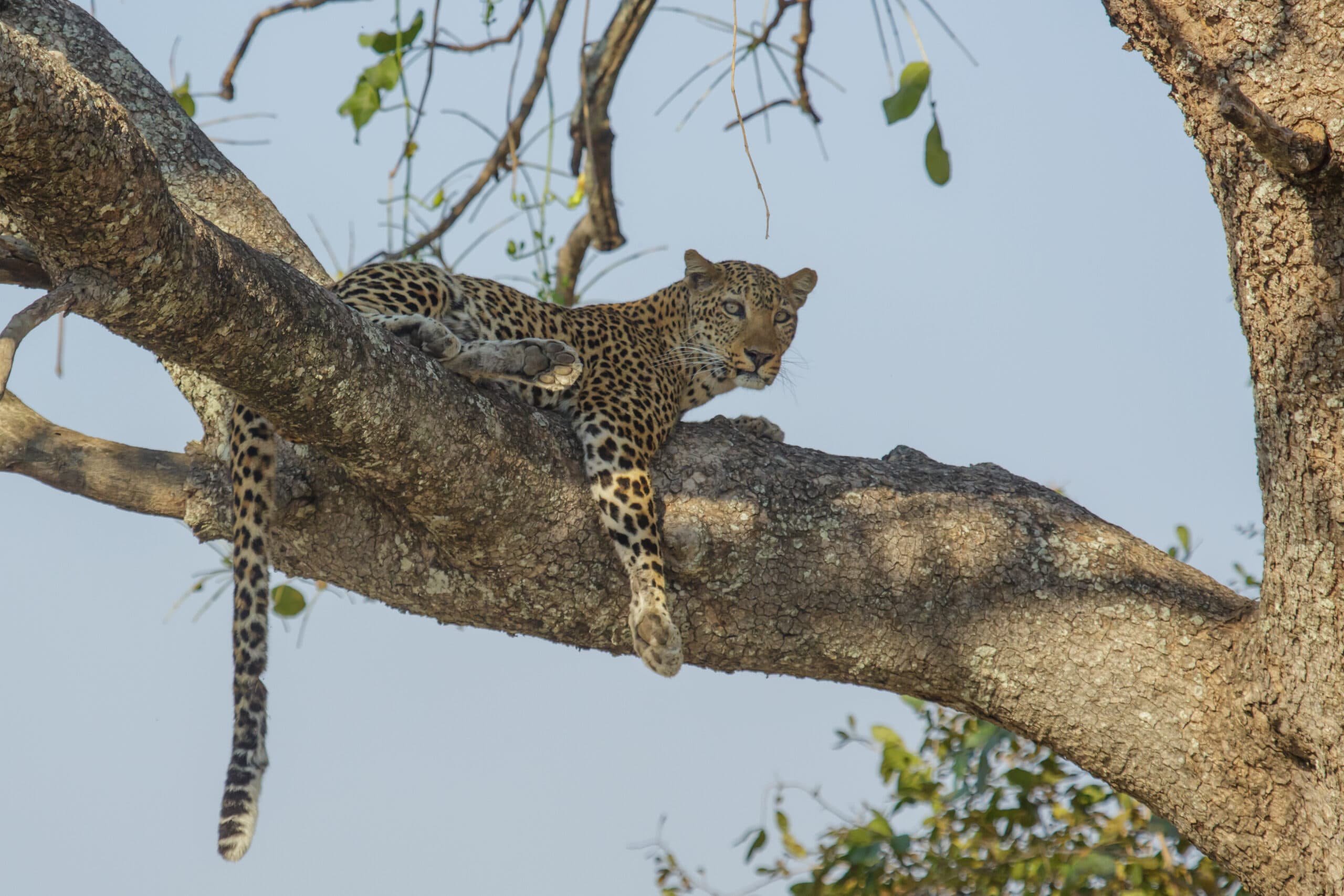
African Leopard (Panthera pardus pardus) is the leopard subspecies native to continental Africa. Modern cat taxonomy places the continent’s surviving leopard populations in Panthera pardus pardus, while recognizing strong regional differences in body size, coat shade, prey and behavior. Its stealth, broad diet and ability to use trees allow it to persist in habitats that challenge many other large carnivores. This guide separates well-supported biology from common assumptions and covers identification, range, habitat, diet, behavior, reproduction and conservation.
Identification
The coat is usually tawny to ochre with black rosettes on the back and flanks, solid spots on the face and limbs, and a pale belly. Rosettes lack the central spot common in jaguars. The body is long and muscular, the head broad, and the tail nearly as long as the body, providing balance in trees. Melanistic animals are possible but uncommon in most African populations. Males are substantially heavier, with broader heads and more robust shoulders; females have the same rosette pattern but a lighter build.
Identification should combine body shape, markings, size, voice or movement, and location. One feature by itself can overlap with a related animal, a juvenile, or an individual in unusual light.
Photographs are most useful when they preserve scale and show several diagnostic features. Handling or repositioning a wild african leopard for identification can cause stress and is unnecessary.
Size and physical adaptations
African Leopard typically measures Body about 90–190 cm, excluding tail and weighs Females often 20–60 kg; males often 30–90 kg. Size varies strongly with sex, habitat and prey availability; these broad ranges describe African populations rather than every locality.
Its useful adaptations include rosettes break up the body outline in dappled cover, retractable claws grip prey and bark, long tail balances climbing and sharp turns, powerful shoulders lift carcasses into trees, sensitive whiskers guide movement at close range, broad prey choice buffers seasonal shortages. These traits work together in the animal’s normal setting rather than serving as isolated curiosities.
Published measurements may use different methods, life stages or sample locations. Comparing figures responsibly means checking what was measured rather than selecting the largest number available.
Range and distribution
Once widespread across nearly all of Africa, African leopards now occupy a fragmented range concentrated in sub-Saharan Africa, with tiny or uncertain remnants in parts of North Africa. Strongholds remain in eastern and southern Africa and in some central and west African forests, while large gaps reflect habitat conversion and persecution. The native range includes Algeria, Angola, Benin, Botswana, Burkina Faso, Burundi, Cameroon, Central African Republic, Chad, Republic of the Congo, Democratic Republic of the Congo, Côte d’Ivoire, Djibouti, Equatorial Guinea, Eritrea, Ethiopia, Gabon, Ghana, Guinea, Guinea-Bissau, Kenya, Liberia, Malawi, Mali, Mauritania, Mozambique, Namibia, Niger, Nigeria, Rwanda, Senegal, Sierra Leone, Somalia, South Africa, South Sudan, Sudan, Eswatini, Tanzania, Togo, Uganda, Zambia, Zimbabwe.
A country-level map indicates broad distribution, not continuous occupation. Climate, elevation, water, vegetation, prey, breeding sites, barriers and survey effort all affect where records occur.
Records near the edge of the range deserve careful documentation because they may reflect natural movement, improved survey coverage, accidental transport or a genuine distribution change.
Habitat
Tropical rainforest, woodland, savanna, grassland mosaics, scrub, rocky mountains, dry desert margins and some agricultural landscapes with sufficient cover and prey.
Leopards favor places that combine concealment, prey and secure resting or den sites. They use dense vegetation, rocky outcrops, river corridors and trees. In human-dominated landscapes they often become more nocturnal and move through remnant cover to avoid people. Protecting a population therefore requires the feeding, shelter and breeding features that make a site usable, along with connections that allow movement.
Microhabitat matters. Shade, soil, current, moisture, shelter or host plants can determine whether a small area is usable even when the surrounding landscape appears suitable.
Diet and feeding
African Leopard is a obligate carnivore and opportunistic ambush predator. Important foods include impala and other antelope, warthogs and young ungulates, monkeys and baboons, rodents and hares, birds and reptiles, livestock where wild prey is scarce, carrion. The leopard stalks low through cover, closes to short range and attacks with a rapid rush. A throat or neck bite subdues prey. Where lions, hyenas or wild dogs compete, it often drags the carcass into a tree or dense thicket and returns for several meals. Prey size and species vary enormously by region.
Diet changes with age, season, location and food supply. A dramatic prey record does not establish what most individuals eat most of the time; repeated field observations provide a stronger picture.
Feeding opportunities also create risk. An animal focused on prey may be less alert to predators, traffic or people, while contaminated prey can transfer pollutants through the food web.
Behavior and communication
Often nocturnal or crepuscular, but active by day where disturbance is low. Adults are solitary and territorial. Each cat uses scent-marked routes, scrapes, calls and favored resting sites within a home range that shifts with prey density and habitat. Leopards climb readily, swim when necessary and rest in trees, caves or dense shade during heat.
A rasping territorial call, often compared with sawing wood, carries through the night. Urine spraying, scrapes, feces and cheek rubbing leave chemical messages. Growls, hisses, grunts and purr-like sounds occur at close range between rivals, mates or mothers and cubs. Behavior should be interpreted in context: alarm, courtship, feeding and temperature regulation can produce very different actions from the same animal.
Daily schedules are flexible responses, not rigid rules. Weather, breeding condition, disturbance, tides or food can move activity into a different part of the day.
Reproduction and development
Breeding can occur year-round, with local peaks linked to rainfall and prey. A receptive female and male may remain together for several days and mate repeatedly. The female later chooses a hidden den in dense brush, rock cleft, cave or hollow tree. Usually 2–3 cubs Cubs are born blind and vulnerable. Their mother moves them between dens, nurses them for roughly three months and introduces meat as they grow. Cubs accompany her on hunts, learn prey handling and usually become independent between about 13 and 20 months.
Young animals face different risks and may use different microhabitats or food than adults. Breeding success depends on adult condition, suitable sites and the survival of offspring through vulnerable early stages.
Counts of eggs or young describe reproductive output, not the number expected to reach adulthood. Mortality is normally greatest during eggs, larval or juvenile stages.
Predators and ecological role
African leopards regulate populations of medium-sized herbivores and smaller mammals, remove vulnerable prey and provide carcass remains to scavengers. They overlap with lions, hyenas, cheetahs and wild dogs but reduce competition through stealth, nocturnal activity, smaller prey and tree caching. Documented or likely predators include Lion, Spotted Hyena, African Wild Dog, Humans.
This animal is both a consumer and a food source. Its influence comes through many repeated interactions, so ecological claims should be based on measured populations rather than assumptions drawn from appearance.
Predator and prey relationships differ among places. A species can be ecologically influential without being abundant everywhere, and its role can change across its range.
Relationship with people
Leopards attract tourism and carry deep cultural meaning, yet conflict arises when they take goats, sheep, calves or dogs. Retaliatory killing, poorly set snares and loss of wild prey threaten populations. Secure nighttime livestock enclosures, attentive herding and rapid compensation can reduce losses.
Never approach or corner a leopard. Keep children and pets close in leopard habitat, avoid walking alone after dark where authorities advise against it, and follow local wildlife guidance. If encountered at close range, remain upright, face the cat, make yourself look larger, back away slowly and do not run. Responsible observation means keeping an appropriate distance, avoiding capture or feeding, protecting habitat and following local wildlife or invasive-species guidance.
Wildlife guidance should come from the responsible local agency because collection rules, reporting requests and appropriate responses differ between native and introduced ranges.
Conservation
The IUCN Red List assesses the leopard species Panthera pardus as Vulnerable. African leopards remain widespread compared with several Asian subspecies, but they have disappeared from large parts of their historic range and continue to decline through habitat loss, prey depletion, conflict, illegal trade and unsustainable killing. The reported global trend is Decreasing.
Important pressures include habitat loss and fragmentation, loss of wild prey, retaliatory killing, snares and illegal trade, unsustainable trophy harvest, road expansion and human disturbance. Global status can hide local decline or recovery, so current regional monitoring and habitat management remain necessary.
The most useful conservation action follows the documented pressure. Protecting breeding sites, reducing road deaths or limiting pollutants can require different tools in different populations.
