
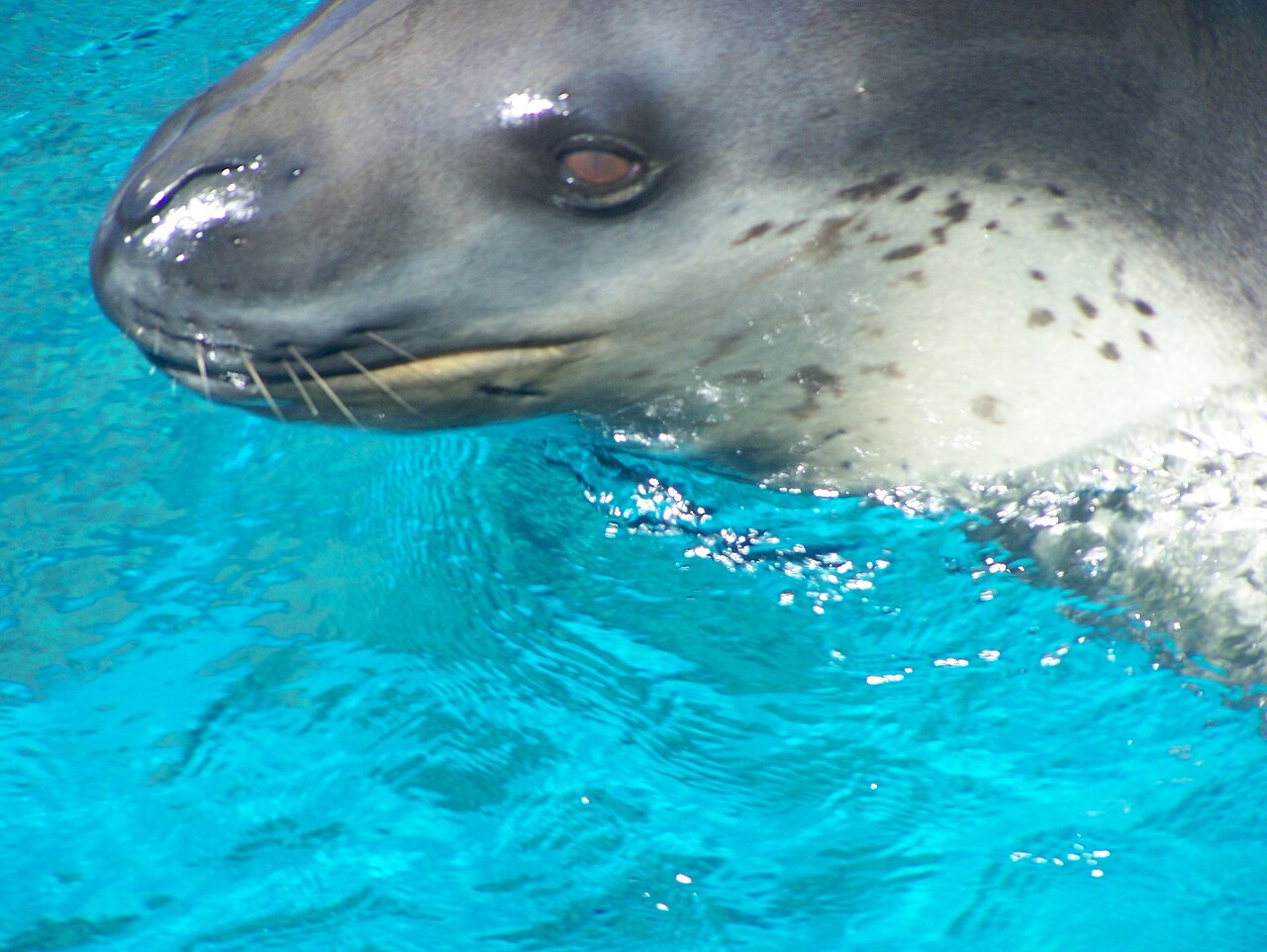
Leopard Seal (Hydrurga leptonyx) is a large, solitary true seal of Antarctic pack ice and the surrounding Southern Ocean. This guide separates well-supported biology from common assumptions and covers identification, range, habitat, diet, behavior, reproduction and conservation.
Identification
A long, muscular seal with an unusually large reptile-like head, wide jaws, long foreflippers and a dark gray back over a paler, spotted underside. Its mouth contains long canines and interlocking multi-cusped cheek teeth. Females average larger and heavier than males, reversing the pattern seen in many other seals.
Identification should combine body shape, markings, size, voice or movement, and location. One feature by itself can overlap with a related animal, a juvenile, or an individual in unusual light.
Photographs are most useful when they preserve scale and show several diagnostic features. Handling or repositioning a wild leopard seal for identification can cause stress and is unnecessary.
Size and physical adaptations
Leopard Seal typically measures males about 2.8 m; females commonly about 3.0 m, with large females over 3.5 m and weighs males around 320 kg and females around 370 kg; exceptional females exceed 500 kg. Published averages and maxima vary by sample and season because seals gain and lose substantial mass.
Its useful adaptations include long foreflippers provide speed and maneuverability, interlocking cheek teeth strain krill from seawater, large canines grip vertebrate prey, thick blubber insulates and stores energy, streamlined body reduces drag. These traits work together in the animal’s normal setting rather than serving as isolated curiosities.
Published measurements may use different methods, life stages or sample locations. Comparing figures responsibly means checking what was measured rather than selecting the largest number available.
Range and distribution
Circumpolar Antarctic pack ice and coastal waters, with regular occurrence at subantarctic islands and occasional dispersal by younger animals into temperate waters of southern South America, Australia and New Zealand. The native range includes Antarctica, South Georgia and the South Sandwich Islands, Australia and its subantarctic territories, New Zealand and its subantarctic islands, Chile.
A country-level map indicates broad distribution, not continuous occupation. Climate, elevation, water, vegetation, prey, breeding sites, barriers and survey effort all affect where records occur.
Records near the edge of the range deserve careful documentation because they may reflect natural movement, improved survey coverage, accidental transport or a genuine distribution change.
Habitat
Pack-ice margins, ice floes, Antarctic coastal water and productive subantarctic seas.
Individuals hunt in open leads and along ice edges, rest and give birth on ice, and may establish seasonal feeding areas near penguin or seal colonies. Some travel far north of the main pack-ice zone. Protecting a population therefore requires the feeding, shelter and breeding features that make a site usable, along with connections that allow movement.
Microhabitat matters. Shade, soil, current, moisture, shelter or host plants can determine whether a small area is usable even when the surrounding landscape appears suitable.
Diet and feeding
Leopard Seal is a carnivore with both filter-feeding and active predation. Important foods include antarctic krill, fish, squid, penguins, young seals, other crustaceans. Leopard seals can close their jaws so water escapes through interlocking cheek teeth while krill remain inside. Other individuals patrol shorelines, chase penguins underwater or take seal pups. Diet varies strongly among individuals, age groups and seasons.
Diet changes with age, season, location and food supply. A dramatic prey record does not establish what most individuals eat most of the time; repeated field observations provide a stronger picture.
Feeding opportunities also create risk. An animal focused on prey may be less alert to predators, traffic or people, while contaminated prey can transfer pollutants through the food web.
Behavior and communication
Forages and travels in water, hauling out on ice or land to rest, moult and reproduce. Usually solitary and widely dispersed. Leopard seals are graceful, fast swimmers but move awkwardly on solid surfaces. Some repeatedly hunt at the same colony, while others specialize on fish or krill. Curiosity toward boats or divers must never be mistaken for safety.
Males produce loud, patterned underwater vocalizations during the breeding season. Visual posture, touch and scent also matter during close encounters. Behavior should be interpreted in context: alarm, courtship, feeding and temperature regulation can produce very different actions from the same animal.
Daily schedules are flexible responses, not rigid rules. Weather, breeding condition, disturbance, tides or food can move activity into a different part of the day.
Reproduction and development
Breeding is difficult to observe in drifting pack ice. Females give birth to a single pup on ice in the austral spring, nurse it for several weeks and mate after weaning. One pup undefined
Young animals face different risks and may use different microhabitats or food than adults. Breeding success depends on adult condition, suitable sites and the survival of offspring through vulnerable early stages.
Counts of eggs or young describe reproductive output, not the number expected to reach adulthood. Mortality is normally greatest during eggs, larval or juvenile stages.
Predators and ecological role
A flexible Southern Ocean predator linking krill, fish, seabirds and marine mammals. Differences among individual diets mean some seals function largely as krill consumers while others are top predators at colonies. Documented or likely predators include Killer Whale.
This animal is both a consumer and a food source. Its influence comes through many repeated interactions, so ecological claims should be based on measured populations rather than assumptions drawn from appearance.
Predator and prey relationships differ among places. A species can be ecologically influential without being abundant everywhere, and its role can change across its range.
Relationship with people
Leopard seals are protected within the Antarctic Treaty system and are important research subjects. Encounters are uncommon, but a large wild predator can seriously injure or kill a person.
Keep well away on ice, shore and water. Never block its route to the sea, feed it or enter the water nearby. Expedition staff and researchers should follow formal wildlife and dive procedures. Responsible observation means keeping an appropriate distance, avoiding capture or feeding, protecting habitat and following local wildlife or invasive-species guidance.
Wildlife guidance should come from the responsible local agency because collection rules, reporting requests and appropriate responses differ between native and introduced ranges.
Conservation
The 2026 IUCN assessment classifies the leopard seal as Least Concern. Abundance and trend remain uncertain across much of Antarctica, and continuing sea-ice loss is a major long-term concern. The reported global trend is Unknown globally, with no confirmed overall decline.
Important pressures include climate-driven sea-ice loss, changes in krill and prey availability, fishery interactions, pollution and contaminants, human disturbance. Global status can hide local decline or recovery, so current regional monitoring and habitat management remain necessary.
The most useful conservation action follows the documented pressure. Protecting breeding sites, reducing road deaths or limiting pollutants can require different tools in different populations.