
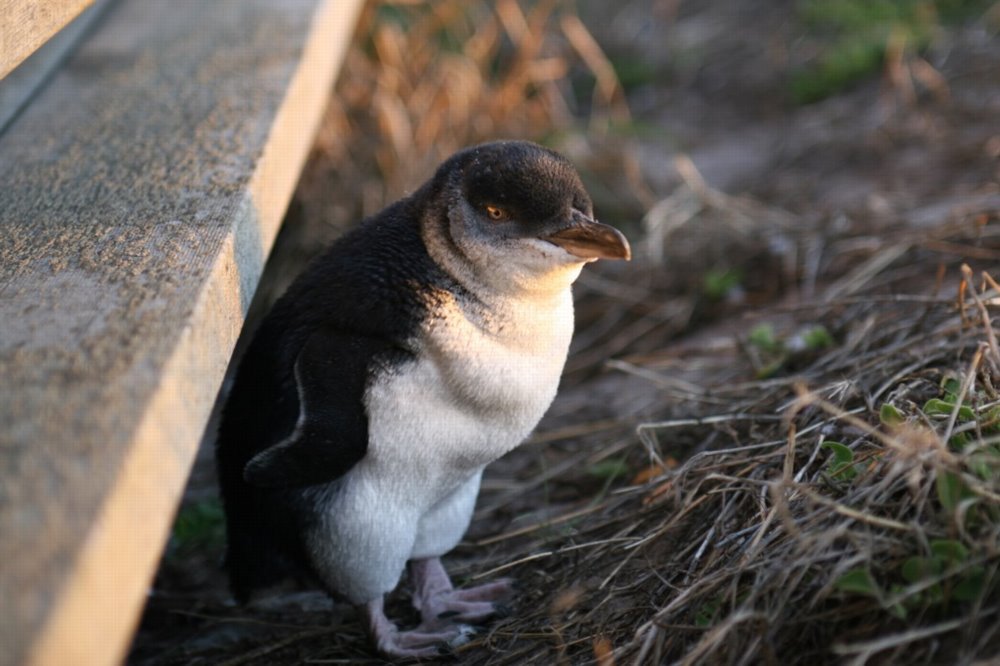
Little Penguin (Eudyptula minor) is a small blue-backed seabird that breeds around New Zealand and southern Australia and hunts in nearby coastal seas. This guide separates well-supported biology from common assumptions and covers identification, range, habitat, diet, behavior, reproduction and conservation.
Identification
A compact flightless seabird with slate-blue to indigo upperparts, white underparts, narrow flippers, a dark bill and pinkish-gray feet. Juveniles can appear brighter blue than adults. Sexes look alike, although males average slightly heavier and have a deeper, more strongly hooked bill.
Identification should combine body shape, markings, size, voice or movement, and location. One feature by itself can overlap with a related animal, a juvenile, or an individual in unusual light.
Photographs are most useful when they preserve scale and show several diagnostic features. Handling or repositioning a wild little penguin for identification can cause stress and is unnecessary.
Size and physical adaptations
Little Penguin typically measures about 30–40 cm, with regional variation and weighs usually around 1 kg. The little penguin is the smallest living penguin; measurements vary among populations, seasons and taxonomic treatments.
Its useful adaptations include blue-and-white countershading reduces visibility at sea, dense overlapping feathers trap insulating air, flippers provide underwater propulsion, salt glands remove excess salt from seawater, clear nictitating membranes protect the eyes underwater. These traits work together in the animal’s normal setting rather than serving as isolated curiosities.
Published measurements may use different methods, life stages or sample locations. Comparing figures responsibly means checking what was measured rather than selecting the largest number available.
Range and distribution
Coasts and offshore islands of southern Australia, Tasmania and New Zealand, including populations around the Chatham Islands under some taxonomic treatments. The native range includes Australia, New Zealand.
A country-level map indicates broad distribution, not continuous occupation. Climate, elevation, water, vegetation, prey, breeding sites, barriers and survey effort all affect where records occur.
Records near the edge of the range deserve careful documentation because they may reflect natural movement, improved survey coverage, accidental transport or a genuine distribution change.
Habitat
Temperate coastal waters, sheltered bays, rocky shores, dunes, islands and coastal vegetation with nest cavities.
The birds forage over continental shelves and inshore waters, then come ashore after dusk. Nests occur in soil burrows, rock crevices, caves, dense vegetation and sometimes human structures or purpose-built boxes. Protecting a population therefore requires the feeding, shelter and breeding features that make a site usable, along with connections that allow movement.
Microhabitat matters. Shade, soil, current, moisture, shelter or host plants can determine whether a small area is usable even when the surrounding landscape appears suitable.
Diet and feeding
Little Penguin is a carnivore; pursuit-diving seabird. Important foods include anchovies, pilchards, small barracouta, red cod, warehou, squid, krill, small crustaceans, sea jellies. Little penguins use rapid flipper strokes to pursue schooling fish and invertebrates underwater. During breeding they are central-place foragers, repeatedly returning from sea to deliver regurgitated food to chicks.
Diet changes with age, season, location and food supply. A dramatic prey record does not establish what most individuals eat most of the time; repeated field observations provide a stronger picture.
Feeding opportunities also create risk. An animal focused on prey may be less alert to predators, traffic or people, while contaminated prey can transfer pollutants through the food web.
Behavior and communication
Feeds mainly by day at sea and usually crosses exposed beaches after dusk. Before landing, birds gather offshore in rafts and approach the beach together. They navigate to familiar burrows using landmarks and calls. Colonies can be noisy, and adults defend nest entrances while also recognizing partners and chicks among many neighbors.
Brays, growls, barks and individualized calls help advertise a nest, maintain a pair bond and locate mates or chicks. Behavior should be interpreted in context: alarm, courtship, feeding and temperature regulation can produce very different actions from the same animal.
Daily schedules are flexible responses, not rigid rules. Weather, breeding condition, disturbance, tides or food can move activity into a different part of the day.
Reproduction and development
Timing varies by latitude and food conditions. Both partners prepare a nest, incubate the clutch in shifts and feed chicks after hatching. Usually two white eggs undefined
Young animals face different risks and may use different microhabitats or food than adults. Breeding success depends on adult condition, suitable sites and the survival of offspring through vulnerable early stages.
Counts of eggs or young describe reproductive output, not the number expected to reach adulthood. Mortality is normally greatest during eggs, larval or juvenile stages.
Predators and ecological role
A nearshore marine predator that transfers nutrients to land around colonies and responds quickly to changes in small-fish availability, making it useful for coastal ecosystem monitoring. Documented or likely predators include Pacific Gull, White-bellied Sea Eagle, New Zealand Fur Seal, Domestic Dog, Red Fox, Stoat.
This animal is both a consumer and a food source. Its influence comes through many repeated interactions, so ecological claims should be based on measured populations rather than assumptions drawn from appearance.
Predator and prey relationships differ among places. A species can be ecologically influential without being abundant everywhere, and its role can change across its range.
Relationship with people
Urban growth brings roads, pets, lighting, boat traffic and the loss of natural nesting sites. Predator control, dog exclusion, careful road design and protected colony habitat can produce strong local recoveries.
Watch only from approved paths or distant observation points. Keep dogs leashed and away from colonies, avoid flash photography, never block a penguin’s route and leave apparently scruffy moulting birds undisturbed. Responsible observation means keeping an appropriate distance, avoiding capture or feeding, protecting habitat and following local wildlife or invasive-species guidance.
Wildlife guidance should come from the responsible local agency because collection rules, reporting requests and appropriate responses differ between native and introduced ranges.
Conservation
Globally assessed as Least Concern under the broad Eudyptula minor treatment, but status differs locally. New Zealand lists kororā as At Risk–Declining, and some Australian colonies have suffered severe losses. The reported global trend is Decreasing in several regions despite stable or recovering managed colonies.
Important pressures include dogs, foxes, cats, ferrets and stoats, coastal development and nest loss, road and boat strikes, fishing-net bycatch, oil pollution, marine heatwaves and shifting prey, human disturbance and artificial light. Global status can hide local decline or recovery, so current regional monitoring and habitat management remain necessary.
The most useful conservation action follows the documented pressure. Protecting breeding sites, reducing road deaths or limiting pollutants can require different tools in different populations.