
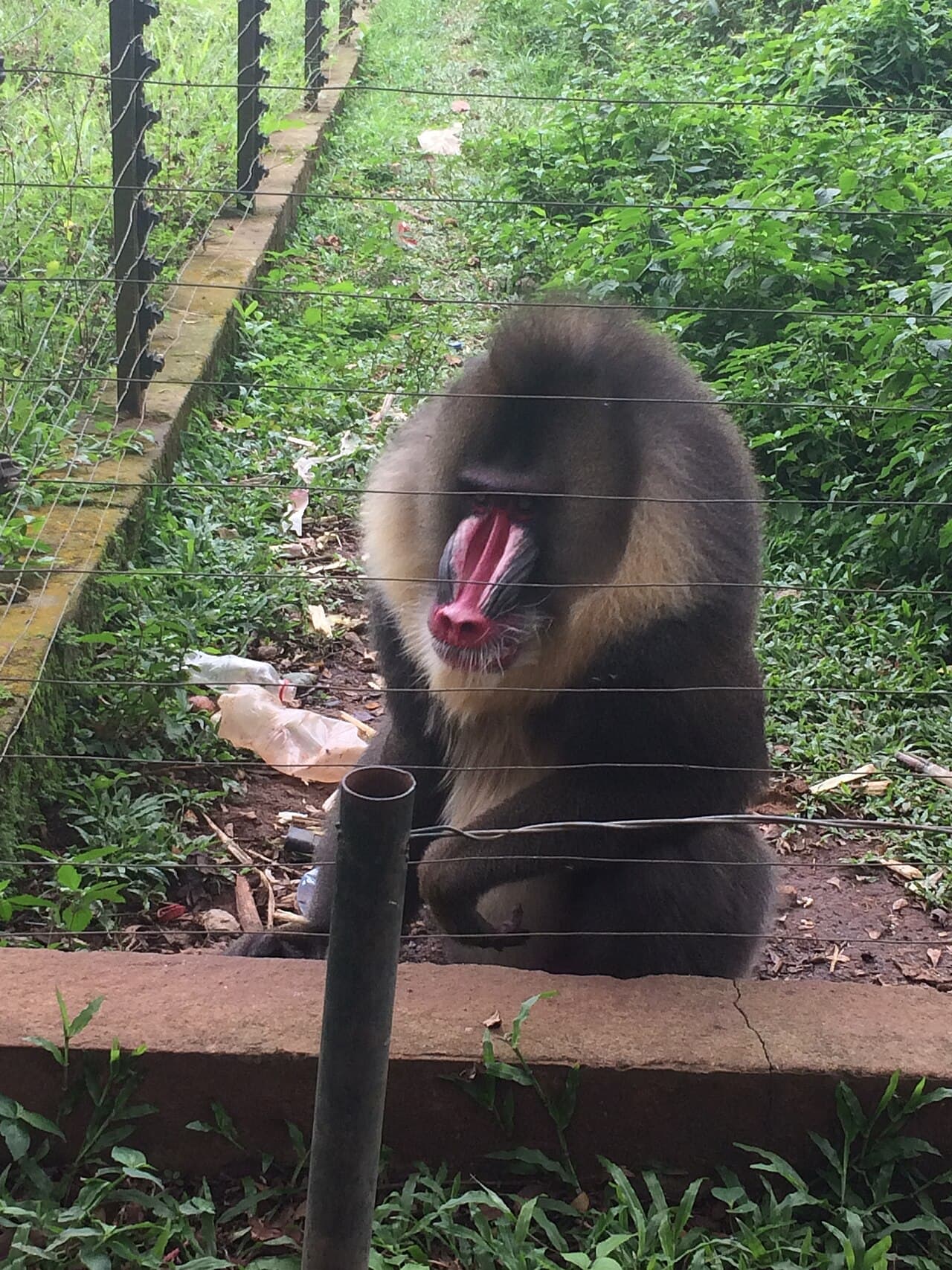
Mandrill (Mandrillus sphinx) is a powerful, mostly ground-foraging Old World monkey of equatorial western Central Africa. This guide separates well-supported biology from common assumptions and covers identification, range, habitat, diet, behavior, reproduction and conservation.
Identification
A stocky monkey with olive-brown fur, a short upright tail, a long muzzle and bright bare skin. Adult males have red noses and lips, ribbed blue muzzle flanges, golden beard and a vividly colored rump. Adult males may weigh more than three times as much as females and are far more brightly colored, with larger canines and a heavier mane.
Identification should combine body shape, markings, size, voice or movement, and location. One feature by itself can overlap with a related animal, a juvenile, or an individual in unusual light.
Photographs are most useful when they preserve scale and show several diagnostic features. Handling or repositioning a wild mandrill for identification can cause stress and is unnecessary.
Size and physical adaptations
Mandrill typically measures head and body roughly 55–95 cm depending on sex and weighs females about 11–13 kg; adult males commonly 25–35 kg and occasionally heavier. It is the heaviest living monkey; published maxima differ because wild and managed populations are sampled differently.
Its useful adaptations include large cheek pouches temporarily store food, powerful limbs support long ground travel, long canines deter rivals and defend the animal, color intensity signals male condition and rank, opposable thumbs manipulate food. These traits work together in the animal’s normal setting rather than serving as isolated curiosities.
Published measurements may use different methods, life stages or sample locations. Comparing figures responsibly means checking what was measured rather than selecting the largest number available.
Range and distribution
Rainforests south of Cameroon’s Sanaga River through mainland Equatorial Guinea and Gabon into the Republic of the Congo, bounded by major rivers and savanna. The native range includes Cameroon, Equatorial Guinea, Gabon, Republic of the Congo.
A country-level map indicates broad distribution, not continuous occupation. Climate, elevation, water, vegetation, prey, breeding sites, barriers and survey effort all affect where records occur.
Records near the edge of the range deserve careful documentation because they may reflect natural movement, improved survey coverage, accidental transport or a genuine distribution change.
Habitat
Lowland tropical rainforest, semi-deciduous and secondary forest, gallery forest, dense understory and forest-savanna mosaics.
Mandrills travel mostly on the forest floor by day, feeding from ground level into the canopy, then climb trees to sleep. Productive fruiting areas can draw multiple social units into very large temporary hordes. Protecting a population therefore requires the feeding, shelter and breeding features that make a site usable, along with connections that allow movement.
Microhabitat matters. Shade, soil, current, moisture, shelter or host plants can determine whether a small area is usable even when the surrounding landscape appears suitable.
Diet and feeding
Mandrill is a omnivore with fruit as a major component. Important foods include fruit, seeds, nuts, roots, fungi, leaves, insects, snails, worms, frogs, lizards, small vertebrates. Individuals search leaf litter, dig for roots and invertebrates and climb for fruit. Cheek pouches let a monkey gather food rapidly and move it to a safer place before chewing.
Diet changes with age, season, location and food supply. A dramatic prey record does not establish what most individuals eat most of the time; repeated field observations provide a stronger picture.
Feeding opportunities also create risk. An animal focused on prey may be less alert to predators, traffic or people, while contaminated prey can transfer pollutants through the food web.
Behavior and communication
Diurnal, traveling and foraging by day and sleeping in trees at night. Females and young form stable matrilineal social units. Adult males may spend time alone outside the mating season and join groups when females are receptive. Units sometimes merge into hordes numbering hundreds; a documented aggregation exceeded one thousand.
Deep grunts maintain contact in dense vegetation. Screams, growls, body posture, facial displays, grooming and scent from a chest gland convey identity, rank and intention. A silent bared-teeth display can be friendly rather than a threat. Behavior should be interpreted in context: alarm, courtship, feeding and temperature regulation can produce very different actions from the same animal.
Daily schedules are flexible responses, not rigid rules. Weather, breeding condition, disturbance, tides or food can move activity into a different part of the day.
Reproduction and development
Reproduction is seasonal in much of the range. The brightest high-ranking males obtain many matings, but genetic work shows that mating is not limited to one permanent harem male. Usually one infant; twins are rare undefined
Young animals face different risks and may use different microhabitats or food than adults. Breeding success depends on adult condition, suitable sites and the survival of offspring through vulnerable early stages.
Counts of eggs or young describe reproductive output, not the number expected to reach adulthood. Mortality is normally greatest during eggs, larval or juvenile stages.
Predators and ecological role
A major consumer and disperser of forest fruit and seeds. By moving across large home ranges, mandrills connect fruiting trees and influence plant recruitment, while also consuming many invertebrates. Documented or likely predators include Leopard, Crowned Eagle, Humans.
This animal is both a consumer and a food source. Its influence comes through many repeated interactions, so ecological claims should be based on measured populations rather than assumptions drawn from appearance.
Predator and prey relationships differ among places. A species can be ecologically influential without being abundant everywhere, and its role can change across its range.
Relationship with people
Mandrills are hunted for the commercial bushmeat trade and lose forest to roads, logging and agriculture. Roads also give hunters access to previously remote habitat. Effective protection requires large connected forests and enforcement, not just small isolated reserves.
Never approach, feed or stare at a wild or managed mandrill. Adult males have very large canines and exceptional strength; follow guides and secure barriers. Responsible observation means keeping an appropriate distance, avoiding capture or feeding, protecting habitat and following local wildlife or invasive-species guidance.
Wildlife guidance should come from the responsible local agency because collection rules, reporting requests and appropriate responses differ between native and introduced ranges.
Conservation
The IUCN lists the mandrill as Vulnerable because hunting and forest loss are driving decline across its restricted Central African range. The reported global trend is Decreasing.
Important pressures include commercial bushmeat hunting, logging roads that increase access, forest conversion for agriculture, habitat fragmentation, weak enforcement in remote forests. Global status can hide local decline or recovery, so current regional monitoring and habitat management remain necessary.
The most useful conservation action follows the documented pressure. Protecting breeding sites, reducing road deaths or limiting pollutants can require different tools in different populations.