
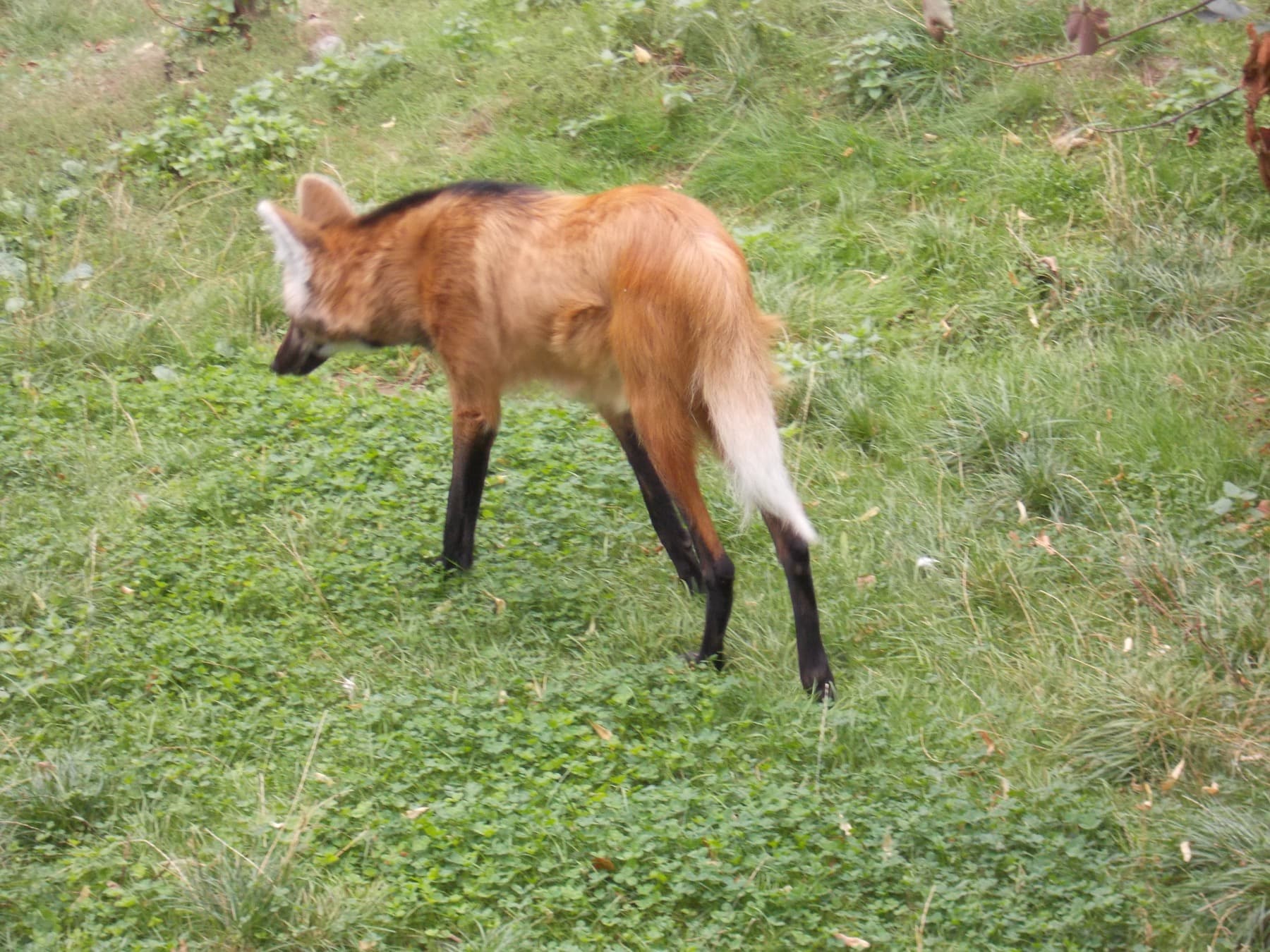
Maned Wolf (Chrysocyon brachyurus) is neither a true wolf nor a fox but the sole living species in the genus Chrysocyon. It combines a foxlike red coat and huge ears with long, dark legs suited to tall grass. Unlike pack-hunting wolves, it usually travels and feeds alone, eating almost equal portions of small animals and fruit. This guide separates well-supported biology from common assumptions and covers identification, range, habitat, diet, behavior, reproduction and conservation.
Identification
A Maned Wolf stands nearly one meter at the shoulder on long slender legs that darken to black below the knees. The body is narrow, the coat golden-red, the muzzle and mane black, and the throat and tail tip white. Large upright ears catch faint sounds. When alarmed, long hair along the shoulders rises into a dark crest that makes the animal appear larger. Males average slightly larger than females, but the sexes look very similar in the field.
Identification should combine body shape, markings, size, voice or movement, and location. One feature by itself can overlap with a related animal, a juvenile, or an individual in unusual light.
Photographs are most useful when they preserve scale and show several diagnostic features. Handling or repositioning a wild maned wolf for identification can cause stress and is unnecessary.
Size and physical adaptations
Maned Wolf typically measures Head and body about 1.25–1.32 m and weighs About 20–30 kg. Shoulder height is approximately 75–90 cm, unusually tall for its mass.
Its useful adaptations include long legs provide vision and movement through tall grass, large ears detect rodents and insects, broad molars crush fruit and plant foods, stilted gait crosses wet grassland, erectile mane enlarges threat display, omnivory buffers seasonal prey shortages, strong-smelling urine marks wide territories, pouncing captures small hidden prey. These traits work together in the animal’s normal setting rather than serving as isolated curiosities.
Published measurements may use different methods, life stages or sample locations. Comparing figures responsibly means checking what was measured rather than selecting the largest number available.
Range and distribution
Centered in the Cerrado of central Brazil and extending into Bolivia, Paraguay, southeastern Peru and northern Argentina. Historical range reached farther south into Uruguay and Argentina. Local expansion into deforested areas in eastern Brazil does not offset losses and fragmentation across native grasslands. The native range includes Brazil, Bolivia, Paraguay, Argentina, Peru.
A country-level map indicates broad distribution, not continuous occupation. Climate, elevation, water, vegetation, prey, breeding sites, barriers and survey effort all affect where records occur.
Records near the edge of the range deserve careful documentation because they may reflect natural movement, improved survey coverage, accidental transport or a genuine distribution change.
Habitat
Cerrado savanna, open grassland, wet meadow, marsh edge, scrub, gallery-forest edge and agricultural mosaics retaining natural cover.
Maned Wolves use broad territories containing grass for hunting, brush for daytime shelter, wetlands and patches of fruiting shrubs. They rest in dense vegetation and travel roads or firebreaks at night. Pairs overlap a shared territory but usually forage apart, meeting most closely during breeding. Protecting a population therefore requires the feeding, shelter and breeding features that make a site usable, along with connections that allow movement.
Microhabitat matters. Shade, soil, current, moisture, shelter or host plants can determine whether a small area is usable even when the surrounding landscape appears suitable.
Diet and feeding
Maned Wolf is a omnivore. Important foods include wolf apple fruit, other fruit, rodents, armadillos, rabbits, birds and eggs, reptiles, insects, snails. A Maned Wolf walks slowly with ears forward, pauses to listen and pounces on rodents or insects hidden in grass. Small vertebrates are swallowed or torn apart; large prey is unusual. Fruit, especially wolf apple, supplies a large seasonal share of food. The mixed diet makes the species an important seed disperser as well as a predator of agricultural pests.
Diet changes with age, season, location and food supply. A dramatic prey record does not establish what most individuals eat most of the time; repeated field observations provide a stronger picture.
Feeding opportunities also create risk. An animal focused on prey may be less alert to predators, traffic or people, while contaminated prey can transfer pollutants through the food web.
Behavior and communication
Primarily crepuscular and nocturnal, with daytime activity in cool or undisturbed areas. Adults usually hunt, travel and rest alone even when belonging to a monogamous pair. Partners share and scent-mark a territory and communicate over distance. Each animal covers many kilometers during a night, using long legs to step through grass rather than sprinting after large prey. Direct encounters between neighboring adults are generally avoided.
A deep single bark, often called a roar-bark, carries across open savanna after dusk. Whines occur at close range and growls accompany conflict. Urine and feces mark repeated sites; the urine has a famously pungent odor. Ear position, body height and the raised black mane add visual signals. Behavior should be interpreted in context: alarm, courtship, feeding and temperature regulation can produce very different actions from the same animal.
Daily schedules are flexible responses, not rigid rules. Weather, breeding condition, disturbance, tides or food can move activity into a different part of the day.
Reproduction and development
Wild pairs are generally monogamous but spend much of the year apart. Females enter estrus once annually, and breeding timing follows season and latitude. After about two months of gestation, pups are born in a concealed nest of dense grass or brush. Usually 1–5 pups, commonly 2–3 Pups are born dark, blind and dependent, opening eyes and ears after roughly nine days. Their coat shifts toward red over the first months. They nurse for several months and begin taking regurgitated food early. Mothers provide most wild care; evidence from managed animals and field observations indicates fathers may also provision pups.
Young animals face different risks and may use different microhabitats or food than adults. Breeding success depends on adult condition, suitable sites and the survival of offspring through vulnerable early stages.
Counts of eggs or young describe reproductive output, not the number expected to reach adulthood. Mortality is normally greatest during eggs, larval or juvenile stages.
Predators and ecological role
Maned Wolves regulate rodents and other small animals while dispersing seeds across long routes. Wolf apple may benefit because seeds pass through the digestive tract and are deposited in nutrient-rich dung. The canid shares landscapes with domestic cattle and dogs, creating risks from roads, persecution and disease rather than heavy direct competition with large predators. Documented or likely predators include Human, Domestic Dog, Jaguar, Puma.
This animal is both a consumer and a food source. Its influence comes through many repeated interactions, so ecological claims should be based on measured populations rather than assumptions drawn from appearance.
Predator and prey relationships differ among places. A species can be ecologically influential without being abundant everywhere, and its role can change across its range.
Relationship with people
The Maned Wolf controls crop-eating rodents and attracts wildlife tourism, yet is sometimes blamed for poultry losses. Road kills are frequent where highways cross Cerrado habitat. Coexistence depends on secure night housing for poultry, dog vaccination and control, speed reduction, connected habitat and avoiding fire during sensitive seasons.
Maned Wolves usually avoid people and attacks are extraordinarily rare. Never corner, feed or chase one. Keep dogs restrained, protect poultry at night and contact wildlife authorities if an animal is injured or repeatedly enters a settlement. Handling requires professionals because any frightened canid can bite. Responsible observation means keeping an appropriate distance, avoiding capture or feeding, protecting habitat and following local wildlife or invasive-species guidance.
Wildlife guidance should come from the responsible local agency because collection rules, reporting requests and appropriate responses differ between native and introduced ranges.
Conservation
The IUCN lists the Maned Wolf as Near Threatened. Habitat conversion, fragmentation, road deaths, killing, fire and diseases transmitted by domestic dogs reduce populations. Its broad range includes protected areas, but many animals live in working landscapes where survival depends on coexistence. The reported global trend is Decreasing.
Important pressures include agricultural habitat conversion, road collisions, domestic-dog disease, persecution for poultry losses, uncontrolled fire, habitat fragmentation. Global status can hide local decline or recovery, so current regional monitoring and habitat management remain necessary.
The most useful conservation action follows the documented pressure. Protecting breeding sites, reducing road deaths or limiting pollutants can require different tools in different populations.
Despite its name, the long-legged Maned Wolf is not a true wolf; compare its solitary omnivory with the pack-hunting Gray Wolf.