
Home/Animals/Reptilia/Marine Iguana
Species profileIUCN: VU

Marine Iguana

Amblyrhynchus cristatus

The world’s only sea-foraging lizard, grazing algae from the volcanic shores of Galápagos.

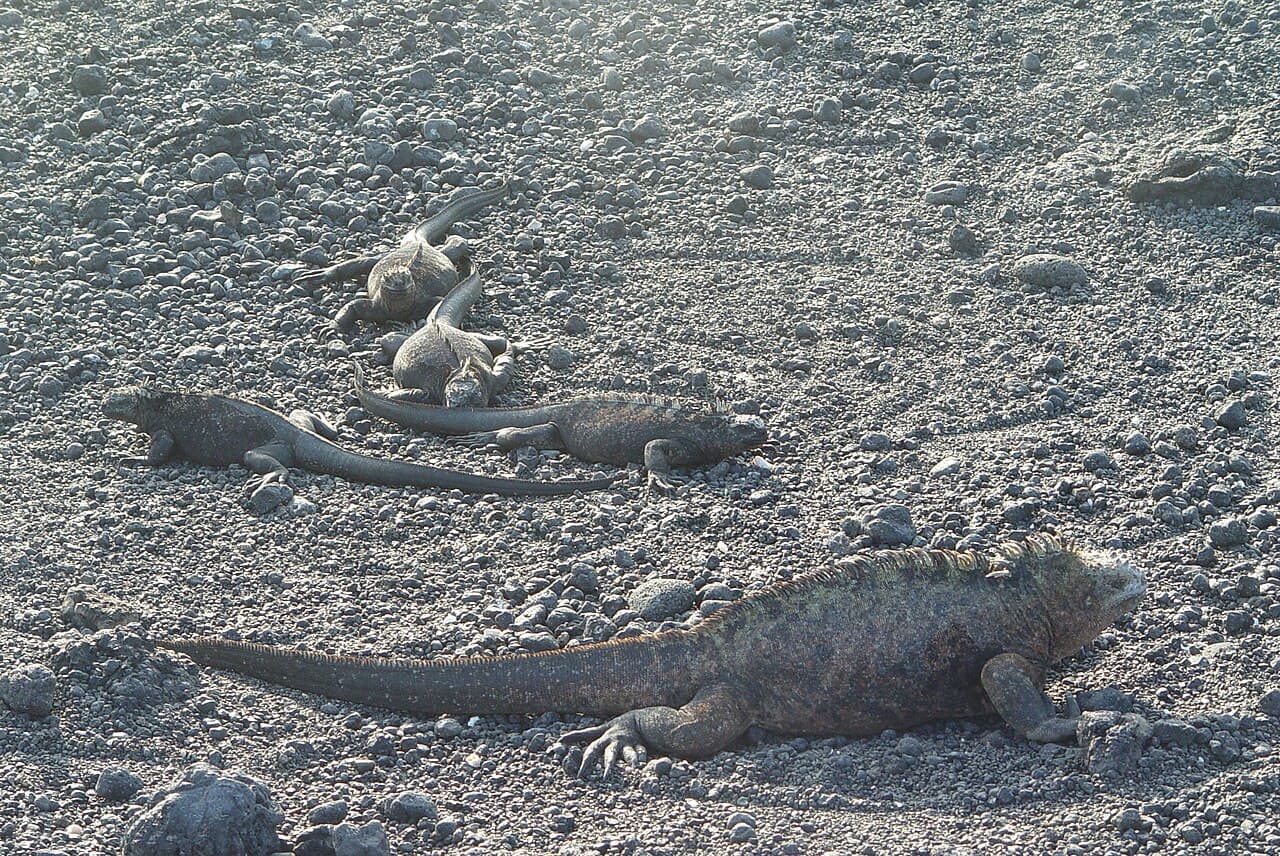
Marine iguana resting on dark Galápagos lava with its dorsal crest visible
Adavyd / Wikimedia Commons / CC BY-SA 4.0
🌐 Read in Language:

⚡ At a Glance

Species profile
Diet Category
Herbivore specialized on marine algae
Activity Rhythm
Diurnal and synchronized with sun, tide, sea temperature and wave conditions.
Wild Lifespan
Often estimated at five to twelve years, with some individuals living longer
Typical Weight
often 1–5 kg, varying strongly by island and sex
Conservation Status
VU
💡 Key Biological Insight: Marine iguanas can temporarily shrink in body length during severe El Niño food shortages, then grow longer again when algae recover.

🌳 Scientific Taxonomy Hierarchy

The marine iguana is the only living species in genus Amblyrhynchus. It belongs to the iguana family Iguanidae; island populations are divided into several subspecies whose size, color and conservation condition differ.

KingdomAnimalia
PhylumChordata
ClassReptilia
OrderSquamata
FamilyIguanidae
GenusAmblyrhynchus
SpeciesAmblyrhynchus cristatus

Distinguishing Anatomical Features

  • ✓A heavy-bodied iguana with a blunt snout, crest of pointed dorsal scales, long claws and a laterally flattened tail. Most adults are charcoal to black outside breeding, while mature males in some island populations develop red, green, turquoise or brick tones.
  • ✓Flattened tail powers swimming
  • ✓Blunt snout crops algae close to rock
  • ✓Long claws grip lava in surf
  • ✓Nasal salt glands expel excess salt
  • ✓Dark scales speed warming after cold dives
  • ✓Heart rate slows during submersion

📏 Physical Measurements

Total Lengthcommonly about 1.6–3.3 ft; large males can reach roughly 4.9 ft
Body Weightoften 2.2–11 lb, varying strongly by island and sex
Tail LengthLong and flattened side-to-side for propulsion
WingspanNot applicable
Top SpeedNo dependable universal maximumMovement changes with context and conditions.

🎨 Appearance & Distinctive Markings

Charcoal blackGrayBrick redGreenTurquoise in some breeding males

Skin / Covering: Rough keeled scales

Sexual Dimorphism: Males are generally larger, develop taller crests and become more colorful during breeding; females remain smaller and usually darker.

🗺️ Geographic Distribution & Habitat

Restricted to the Galápagos Archipelago, with populations on most major islands and many islets and nowhere else naturally.

Rocky lava shores, exposed intertidal benches, sheltered coves and nearby shallow coastal water.

Country-level distribution map

Native range
FijiTanzaniaWestern SaharaCanadaUnited StatesKazakhstanUzbekistanPapua New GuineaIndonesiaArgentinaChileCongo - KinshasaSomaliaKenyaSudanChadHaitiDominican RepublicRussiaBahamasFalkland IslandsNorwayGreenlandFrench Southern TerritoriesTimor-LesteSouth AfricaLesothoMexicoUruguayBrazilBoliviaPeruColombiaPanamaCosta RicaNicaraguaHondurasEl SalvadorGuatemalaBelizeVenezuelaGuyanaSurinameFranceEcuador — Native rangePuerto RicoJamaicaCubaZimbabweBotswanaNamibiaSenegalMaliMauritaniaBeninNigerNigeriaCameroonTogoGhanaCôte d’IvoireGuineaGuinea-BissauLiberiaSierra LeoneBurkina FasoCentral African RepublicCongo - BrazzavilleGabonEquatorial GuineaZambiaMalawiMozambiqueEswatiniAngolaBurundiIsraelLebanonMadagascarPalestinian TerritoriesGambiaTunisiaAlgeriaJordanUnited Arab EmiratesQatarKuwaitIraqOmanVanuatuCambodiaThailandLaosMyanmar (Burma)VietnamNorth KoreaSouth KoreaMongoliaIndiaBangladeshBhutanNepalPakistanAfghanistanTajikistanKyrgyzstanTurkmenistanIranSyriaArmeniaSwedenBelarusUkrainePolandAustriaHungaryMoldovaRomaniaLithuaniaLatviaEstoniaGermanyBulgariaGreeceTürkiyeAlbaniaCroatiaSwitzerlandLuxembourgBelgiumNetherlandsPortugalSpainIrelandNew CaledoniaSolomon IslandsNew ZealandAustraliaSri LankaChinaTaiwanItalyDenmarkUnited KingdomIcelandAzerbaijanGeorgiaPhilippinesMalaysiaBruneiSloveniaFinlandSlovakiaCzechiaEritreaJapanParaguayYemenSaudi ArabiaCyprusMoroccoEgyptLibyaEthiopiaDjiboutiUgandaRwandaBosnia & HerzegovinaNorth MacedoniaSerbiaMontenegroKosovoTrinidad & TobagoSouth Sudan
Highlighted countries are recorded profile locations, not precise biological range boundaries.Map boundaries: Natural Earth

Recorded Native Countries & Territories:

💡 Did You Know?

  • 💡Flattened tail powers swimming
  • 💡Blunt snout crops algae close to rock
  • 💡Long claws grip lava in surf
  • 💡Nasal salt glands expel excess salt
  • 💡Dark scales speed warming after cold dives
  • 💡Heart rate slows during submersion

🌿 Conservation Status & Threats

IUCN: VU — Vulnerable

“The IUCN lists the marine iguana as Vulnerable. Status differs among island subspecies, and sudden El Niño-driven food crashes can cause heavy mortality even where habitat is protected.”

Population Trend📉 Decreasing
Wild Population EstimateOften estimated in the hundreds of thousands, but counts are difficult and abundance can fall sharply during warm-water events.

⚠️ Major Threats to Marine Iguana

  • •El Niño loss of edible algae
  • •Climate change and marine heatwaves
  • •Introduced cats, rats and dogs
  • •Oil spills and plastic pollution
  • •Disease and parasites
  • •Tourism and coastal disturbance

🔄 Life Cycle & Reproduction

Wild vs. Captivity Lifespan Comparison

🌿 In the WildOften estimated at five to twelve years, with some individuals living longer
🏠 In Captivity (with veterinary care)Can differ under managed care.
Clutch / Litter SizeUsually one to six eggs depending on female size and island
Incubation / GestationAbout three to four months
Fledging / WeaningHatchlings dig to the surface and move toward rocky cover without parental care. Their small size makes them vulnerable to hawks, herons, snakes, rats and cats.
Sexual MaturityFemales often three to five years; males may mature later
Mating SystemPolygynous; territorial males mate with visiting females
Nesting / Den TypeTunnel excavated in sand, ash or loose soil above the shore

🦅 Behavior & Field Ecology

Herbivore specialized on marine algae

🌐 Ecological Food Web & Relationships: The species transfers marine nutrients onto land, shapes intertidal algal communities and supports native predators and scavengers. Survival is tightly linked to cold-water upwelling that maintains edible algae.

Social Group SizeDense resting aggregations but individuals forage independently
Activity RhythmDiurnal and synchronized with sun, tide, sea temperature and wave conditions.
Feeding StrategyHerbivore specialized on marine algae

🥩 Primary Prey & Preferred Diet

✓ Red algae✓ Green algae✓ Intertidal seaweed✓ Occasional terrestrial plants during severe shortages

📢 Communication & Territorial Signals

  • Head-bobbing
  • Breeding color
  • Posture and crest display
  • Physical contests

🐾 Wild Temperament & Traits

• Gregarious at rest• Territorial in breeding males• Usually tolerant of nearby iguanas

🤝 Human Interaction & Pet Advisory

⚠️ Strictly Wild Species
🚫

Can You Keep a Marine Iguana as a Pet?

A protected Galápagos endemic with specialized marine ecology that must never be kept as a pet.

Domestication StatusWild and not domesticated
Danger to HumansLow when respected
Economic & Ecotourism RoleA unique marine herbivore, emblem of evolution and major focus of Galápagos research and tourism.

⚠️ Behavioral Risk Factors & Wildlife Safety

  • Territorial males can bite or strike with the tail
  • Wild reptiles may carry bacteria

🌐 Ecological Food Web & Relationships

🦅 Natural Predators (6)

Galápagos HawkButeo galapagoensis
Great Blue HeronArdea herodias
Galápagos RacerPseudalsophis species
Feral CatFelis catus
RatRattus species
SharkVarious species

🧬 Related Species (2)

Galápagos Land IguanaConolophus subcristatusClosest living island relative
Santa Fe Land IguanaConolophus pallidusGalápagos relative

Marine Iguana (Amblyrhynchus cristatus) is an endemic Galápagos reptile that feeds mainly in the intertidal zone and cold coastal ocean. This guide separates well-supported biology from common assumptions and covers identification, range, habitat, diet, behavior, reproduction and conservation.

Identification

A heavy-bodied iguana with a blunt snout, crest of pointed dorsal scales, long claws and a laterally flattened tail. Most adults are charcoal to black outside breeding, while mature males in some island populations develop red, green, turquoise or brick tones. Males are generally larger, develop taller crests and become more colorful during breeding; females remain smaller and usually darker.

Identification should combine body shape, markings, size, voice or movement, and location. One feature by itself can overlap with a related animal, a juvenile, or an individual in unusual light.

Photographs are most useful when they preserve scale and show several diagnostic features. Handling or repositioning a wild marine iguana for identification can cause stress and is unnecessary.

Size and physical adaptations

Marine Iguana typically measures commonly about 0.5–1.0 m; large males can reach roughly 1.5 m and weighs often 1–5 kg, varying strongly by island and sex. The largest animals occur on Isabela and Fernandina; females and iguanas from food-limited islands can be much smaller.

Its useful adaptations include flattened tail powers swimming, blunt snout crops algae close to rock, long claws grip lava in surf, nasal salt glands expel excess salt, dark scales speed warming after cold dives, heart rate slows during submersion. These traits work together in the animal’s normal setting rather than serving as isolated curiosities.

Published measurements may use different methods, life stages or sample locations. Comparing figures responsibly means checking what was measured rather than selecting the largest number available.

Range and distribution

Restricted to the Galápagos Archipelago, with populations on most major islands and many islets and nowhere else naturally. The native range includes Ecuador.

A country-level map indicates broad distribution, not continuous occupation. Climate, elevation, water, vegetation, prey, breeding sites, barriers and survey effort all affect where records occur.

Records near the edge of the range deserve careful documentation because they may reflect natural movement, improved survey coverage, accidental transport or a genuine distribution change.

Habitat

Rocky lava shores, exposed intertidal benches, sheltered coves and nearby shallow coastal water.

Iguanas bask and rest in dense shoreline groups, graze algae exposed at low tide, and forage underwater where larger individuals can withstand cold and currents. Females move to sandy or ash nesting areas inland. Protecting a population therefore requires the feeding, shelter and breeding features that make a site usable, along with connections that allow movement.

Microhabitat matters. Shade, soil, current, moisture, shelter or host plants can determine whether a small area is usable even when the surrounding landscape appears suitable.

Diet and feeding

Marine Iguana is a herbivore specialized on marine algae. Important foods include red algae, green algae, intertidal seaweed, occasional terrestrial plants during severe shortages. Small animals and females often crop exposed algae in tide pools and the intertidal zone. Large males dive and use strong claws to anchor against waves while scraping subtidal algae with the blunt snout and specialized teeth.

Diet changes with age, season, location and food supply. A dramatic prey record does not establish what most individuals eat most of the time; repeated field observations provide a stronger picture.

Feeding opportunities also create risk. An animal focused on prey may be less alert to predators, traffic or people, while contaminated prey can transfer pollutants through the food web.

Behavior and communication

Diurnal and synchronized with sun, tide, sea temperature and wave conditions. Before feeding, individuals raise body temperature by basking on dark lava. In the water they hold limbs near the body and swim with lateral tail waves. Afterward they warm again and expel concentrated salt through the nostrils. They cluster at night but do not form cooperative social groups.

Breeding males use head-bobs, body posture, color and direct contests. Scent and close contact help structure crowded resting and nesting sites. Behavior should be interpreted in context: alarm, courtship, feeding and temperature regulation can produce very different actions from the same animal.

Daily schedules are flexible responses, not rigid rules. Weather, breeding condition, disturbance, tides or food can move activity into a different part of the day.

Reproduction and development

Males defend small display territories and court females. After mating, females travel to suitable sand or volcanic ash, dig tunnels and guard the nest briefly before leaving the eggs to incubate. Usually one to six eggs depending on female size and island undefined

Young animals face different risks and may use different microhabitats or food than adults. Breeding success depends on adult condition, suitable sites and the survival of offspring through vulnerable early stages.

Counts of eggs or young describe reproductive output, not the number expected to reach adulthood. Mortality is normally greatest during eggs, larval or juvenile stages.

Predators and ecological role

The species transfers marine nutrients onto land, shapes intertidal algal communities and supports native predators and scavengers. Survival is tightly linked to cold-water upwelling that maintains edible algae. Documented or likely predators include Galápagos Hawk, Great Blue Heron, Galápagos Racer, Feral Cat, Rat, Shark.

This animal is both a consumer and a food source. Its influence comes through many repeated interactions, so ecological claims should be based on measured populations rather than assumptions drawn from appearance.

Predator and prey relationships differ among places. A species can be ecologically influential without being abundant everywhere, and its role can change across its range.

Relationship with people

Strict national-park protection limits direct exploitation, but tourism, settlement, introduced predators, plastic and oil pollution add pressure. Visitors who crowd or touch basking animals can interrupt essential warming and feeding cycles.

Keep the official wildlife distance, never touch or feed an iguana, avoid blocking its route between sea and basking rock, and follow Galápagos National Park guides. Responsible observation means keeping an appropriate distance, avoiding capture or feeding, protecting habitat and following local wildlife or invasive-species guidance.

Wildlife guidance should come from the responsible local agency because collection rules, reporting requests and appropriate responses differ between native and introduced ranges.

Conservation

The IUCN lists the marine iguana as Vulnerable. Status differs among island subspecies, and sudden El Niño-driven food crashes can cause heavy mortality even where habitat is protected. The reported global trend is Decreasing overall with strong short-term fluctuations.

Important pressures include el niño loss of edible algae, climate change and marine heatwaves, introduced cats, rats and dogs, oil spills and plastic pollution, disease and parasites, tourism and coastal disturbance. Global status can hide local decline or recovery, so current regional monitoring and habitat management remain necessary.

The most useful conservation action follows the documented pressure. Protecting breeding sites, reducing road deaths or limiting pollutants can require different tools in different populations.

Sources and further reading

❓ Frequently Asked Questions

Answers to frequently asked questions verified against peer-reviewed zoological research.

No. They hold their breath while diving and must return to the surface, although a slowed heart rate helps conserve oxygen.