
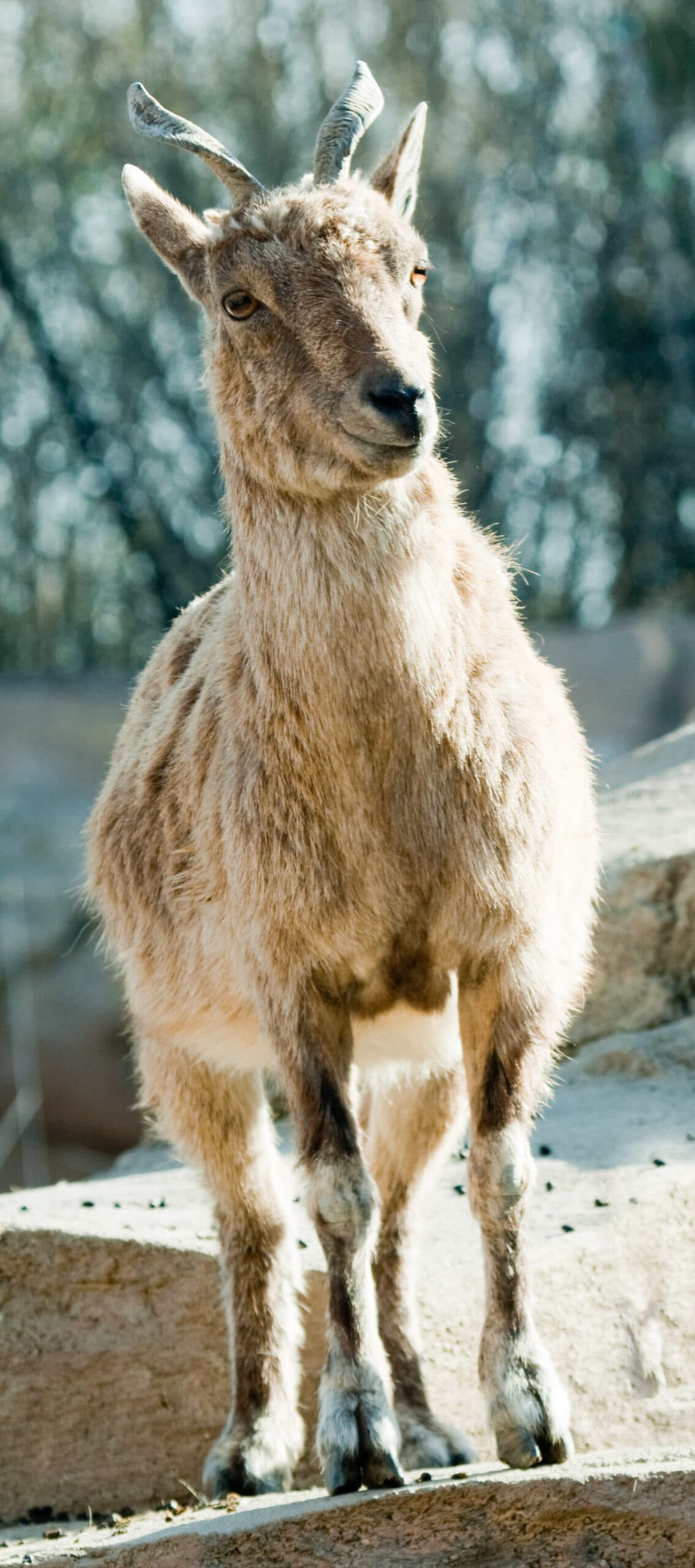
Markhor (Capra falconeri) is a large wild goat of rugged mountains and dry scrub from Afghanistan through Pakistan and India into parts of Central Asia. Both sexes carry spiral horns, but mature males develop the spectacular long corkscrews, heavy beard and shaggy winter coat that make the species unmistakable. This guide separates well-supported biology from common assumptions and covers identification, range, habitat, diet, behavior, reproduction and conservation.
Identification
A Markhor has a deep chest, powerful shoulders, relatively long legs and cloven hooves. Its horns twist around their axis and flare outward, with the tightness and direction of the spiral varying among populations. Adult males have a long dark beard, mane-like neck hair and shaggy pale winter pelage; females are smaller, lighter and less heavily haired, with much shorter horns. Males are substantially larger and heavier than females and carry far longer, more massive horns. Their beard and neck ruff become especially conspicuous in winter and during the rut.
Identification should combine body shape, markings, size, voice or movement, and location. One feature by itself can overlap with a related animal, a juvenile, or an individual in unusual light.
Photographs are most useful when they preserve scale and show several diagnostic features. Handling or repositioning a wild markhor for identification can cause stress and is unnecessary.
Size and physical adaptations
Markhor typically measures Head and body about 1.4–1.8 m and weighs Females roughly 32–50 kg; males often 80–110 kg. Body size and horn form vary among populations; exceptionally long male horns can exceed 1.5 m measured along the curve.
Its useful adaptations include flexible cloven hooves grip broken rock, strong limbs power steep uphill movement, corkscrew horns serve display and combat, seasonal coat insulates during cold winters, ruminant digestion extracts energy from coarse browse, keen eyesight detects distant danger, brown-gray pelage blends with cliffs and scrub, seasonal altitudinal movement tracks forage and snow. These traits work together in the animal’s normal setting rather than serving as isolated curiosities.
Published measurements may use different methods, life stages or sample locations. Comparing figures responsibly means checking what was measured rather than selecting the largest number available.
Range and distribution
Scattered, isolated populations occur through the western Himalaya, Karakoram, Hindu Kush and adjacent mountain systems from eastern Afghanistan across northern and western Pakistan into northwestern India, with remnant populations in Tajikistan, Turkmenistan and Uzbekistan. The native range includes Afghanistan, Pakistan, India, Tajikistan, Turkmenistan, Uzbekistan.
A country-level map indicates broad distribution, not continuous occupation. Climate, elevation, water, vegetation, prey, breeding sites, barriers and survey effort all affect where records occur.
Records near the edge of the range deserve careful documentation because they may reflect natural movement, improved survey coverage, accidental transport or a genuine distribution change.
Habitat
Arid and semi-arid mountains, precipitous rocky slopes, open woodland, oak and pine scrub, juniper country and river gorges, commonly from about 600 to 3,600 m elevation.
Markhor feed on slopes and wooded valleys where shrubs, grasses and tree foliage remain available. Cliffs provide escape terrain from predators. Many populations descend toward lower, less snowy ground in winter and climb higher when summer forage develops, but local movement depends on snow, livestock and disturbance. Protecting a population therefore requires the feeding, shelter and breeding features that make a site usable, along with connections that allow movement.
Microhabitat matters. Shade, soil, current, moisture, shelter or host plants can determine whether a small area is usable even when the surrounding landscape appears suitable.
Diet and feeding
Markhor is a herbivore and ruminant. Important foods include grasses, leaves, shrub shoots, oak foliage, juniper, wild fruit, herbs, twigs. Markhor graze grasses and herbs and browse shrubs or low tree branches, sometimes standing on the hind legs to reach leaves. A four-chambered stomach supports rumination, so animals rest and rechew fibrous food after long feeding bouts. Seasonal scarcity can bring them closer to livestock and settlements.
Diet changes with age, season, location and food supply. A dramatic prey record does not establish what most individuals eat most of the time; repeated field observations provide a stronger picture.
Feeding opportunities also create risk. An animal focused on prey may be less alert to predators, traffic or people, while contaminated prey can transfer pollutants through the food web.
Behavior and communication
Mostly diurnal, with strongest feeding in early morning and late afternoon. Females and young form small herds, while mature males are often solitary or in loose bachelor groups outside the breeding season. Animals move deliberately across ledges and run rapidly upslope when alarmed. During winter rut, males join female groups, posture side-on and clash horns to establish access to mates.
Sight and scent are central. Markhor monitor one another’s posture, horn presentation and movement, and smell identifies reproductive condition. Hoof stamps, snorts and alarm movements alert companions; females use soft nasal calls with kids. Rutting males communicate dominance through approach, parallel walking and horn clashes. Behavior should be interpreted in context: alarm, courtship, feeding and temperature regulation can produce very different actions from the same animal.
Daily schedules are flexible responses, not rigid rules. Weather, breeding condition, disturbance, tides or food can move activity into a different part of the day.
Reproduction and development
The rut occurs mainly in late autumn and winter. Males compete for access to female herds, and dominant males mate with several females. After a gestation of roughly five months, females separate into secluded rocky cover to give birth in spring or early summer. Usually 1–2 kids Kids can stand and follow their mother soon after birth. They nurse for about five to six months while sampling vegetation increasingly early. Young remain within protective female groups, where terrain and vigilance reduce predation risk. Females mature earlier than males, whose full competitive size takes several years.
Young animals face different risks and may use different microhabitats or food than adults. Breeding success depends on adult condition, suitable sites and the survival of offspring through vulnerable early stages.
Counts of eggs or young describe reproductive output, not the number expected to reach adulthood. Mortality is normally greatest during eggs, larval or juvenile stages.
Predators and ecological role
By grazing and browsing, Markhor shape mountain plant communities and disperse some seeds. They are important prey for large carnivores, especially Snow Leopards and Wolves. Their overlap with domestic goats and sheep connects wildlife conservation with rangeland management, disease prevention and predator-conflict policy. Documented or likely predators include Snow Leopard, Gray Wolf, Eurasian Lynx, Golden Eagle, Human.
This animal is both a consumer and a food source. Its influence comes through many repeated interactions, so ecological claims should be based on measured populations rather than assumptions drawn from appearance.
Predator and prey relationships differ among places. A species can be ecologically influential without being abundant everywhere, and its role can change across its range.
Relationship with people
The Markhor is Pakistan’s national animal and a powerful conservation symbol. Meat, horns and trophies created strong hunting pressure, while domestic livestock compete for forage and can transmit disease. Carefully regulated community conservation programs in parts of Pakistan have linked limited trophy-hunting revenue with local protection, but results depend on transparent quotas, sound surveys and fair community benefits.
Wild Markhor normally flee people. Observe from a distance and never approach rutting males, females with kids or animals on narrow ledges. Sudden pursuit can cause dangerous falls. Hunters and visitors must follow local protected-area and wildlife rules. Responsible observation means keeping an appropriate distance, avoiding capture or feeding, protecting habitat and following local wildlife or invasive-species guidance.
Wildlife guidance should come from the responsible local agency because collection rules, reporting requests and appropriate responses differ between native and introduced ranges.
Conservation
The IUCN lists the Markhor as Near Threatened. Numbers improved in some monitored areas after community protection, but the species remains fragmented and vulnerable to poaching, livestock competition, habitat degradation, disease and poorly planned development. The reported global trend is Increasing globally in the most recent widely cited assessment, with strong regional differences.
Important pressures include poaching, livestock competition, disease from domestic animals, habitat degradation, fragmentation by roads and development, small isolated populations. Global status can hide local decline or recovery, so current regional monitoring and habitat management remain necessary.
The most useful conservation action follows the documented pressure. Protecting breeding sites, reducing road deaths or limiting pollutants can require different tools in different populations.