
Species profileIUCN: LC

Mata Mata

Chelus fimbriata

A leaf-like South American freshwater turtle that waits on muddy bottoms and opens its enormous mouth to suction small fish from the water.

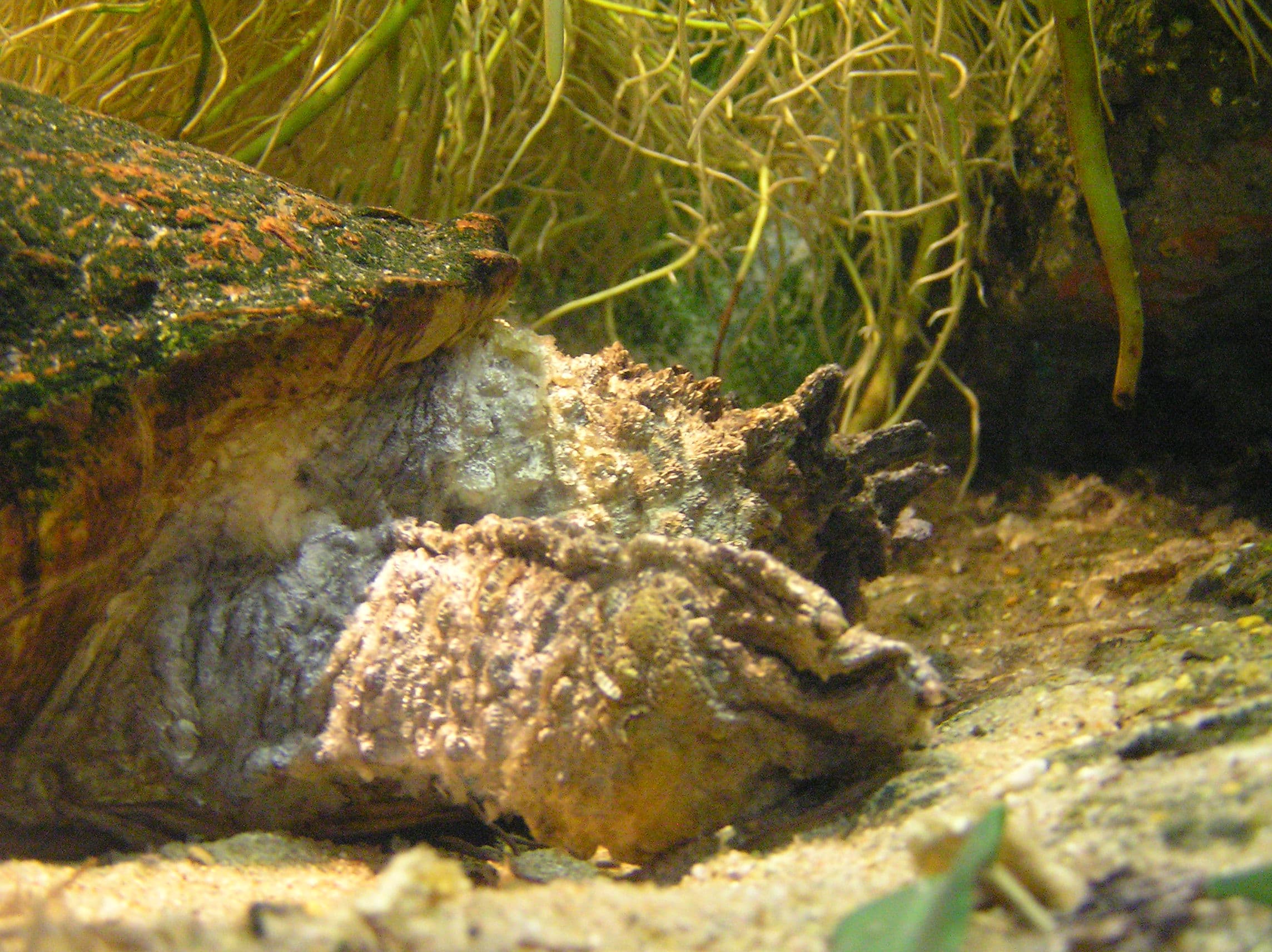
Mata Mata turtle underwater, showing its flattened triangular head, tubular snout, fringed neck and rough brown shell
Frank Wouters / Wikimedia Commons / CC BY 2.0
🌐 Read in Language:

⚡ At a Glance

Species profile
Also Known As
Amazon Mata Mata, Matamata Turtle
Diet Category
Aquatic carnivore and suction-feeding specialist
Activity Rhythm
Active by day and night but often motionless for long periods; many observations describe stronger nocturnal feeding.
Wild Lifespan
Wild lifespan is poorly known; managed animals can live for decades, and older 15-year figures are minimum records rather than a firm maximum
Typical Weight
large adults can reach about 17 kg
Conservation Status
LC
💡 Key Biological Insight: Instead of biting a fish in the usual way, a Mata Mata opens its mouth so quickly that water and prey rush inward together; excess water is expelled while the fish is swallowed whole.

🌳 Scientific Taxonomy Hierarchy

Chelus fimbriata is a full species in the South American side-necked turtle family Chelidae and order Testudines. A 2020 revision separated Orinoco and Río Negro populations as Chelus orinocensis, so older references describing one Mata Mata throughout both great basins combine two species. This page follows the narrower Amazonian concept of C. fimbriata.

KingdomAnimalia
PhylumChordata
ClassReptilia
OrderTestudines
FamilyChelidae
GenusChelus
SpeciesChelus fimbriata

Distinguishing Anatomical Features

  • ✓The flattened triangular head has a long snorkel-like nose, tiny eyes, an extremely wide mouth and numerous fleshy flaps. The long neck carries warts, ridges and fringes that blur its outline. Three knobby keels run along a rough brown carapace with serrated rear edges. Juveniles may show salmon, orange or pink on the plastron and underside of the neck; these colors fade toward yellow and brown with age.
  • ✓Tubular snout permits breathing with little movement
  • ✓Wide mouth creates rapid suction
  • ✓Fleshy skin flaps camouflage the head and sense water movement
  • ✓Rough shell resembles submerged wood
  • ✓Long neck reaches prey without moving the body
  • ✓Webbed feet support movement in shallow water
  • ✓Side-necked folding protects the head beneath the shell edge

📏 Physical Measurements

Total Lengthadult carapace commonly 12–18 in; exceptional females exceed 20 in
Body Weightlarge adults can reach about 38 lb
Tail LengthShort and pointed in females; longer and thicker in males
WingspanNot applicable
Top SpeedNo dependable universal maximumMovement changes with context and conditions.

🎨 Appearance & Distinctive Markings

BrownBlackOliveTanOrangeCreamOliveOrangeCream

Skin / Covering: Rough scaled skin with sensory fringes and tubercles

Sexual Dimorphism: Adult males have a longer, thicker tail, the vent beyond the shell edge and a more concave plastron; females usually grow larger and have a shorter tail.

🗺️ Geographic Distribution & Habitat

Amazon drainage and connected rivers of tropical northern South America, together with eastern Guiana Shield drainages. Older maps often extend the species into the Orinoco and Río Negro, but many of those animals are now assigned to Chelus orinocensis. Local identification should consider basin as well as external pattern.

Warm, shallow, slow-moving streams, oxbow lakes, swamps, marshes and flooded forest with muddy bottoms, leaf litter and submerged vegetation.

Country-level distribution map

Native range
FijiTanzaniaWestern SaharaCanadaUnited StatesKazakhstanUzbekistanPapua New GuineaIndonesiaArgentinaChileCongo - KinshasaSomaliaKenyaSudanChadHaitiDominican RepublicRussiaBahamasFalkland IslandsNorwayGreenlandFrench Southern TerritoriesTimor-LesteSouth AfricaLesothoMexicoUruguayBrazil — Native rangeBolivia — Native rangePeru — Native rangeColombia — Native rangePanamaCosta RicaNicaraguaHondurasEl SalvadorGuatemalaBelizeVenezuelaGuyana — Native rangeSuriname — Native rangeFranceEcuador — Native rangePuerto RicoJamaicaCubaZimbabweBotswanaNamibiaSenegalMaliMauritaniaBeninNigerNigeriaCameroonTogoGhanaCôte d’IvoireGuineaGuinea-BissauLiberiaSierra LeoneBurkina FasoCentral African RepublicCongo - BrazzavilleGabonEquatorial GuineaZambiaMalawiMozambiqueEswatiniAngolaBurundiIsraelLebanonMadagascarPalestinian TerritoriesGambiaTunisiaAlgeriaJordanUnited Arab EmiratesQatarKuwaitIraqOmanVanuatuCambodiaThailandLaosMyanmar (Burma)VietnamNorth KoreaSouth KoreaMongoliaIndiaBangladeshBhutanNepalPakistanAfghanistanTajikistanKyrgyzstanTurkmenistanIranSyriaArmeniaSwedenBelarusUkrainePolandAustriaHungaryMoldovaRomaniaLithuaniaLatviaEstoniaGermanyBulgariaGreeceTürkiyeAlbaniaCroatiaSwitzerlandLuxembourgBelgiumNetherlandsPortugalSpainIrelandNew CaledoniaSolomon IslandsNew ZealandAustraliaSri LankaChinaTaiwanItalyDenmarkUnited KingdomIcelandAzerbaijanGeorgiaPhilippinesMalaysiaBruneiSloveniaFinlandSlovakiaCzechiaEritreaJapanParaguayYemenSaudi ArabiaCyprusMoroccoEgyptLibyaEthiopiaDjiboutiUgandaRwandaBosnia & HerzegovinaNorth MacedoniaSerbiaMontenegroKosovoTrinidad & TobagoSouth Sudan
Highlighted countries are recorded profile locations, not precise biological range boundaries.Map boundaries: Natural Earth

💡 Did You Know?

  • 💡Tubular snout permits breathing with little movement
  • 💡Wide mouth creates rapid suction
  • 💡Fleshy skin flaps camouflage the head and sense water movement
  • 💡Rough shell resembles submerged wood
  • 💡Long neck reaches prey without moving the body
  • 💡Webbed feet support movement in shallow water
  • 💡Side-necked folding protects the head beneath the shell edge

🌿 Conservation Status & Threats

IUCN: LC — Least Concern

“Recent freshwater-turtle assessments treat Chelus fimbriata as Least Concern, but national status and local pressure differ. Collection for trade, wetland degradation and poor species-level records justify continued monitoring after the split from C. orinocensis.”

Population TrendUnknown at species level after the recent taxonomic split
Wild Population EstimateNo reliable global count; broad but uneven distribution in Amazonian and Guianan waters
CITESAppendix II for Chelus species since 2023

⚠️ Major Threats to Mata Mata

  • •Collection for international pet trade
  • •Floodplain deforestation
  • •Water pollution
  • •Dams and altered flood cycles
  • •Fire and drought
  • •Confusion in records with Chelus orinocensis

🔄 Life Cycle & Reproduction

Wild vs. Captivity Lifespan Comparison

🌿 In the WildWild lifespan is poorly known; managed animals can live for decades, and older 15-year figures are minimum records rather than a firm maximum
🏠 In Captivity (with veterinary care)Accredited institutions provide large shallow pools, gentle filtration, warm stable water, hiding structure, varied whole fish and veterinary monitoring while maintaining legal provenance records.
Clutch / Litter SizeUsually about 12–28 nearly spherical eggs
Incubation / GestationAround 200 days in reported managed conditions, influenced by temperature
Fledging / WeaningIndependent aquatic hatchling with brighter underside colors
Sexual MaturityNot reliably established across wild populations
Mating SystemAquatic courtship with internal fertilization
Nesting / Den TypeBuried terrestrial nest in soil or decaying vegetation near water

🦅 Behavior & Field Ecology

Aquatic carnivore and suction-feeding specialist

🌐 Ecological Food Web & Relationships: The Mata Mata is a specialized mesopredator in quiet-water food webs. It consumes small fish and other aquatic prey and is itself most vulnerable as an egg or hatchling. Floodplain connectivity lets prey recolonize pools and maintains the leaf-litter habitat that makes camouflage effective. By focusing on prey close to the bottom, it occupies a different hunting niche from fast-swimming fish predators.

Social Group SizeSolitary except during courtship
Activity RhythmActive by day and night but often motionless for long periods; many observations describe stronger nocturnal feeding.
Feeding StrategyAquatic carnivore and suction-feeding specialist

🥩 Primary Prey & Preferred Diet

✓ Small fish✓ Aquatic insect larvae✓ Crustaceans✓ Tadpoles✓ Other small aquatic animals

📢 Communication & Territorial Signals

  • Water-borne vibration
  • Chemical cues
  • Head extension during courtship
  • Mouth-opening display
  • Movement of head fringes
  • Tactile contact

🐾 Wild Temperament & Traits

• Solitary• Sedentary• Patient ambush predator• Aquatic• Secretive• Poor swimmer in strong current

🤝 Human Interaction & Pet Advisory

⚠️ Strictly Wild Species
🚫

Can You Keep a Mata Mata as a Pet?

This is unsuitable for casual pet keeping. An adult needs an enormous warm filtered pool with shallow depth, low current, secure land access and specialized whole-prey nutrition. Legal CITES documentation, long-term veterinary care and decades of commitment are essential. Wild-caught animals should not be purchased.

Domestication StatusWild turtle; never domesticated
Danger to HumansLow; defensive handling and hygiene risks
Economic & Ecotourism RoleFloodplain food webs, study of suction feeding and sensory biology, responsible ecotourism, taxonomic research and public education about Amazon wetlands.

⚠️ Behavioral Risk Factors & Wildlife Safety

  • Powerful suction and wide jaws can startle handlers
  • Heavy shell can be dropped if unsupported
  • Aquatic turtles can carry Salmonella
  • Rough handling damages the long neck and snout

🌐 Ecological Food Web & Relationships

🦅 Natural Predators (5)

Large CaimanCaimaninae
Large CatfishSiluriformes
TeguSalvator spp.
Vultures and CorvidsAves
HumanHomo sapiens

🧬 Related Species (4)

Orinoco Mata MataChelus orinocensisSister species described from the Orinoco and Río Negro basins
Snake-Necked TurtleHydromedusa tectiferaSouth American chelid with a long neck
Giant South American River TurtlePodocnemis expansaLarge side-necked river turtle with different feeding and nesting ecology
Common Snapping TurtleChelydra serpentinaUnrelated ambush-feeding turtle sometimes compared by appearance

Mata Mata (Chelus fimbriata) is an aquatic side-necked turtle of the Amazon basin and eastern Guianas. Its triangular head, tubular snout, fringed neck and ridged shell resemble waterlogged bark and leaves. The disguise supports a patient feeding strategy: the turtle remains still until prey approaches, then rapidly expands its throat and mouth to pull in water and a fish. This guide separates well-supported biology from common assumptions and covers identification, range, habitat, diet, behavior, reproduction and conservation.

Identification

The flattened triangular head has a long snorkel-like nose, tiny eyes, an extremely wide mouth and numerous fleshy flaps. The long neck carries warts, ridges and fringes that blur its outline. Three knobby keels run along a rough brown carapace with serrated rear edges. Juveniles may show salmon, orange or pink on the plastron and underside of the neck; these colors fade toward yellow and brown with age. Adult males have a longer, thicker tail, the vent beyond the shell edge and a more concave plastron; females usually grow larger and have a shorter tail.

Identification should combine body shape, markings, size, voice or movement, and location. One feature by itself can overlap with a related animal, a juvenile, or an individual in unusual light.

Photographs are most useful when they preserve scale and show several diagnostic features. Handling or repositioning a wild mata mata for identification can cause stress and is unnecessary.

Size and physical adaptations

Mata Mata typically measures adult carapace commonly 31–45 cm; exceptional females exceed 50 cm and weighs large adults can reach about 17 kg. The highest measurements vary among studies and may reflect populations formerly combined before Chelus orinocensis was recognized.

Its useful adaptations include tubular snout permits breathing with little movement, wide mouth creates rapid suction, fleshy skin flaps camouflage the head and sense water movement, rough shell resembles submerged wood, long neck reaches prey without moving the body, webbed feet support movement in shallow water, side-necked folding protects the head beneath the shell edge. These traits work together in the animal’s normal setting rather than serving as isolated curiosities.

Published measurements may use different methods, life stages or sample locations. Comparing figures responsibly means checking what was measured rather than selecting the largest number available.

Range and distribution

Amazon drainage and connected rivers of tropical northern South America, together with eastern Guiana Shield drainages. Older maps often extend the species into the Orinoco and Río Negro, but many of those animals are now assigned to Chelus orinocensis. Local identification should consider basin as well as external pattern. The native range includes Bolivia, Brazil, Colombia, Ecuador, French Guiana, Guyana, Peru, Suriname.

A country-level map indicates broad distribution, not continuous occupation. Climate, elevation, water, vegetation, prey, breeding sites, barriers and survey effort all affect where records occur.

Records near the edge of the range deserve careful documentation because they may reflect natural movement, improved survey coverage, accidental transport or a genuine distribution change.

Habitat

Warm, shallow, slow-moving streams, oxbow lakes, swamps, marshes and flooded forest with muddy bottoms, leaf litter and submerged vegetation.

Adults usually walk slowly along the bottom rather than swimming through open water. They choose quiet margins where leaf debris and roots provide cover and where the tubular snout can reach the surface without exposing the head. Flood pulses connect pools and forest habitat, while females require accessible banks or decaying vegetation for nests. Fast current and deep open water are poor matches for their weak-swimming build. Protecting a population therefore requires the feeding, shelter and breeding features that make a site usable, along with connections that allow movement.

Microhabitat matters. Shade, soil, current, moisture, shelter or host plants can determine whether a small area is usable even when the surrounding landscape appears suitable.

Diet and feeding

Mata Mata is a aquatic carnivore and suction-feeding specialist. Important foods include small fish, aquatic insect larvae, crustaceans, tadpoles, other small aquatic animals. A Mata Mata waits nearly motionless until a fish enters range. Sensory nerves in facial fringes and skin detect water displacement even in murky habitat. The turtle thrusts the head, drops the floor of the mouth and expands the throat, creating negative pressure that draws prey and water inward. The jaws are not built to tear food, so suitable prey is swallowed whole after water is expelled.

Diet changes with age, season, location and food supply. A dramatic prey record does not establish what most individuals eat most of the time; repeated field observations provide a stronger picture.

Feeding opportunities also create risk. An animal focused on prey may be less alert to predators, traffic or people, while contaminated prey can transfer pollutants through the food web.

Behavior and communication

Active by day and night but often motionless for long periods; many observations describe stronger nocturnal feeding. This is a solitary, sedentary turtle. Camouflage and slow deliberate movement reduce the need to chase prey or flee conspicuously. Adults rarely bask and usually remain submerged, surfacing only the tip of the snout to breathe. When disturbed they may withdraw the head sideways beneath the front shell edge, release water or attempt to walk deeper rather than sprinting across land.

Mata Matas rely strongly on vibration, water movement, touch and chemical information. During courtship a male extends the head toward a female, opens and closes the mouth, moves the lateral head flaps and stretches the limbs. Outside breeding encounters, there is little evidence for elaborate social signaling or stable groups. Behavior should be interpreted in context: alarm, courtship, feeding and temperature regulation can produce very different actions from the same animal.

Daily schedules are flexible responses, not rigid rules. Weather, breeding condition, disturbance, tides or food can move activity into a different part of the day.

Reproduction and development

Courtship occurs in water, where a male repeatedly extends his head toward a female and performs mouth and limb displays. Fertilization is internal. In parts of the upper Amazon, nesting is reported from October through December. The female leaves water and digs in soft soil or decaying vegetation near forest margins, a different setting from the open sand used by many river turtles. Usually about 12–28 nearly spherical eggs Embryos develop slowly inside hard-shelled eggs about 3.5 centimetres across. Hatchlings dig free and move toward water without parental care. Young turtles have brighter salmon and dark markings below, a smaller feeding gape and greater swimming ability than heavy adults. Growth, survival and sex determination in wild nests need further field study.

Young animals face different risks and may use different microhabitats or food than adults. Breeding success depends on adult condition, suitable sites and the survival of offspring through vulnerable early stages.

Counts of eggs or young describe reproductive output, not the number expected to reach adulthood. Mortality is normally greatest during eggs, larval or juvenile stages.

Predators and ecological role

The Mata Mata is a specialized mesopredator in quiet-water food webs. It consumes small fish and other aquatic prey and is itself most vulnerable as an egg or hatchling. Floodplain connectivity lets prey recolonize pools and maintains the leaf-litter habitat that makes camouflage effective. By focusing on prey close to the bottom, it occupies a different hunting niche from fast-swimming fish predators. Documented or likely predators include Large Caiman, Large Catfish, Tegu, Vultures and Corvids, Human.

This animal is both a consumer and a food source. Its influence comes through many repeated interactions, so ecological claims should be based on measured populations rather than assumptions drawn from appearance.

Predator and prey relationships differ among places. A species can be ecologically influential without being abundant everywhere, and its role can change across its range.

Relationship with people

The extraordinary appearance makes Mata Matas valuable for education and highly sought in the international pet trade. Range countries have imposed export controls, and the genus Chelus is listed in CITES Appendix II, requiring documented legal international trade. Taxonomic separation of C. fimbriata and C. orinocensis also means shipment records and older population reports must be rechecked by basin.

A Mata Mata is not aggressive toward people, but it should be left in water and never lifted by the neck, limbs or tail. Its heavy body requires full support. Wild animals may carry Salmonella, and capture can injure the delicate snout and skin fringes. Never release captive turtles, and report illegal trade through wildlife authorities. Responsible observation means keeping an appropriate distance, avoiding capture or feeding, protecting habitat and following local wildlife or invasive-species guidance.

Wildlife guidance should come from the responsible local agency because collection rules, reporting requests and appropriate responses differ between native and introduced ranges.

Conservation

Recent freshwater-turtle assessments treat Chelus fimbriata as Least Concern, but national status and local pressure differ. Collection for trade, wetland degradation and poor species-level records justify continued monitoring after the split from C. orinocensis. The reported global trend is Unknown at species level after the recent taxonomic split.

Important pressures include collection for international pet trade, floodplain deforestation, water pollution, dams and altered flood cycles, fire and drought, confusion in records with chelus orinocensis. Global status can hide local decline or recovery, so current regional monitoring and habitat management remain necessary.

The most useful conservation action follows the documented pressure. Protecting breeding sites, reducing road deaths or limiting pollutants can require different tools in different populations.

Sources and further reading

❓ Frequently Asked Questions

Answers to frequently asked questions verified against peer-reviewed zoological research.

It opens its wide mouth and expands the throat extremely quickly, creating suction that pulls water and a nearby fish into the mouth.