
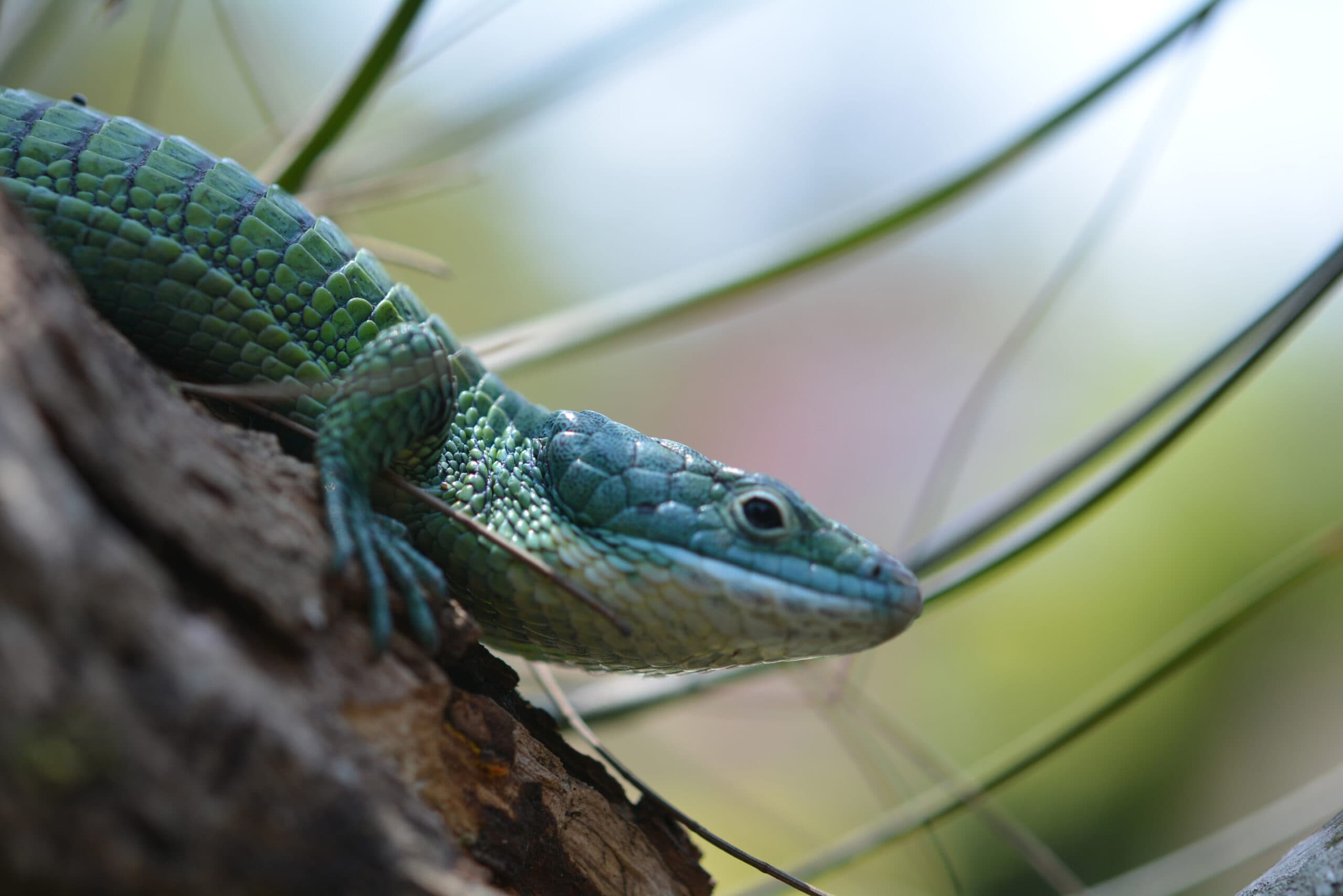
Mexican Alligator Lizard (Abronia graminea) is an arboreal anguine lizard endemic to highlands in Veracruz, eastern Puebla and northern Oaxaca. Adults are famous for green or blue-green scales, a triangular head and a long grasping tail, but juveniles and some adults can be brown or mottled. They live in cool humid forest canopies, using moss, bark crevices and epiphytes for shelter and hunting. This guide separates well-supported biology from common assumptions and covers identification, range, habitat, diet, behavior, reproduction and conservation.
Identification
Adults have a flattened triangular head, strong jaws, a long body, short sturdy limbs and a tail longer than the head and body. The large overlapping scales form an armored, alligator-like texture. Mature animals are often bright green, turquoise or blue-green with yellow around the eyes, while juveniles tend to be brown and banded. Color varies with age, sex, individual and light, so scale arrangement and locality remain important. Adult males often have broader heads and more robust jaw muscles, while females may become heavier during pregnancy. Color overlaps between sexes and cannot reliably determine sex by itself.
Identification should combine body shape, markings, size, voice or movement, and location. One feature by itself can overlap with a related animal, a juvenile, or an individual in unusual light.
Photographs are most useful when they preserve scale and show several diagnostic features. Handling or repositioning a wild mexican alligator lizard for identification can cause stress and is unnecessary.
Size and physical adaptations
Mexican Alligator Lizard typically measures up to about 10.6 cm snout to vent plus a tail reaching about 16 cm and weighs commonly several tens of grams; dependable wild mass ranges are limited. Total length can approach 27 cm when the original tail is intact, but tail loss and regeneration change measurements.
Its useful adaptations include long tail braces against branches, strong toes grip bark and epiphytes, armored scales protect the body, green and blue tones blend into mossy canopy, live birth avoids exposed forest eggs, broad head powers a strong defensive bite, slow deliberate movement reduces detection. These traits work together in the animal’s normal setting rather than serving as isolated curiosities.
Published measurements may use different methods, life stages or sample locations. Comparing figures responsibly means checking what was measured rather than selecting the largest number available.
Range and distribution
Endemic to a small, fragmented highland region in central Veracruz, eastern Puebla and northern Oaxaca, Mexico. Records are associated with mountain systems rather than all land inside those states, and the estimated extent of occurrence is under roughly 3,000 square kilometres. The native range includes Mexico.
A country-level map indicates broad distribution, not continuous occupation. Climate, elevation, water, vegetation, prey, breeding sites, barriers and survey effort all affect where records occur.
Records near the edge of the range deserve careful documentation because they may reflect natural movement, improved survey coverage, accidental transport or a genuine distribution change.
Habitat
Cool humid cloud forest, pine-oak forest and well-vegetated secondary forest with epiphytes, mossy trunks and bromeliads, generally at middle to high elevations.
Individuals spend much of their time above ground on trunks, branches and within bromeliads, where humidity remains high and prey is abundant. Dense epiphytes provide cover from predators and temperature extremes. Lizards may descend or appear at forest edges, but survival depends on connected canopy and moist microclimates rather than isolated ornamental trees. Protecting a population therefore requires the feeding, shelter and breeding features that make a site usable, along with connections that allow movement.
Microhabitat matters. Shade, soil, current, moisture, shelter or host plants can determine whether a small area is usable even when the surrounding landscape appears suitable.
Diet and feeding
Mexican Alligator Lizard is a arboreal predator of invertebrates and small animals. Important foods include crickets, beetles, cockroaches, caterpillars, spiders, snails, other small invertebrates. The lizard searches slowly among moss, leaf bases and bark crevices, then seizes prey with strong jaws. Seasonal rain changes insect abundance. Captive feeding reports include many insects, but field diets are incompletely sampled and should not be expanded into unsupported claims about frequent vertebrate prey.
Diet changes with age, season, location and food supply. A dramatic prey record does not establish what most individuals eat most of the time; repeated field observations provide a stronger picture.
Feeding opportunities also create risk. An animal focused on prey may be less alert to predators, traffic or people, while contaminated prey can transfer pollutants through the food web.
Behavior and communication
Diurnal, arboreal and most active under mild humid conditions rather than intense heat. A Mexican Alligator Lizard often freezes among foliage or retreats deeper into a bromeliad when disturbed. It climbs deliberately and can anchor with the tail. If captured, it may gape and bite forcefully; this is defensive behavior, not aggression toward people. Cool conditions limit activity, while basking through filtered light helps regulate body temperature.
Visual posture, scent and touch guide courtship and territorial encounters. Tongue flicking samples chemical information. A threatened animal flattens or arches the body, opens the jaws and may bite, while color and stillness help it avoid detection before conflict begins. It also detects vibrations moving through branches. Behavior should be interpreted in context: alarm, courtship, feeding and temperature regulation can produce very different actions from the same animal.
Daily schedules are flexible responses, not rigid rules. Weather, breeding condition, disturbance, tides or food can move activity into a different part of the day.
Reproduction and development
Mating takes place in the forest canopy and fertilization is internal. Females retain developing embryos and give birth rather than laying exposed eggs. Pregnancy can extend through cool months, allowing females to use behavior and selected basking sites to influence embryo temperature. Usually several live young; reported litters vary with female size and condition Newborns are fully formed, brownish or banded and immediately climb and hunt tiny prey. They receive no prolonged parental feeding. Growth and color change occur gradually, and young lizards depend on dense small-scale cover where dehydration and predation risk are lower.
Young animals face different risks and may use different microhabitats or food than adults. Breeding success depends on adult condition, suitable sites and the survival of offspring through vulnerable early stages.
Counts of eggs or young describe reproductive output, not the number expected to reach adulthood. Mortality is normally greatest during eggs, larval or juvenile stages.
Predators and ecological role
This lizard removes canopy invertebrates and is prey for birds, snakes and small mammals. By using bromeliads and mossy bark it participates in a canopy community that is often missed by ground surveys. Its restricted range makes it a useful indicator of cloud-forest continuity, humidity and the survival of epiphyte-rich old trees. Documented or likely predators include Loggerhead Shrike, Arboreal snakes, Raptors, Small carnivores, Domestic cats.
This animal is both a consumer and a food source. Its influence comes through many repeated interactions, so ecological claims should be based on measured populations rather than assumptions drawn from appearance.
Predator and prey relationships differ among places. A species can be ecologically influential without being abundant everywhere, and its role can change across its range.
Relationship with people
The striking color makes this species valuable to ecotourism and attractive in international reptile trade. Trade is regulated under CITES Appendix II, and Mexico also protects endemic wildlife. Wild animals should never be collected or purchased without legal origin documents. Community forest protection and documented conservation breeding can support survival when they do not create demand for laundering wild-caught animals.
The species is not venomous and is not dangerous when left alone, but a restrained adult can deliver a painful bite. Observe without handling, never pull one from a bromeliad, and wash hands after legitimate captive enclosure work because reptiles can carry Salmonella. Responsible observation means keeping an appropriate distance, avoiding capture or feeding, protecting habitat and following local wildlife or invasive-species guidance.
Wildlife guidance should come from the responsible local agency because collection rules, reporting requests and appropriate responses differ between native and introduced ranges.
Conservation
The IUCN assessment lists Abronia graminea as Endangered because its small highland range is severely fragmented and habitat quality continues to decline. CITES regulates international trade, while Mexican law affords national protection. Local abundance is difficult to estimate because the species lives high in dense vegetation. The reported global trend is Decreasing.
Important pressures include cloud-forest clearing, agricultural expansion, logging and fuelwood removal, fragmentation and edge drying, illegal collection, climate-driven cloud changes, roads and settlement growth. Global status can hide local decline or recovery, so current regional monitoring and habitat management remain necessary.
The most useful conservation action follows the documented pressure. Protecting breeding sites, reducing road deaths or limiting pollutants can require different tools in different populations.