
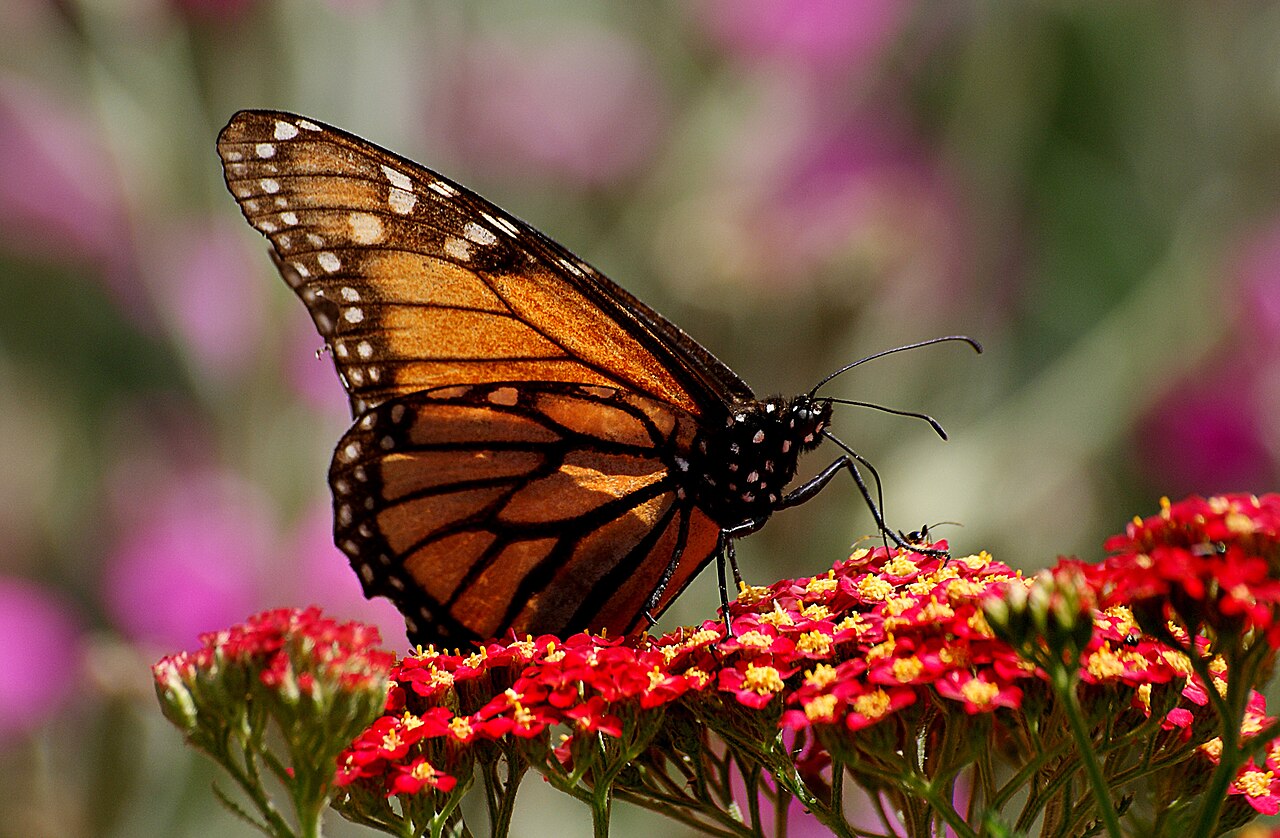
Monarch Butterfly (Danaus plexippus) is an orange-and-black milkweed butterfly found across much of the Americas and introduced to several Pacific regions. This guide separates well-supported biology from common assumptions and covers identification, range, habitat, diet, behavior, reproduction and conservation.
Identification
Adults have orange wings divided by black veins and bordered in black with two rows of white spots. Caterpillars are banded yellow, black and white and carry two pairs of flexible black filaments. Males have a black scent-scale spot on each hindwing and usually thinner black veins; females lack the spots and tend to have thicker veins.
Identification should combine body shape, markings, size, voice or movement, and location. One feature by itself can overlap with a related animal, a juvenile, or an individual in unusual light.
Photographs are most useful when they preserve scale and show several diagnostic features. Handling or repositioning a wild monarch butterfly for identification can cause stress and is unnecessary.
Size and physical adaptations
Monarch Butterfly typically measures adult body roughly 4–5 cm and weighs about 0.25–0.75 g depending on season and condition. Adult wingspan is generally about 8.6–12.4 cm; migratory mass changes as butterflies build and consume fat reserves.
Its useful adaptations include caterpillars sequester milkweed cardenolides, orange-and-black warning colors advertise chemical defense, sun compass and circadian clock guide migration, reproductive diapause extends the migratory generation’s life, broad wings support efficient soaring and gliding. These traits work together in the animal’s normal setting rather than serving as isolated curiosities.
Published measurements may use different methods, life stages or sample locations. Comparing figures responsibly means checking what was measured rather than selecting the largest number available.
Range and distribution
Native across much of North, Central and northern South America and the Caribbean, with established introduced populations on Pacific islands, Australia, New Zealand and parts of the Atlantic region. The native range includes Canada, United States, Mexico, Central America, Caribbean islands.
A country-level map indicates broad distribution, not continuous occupation. Climate, elevation, water, vegetation, prey, breeding sites, barriers and survey effort all affect where records occur.
Records near the edge of the range deserve careful documentation because they may reflect natural movement, improved survey coverage, accidental transport or a genuine distribution change.
Habitat
Open woodland, prairie, meadows, wetlands, roadsides, gardens and agricultural edges where milkweed and season-long nectar are available; migratory populations also require protected overwintering forests.
Eggs and larvae depend on milkweeds. Adults use many nectar flowers and stopover sites. Eastern migrants cluster in high-elevation oyamel fir forest in central Mexico, while western butterflies use multiple coastal and Mexican sites. Protecting a population therefore requires the feeding, shelter and breeding features that make a site usable, along with connections that allow movement.
Microhabitat matters. Shade, soil, current, moisture, shelter or host plants can determine whether a small area is usable even when the surrounding landscape appears suitable.
Diet and feeding
Monarch Butterfly is a herbivore as a larva; nectar feeder as an adult. Important foods include milkweed leaves for caterpillars, flower nectar for adults, water and dissolved minerals from damp ground. Larvae chew milkweed and store some plant cardenolides that deter many predators. Adults uncoil a proboscis to drink nectar, building lipid reserves needed for migration and overwintering.
Diet changes with age, season, location and food supply. A dramatic prey record does not establish what most individuals eat most of the time; repeated field observations provide a stronger picture.
Feeding opportunities also create risk. An animal focused on prey may be less alert to predators, traffic or people, while contaminated prey can transfer pollutants through the food web.
Behavior and communication
Diurnal, flying when sunlight and temperature permit and roosting communally during migration. Breeding generations move progressively north and live only weeks. The autumn generation delays reproduction, orients using sunlight adjusted by an internal clock, rides favorable air currents and can travel thousands of kilometres before clustering through winter.
Adults rely mainly on vision and chemical cues. Males use pheromones and courtship flight; color warns predators, while larvae detect plant chemicals and vibration. Behavior should be interpreted in context: alarm, courtship, feeding and temperature regulation can produce very different actions from the same animal.
Daily schedules are flexible responses, not rigid rules. Weather, breeding condition, disturbance, tides or food can move activity into a different part of the day.
Reproduction and development
A female searches for milkweed and attaches single eggs, usually to the underside of a leaf. Multiple generations reproduce across the warm season; autumn migrants pause reproduction until late winter or spring. Hundreds of eggs laid singly across many plants undefined
Young animals face different risks and may use different microhabitats or food than adults. Breeding success depends on adult condition, suitable sites and the survival of offspring through vulnerable early stages.
Counts of eggs or young describe reproductive output, not the number expected to reach adulthood. Mortality is normally greatest during eggs, larval or juvenile stages.
Predators and ecological role
Monarchs pollinate some flowers while feeding, transfer energy among trophic levels and connect farms, cities, prairies and forests across an international migration corridor. Documented or likely predators include Black-headed Grosbeak, Black-backed Oriole, Chinese Mantis, Tachinid Flies.
This animal is both a consumer and a food source. Its influence comes through many repeated interactions, so ecological claims should be based on measured populations rather than assumptions drawn from appearance.
Predator and prey relationships differ among places. A species can be ecologically influential without being abundant everywhere, and its role can change across its range.
Relationship with people
Habitat restoration can help, but it must use locally native milkweeds and pesticide-aware management. Handling or mass-rearing may spread disease and disrupt adaptation, so habitat creation is generally more useful than releasing captive butterflies.
Monarchs are harmless to people. Avoid touching wings, and wash hands after handling milkweed because its sap can irritate skin and eyes. Responsible observation means keeping an appropriate distance, avoiding capture or feeding, protecting habitat and following local wildlife or invasive-species guidance.
Wildlife guidance should come from the responsible local agency because collection rules, reporting requests and appropriate responses differ between native and introduced ranges.
Conservation
The IUCN lists the migratory monarch as Vulnerable following a reassessment of population data. U.S. federal protection has also been proposed. Risk differs among eastern, western and non-migratory populations, but major North American migratory populations remain far below historical abundance. The reported global trend is Decreasing overall with large annual fluctuations.
Important pressures include loss of milkweed and nectar habitat, degradation of overwintering forest, herbicide and insecticide exposure, drought, heat and severe storms, disease associated with crowding and poor rearing practices. Global status can hide local decline or recovery, so current regional monitoring and habitat management remain necessary.
The most useful conservation action follows the documented pressure. Protecting breeding sites, reducing road deaths or limiting pollutants can require different tools in different populations.