
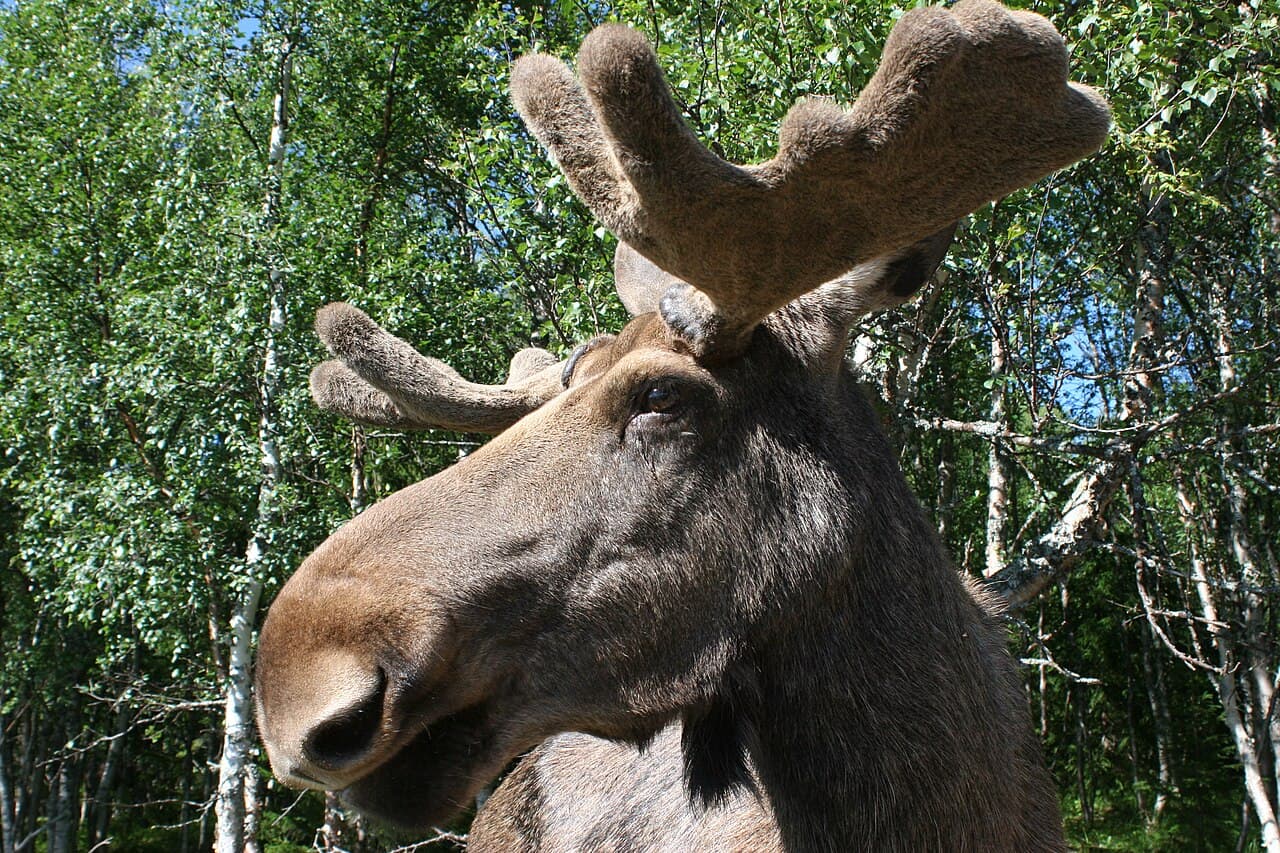
Moose (Alces alces) is the largest living member of the deer family and a defining animal of boreal forests across North America and Eurasia. Long legs carry it through snow, marshes and fallen timber, while a flexible upper lip strips leaves and twigs. Bulls grow enormous palmate antlers each year. Despite their height and power, Moose face heat stress, parasites and vehicle collisions as northern climates change. This guide separates well-supported biology from common assumptions and covers identification, range, habitat, diet, behavior, reproduction and conservation.
Identification
A Moose has an extremely tall shoulder, long pale lower legs, a short tail, humped shoulders and an elongated overhanging muzzle. A furred flap called the bell hangs beneath the throat in both sexes. Coat color ranges from golden brown to nearly black. Only bulls normally grow broad palm-shaped antlers, which are covered in velvet while growing and shed each winter. Bulls are larger than cows and grow antlers; cows lack antlers and have a more slender head.
Identification should combine body shape, markings, size, voice or movement, and location. One feature by itself can overlap with a related animal, a juvenile, or an individual in unusual light.
Photographs are most useful when they preserve scale and show several diagnostic features. Handling or repositioning a wild moose for identification can cause stress and is unnecessary.
Size and physical adaptations
Moose typically measures About 2.4–3.2 m head and body and weighs Usually 270–700 kg; large Alaska bulls may exceed 700 kg. Alaska and Yukon populations include the largest animals, while southern subspecies are smaller.
Its useful adaptations include long legs cross deep snow and wetlands, wide spreading hooves support weight on soft ground, large muzzle and mobile upper lip strip browse, dense hollow hair traps insulating air, closable nostrils assist underwater feeding, large body conserves heat, excellent swimming connects islands and feeding sites, rapid annual antler growth supports rut competition. These traits work together in the animal’s normal setting rather than serving as isolated curiosities.
Published measurements may use different methods, life stages or sample locations. Comparing figures responsibly means checking what was measured rather than selecting the largest number available.
Range and distribution
Circumpolar across northern forests from Alaska and Canada through parts of the northern United States, Scandinavia, the Baltic region, Poland and Belarus east across Russia to Mongolia and northern China. Southern boundaries follow cool wetlands, mountains and regenerating forests. Small introduced populations or historical introductions have occurred outside the native range. The native range includes United States, Canada, Norway, Sweden, Finland, Russia, Estonia, Latvia, Lithuania, Poland, Belarus, Ukraine, Czech Republic, Mongolia, China, Kazakhstan.
A country-level map indicates broad distribution, not continuous occupation. Climate, elevation, water, vegetation, prey, breeding sites, barriers and survey effort all affect where records occur.
Records near the edge of the range deserve careful documentation because they may reflect natural movement, improved survey coverage, accidental transport or a genuine distribution change.
Habitat
Boreal and mixed forest, willow and birch scrub, forest burns, wetlands, lake margins, river valleys and subalpine meadows.
Moose select young forest, burns and logged areas rich in regenerating willow, birch and aspen. In summer they cool in shaded wetlands and feed on aquatic plants. Winter pushes them toward conifer cover and browse above deep snow. Access to both dense refuge and productive openings is more important than old forest alone. Protecting a population therefore requires the feeding, shelter and breeding features that make a site usable, along with connections that allow movement.
Microhabitat matters. Shade, soil, current, moisture, shelter or host plants can determine whether a small area is usable even when the surrounding landscape appears suitable.
Diet and feeding
Moose is a herbivore and browser. Important foods include willow leaves and twigs, birch, aspen, mountain ash, aquatic pondweeds, water lilies, bark and conifer shoots, herbs. A Moose sweeps its flexible lips around leaves and pulls twigs through the mouth, avoiding many woody stems. Long legs and neck make grazing short grass awkward, so browsing dominates. During summer it wades or swims to reach sodium-rich aquatic vegetation, sometimes submerging its head completely. Winter diet shifts to woody shoots and bark when leafy food disappears.
Diet changes with age, season, location and food supply. A dramatic prey record does not establish what most individuals eat most of the time; repeated field observations provide a stronger picture.
Feeding opportunities also create risk. An animal focused on prey may be less alert to predators, traffic or people, while contaminated prey can transfer pollutants through the food web.
Behavior and communication
Active mainly around dawn and dusk, with seasonal changes driven by heat, insects, snow and human disturbance. Most Moose are solitary outside the rut and mother-calf period. They move between seasonal ranges, use trails through deep snow and cool in water during hot weather. Bulls rub velvet from hardening antlers and spar before serious rut contests. Cows defend calves with powerful kicks. Moose can run quickly and swim several kilometers, despite their ungainly appearance.
During the autumn rut, bulls grunt and cows give long moaning calls that carry through forest. Bulls thrash vegetation, scrape ground and deposit scent. Antler size, posture, ear position and sideways presentation communicate strength before a fight. Mothers and calves use soft grunts and close contact, while an agitated Moose lays its ears back and may raise neck hair. Behavior should be interpreted in context: alarm, courtship, feeding and temperature regulation can produce very different actions from the same animal.
Daily schedules are flexible responses, not rigid rules. Weather, breeding condition, disturbance, tides or food can move activity into a different part of the day.
Reproduction and development
The rut occurs in autumn. Bulls search for cows, advertise with calls and scent, and compete through displays or antler clashes. A dominant bull may mate with several females. Cows carry calves through winter and give birth in spring when new vegetation supports milk production. They aggressively isolate from other Moose around calving. Usually one calf; twins common where cows are well nourished Calves stand within hours and follow the cow as she moves between feeding and hiding sites. They nurse for several months while beginning to browse within weeks. Summer growth is rapid, and a calf may reach several hundred kilograms by autumn in productive habitat. The mother drives yearlings away shortly before the next birth.
Young animals face different risks and may use different microhabitats or food than adults. Breeding success depends on adult condition, suitable sites and the survival of offspring through vulnerable early stages.
Counts of eggs or young describe reproductive output, not the number expected to reach adulthood. Mortality is normally greatest during eggs, larval or juvenile stages.
Predators and ecological role
Moose shape young forests by browsing willow, birch and aspen and move nutrients between wetlands and uplands. Wolves are major predators, while bears take many newborn calves. Carcasses feed scavengers through winter. Where wolves are scarce, high Moose density can suppress tree regeneration and increase vulnerability to starvation, disease and parasites. Documented or likely predators include Gray Wolf, Brown Bear, American Black Bear, Siberian Tiger, Human.
This animal is both a consumer and a food source. Its influence comes through many repeated interactions, so ecological claims should be based on measured populations rather than assumptions drawn from appearance.
Predator and prey relationships differ among places. A species can be ecologically influential without being abundant everywhere, and its role can change across its range.
Relationship with people
Moose provide meat, hides, antler and cultural value to northern Indigenous and rural communities. Regulated hunting can supply food and data when populations are healthy. Roads create dangerous collision zones because tall bodies can strike vehicle windshields. Forestry can temporarily increase browse, but extensive roads, habitat simplification and climate-driven parasites can outweigh that benefit.
Stay at least 25 meters away and farther if the animal notices you. Never approach a cow with calves or a bull during rut. Watch for ears laid back, raised neck hair, lip licking and direct movement—signs to retreat behind a tree, building or vehicle. Keep dogs leashed because Moose may treat them as wolves. Drive slowly in signed habitat, especially at dawn and dusk. Responsible observation means keeping an appropriate distance, avoiding capture or feeding, protecting habitat and following local wildlife or invasive-species guidance.
Wildlife guidance should come from the responsible local agency because collection rules, reporting requests and appropriate responses differ between native and introduced ranges.
Conservation
The IUCN lists the Moose as Least Concern because it remains widespread and abundant overall. Regional populations can nevertheless decline sharply through warming, winter ticks, brainworm, liver flukes, severe winters, habitat change and excessive harvest. Southern range edges are especially sensitive to heat. The reported global trend is Stable overall but increasing, stable or declining depending on region.
Important pressures include climate warming and heat stress, winter tick infestations, brainworm and liver flukes, vehicle collisions, habitat fragmentation, unsustainable local harvest, severe winter and poor browse. Global status can hide local decline or recovery, so current regional monitoring and habitat management remain necessary.
The most useful conservation action follows the documented pressure. Protecting breeding sites, reducing road deaths or limiting pollutants can require different tools in different populations.