
Animal group

Moray Eel

Muraenidae

A worldwide family of elongated reef and seafloor predators with mobile throat jaws and small round gill openings.

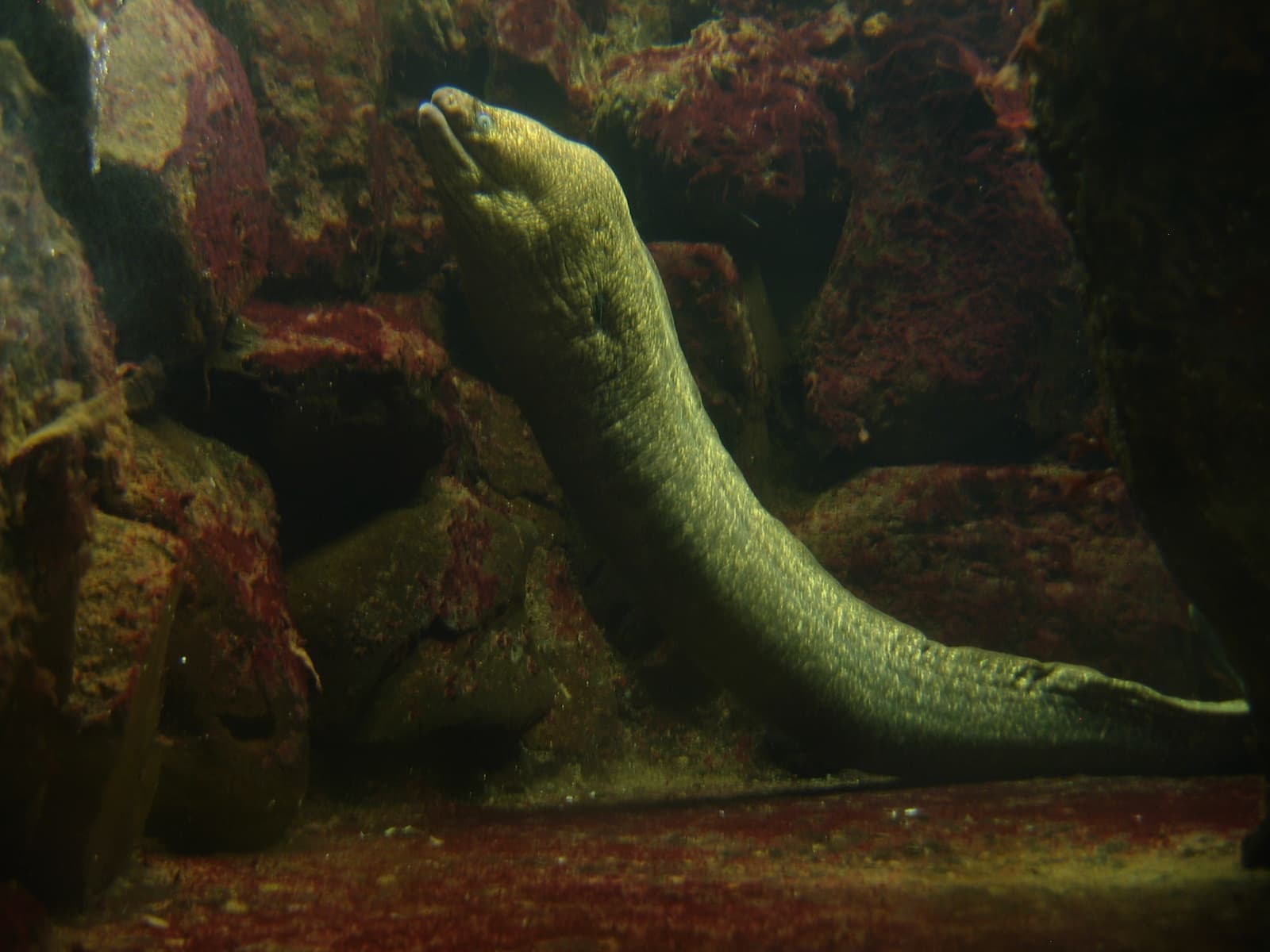
Green moray Gymnothorax funebris showing the long body and open mouth, representative of family Muraenidae
Bobjgalindo / Wikimedia Commons / CC BY-SA 4.0; representative green moray
๐ŸŒ Read in Language:

โšก At a Glance

Animal group
Also Known As
Morays, muraenids
Diet Category
Carnivorous family including fish, crustacean and mollusk specialists
Activity Rhythm
Often crepuscular or nocturnal, although daily rhythm differs among species and sites.
Wild Lifespan
Species-specific and incompletely documented; some large morays live for decades
Typical Weight
Strongly dependent on species and length; no reliable family-wide range
Conservation Status
Varies by species
๐Ÿ’ก Key Biological Insight: After the oral jaws seize prey, a moray can project a second set of jaws forward from the throat to grip the prey and pull it toward the esophagus.

๐ŸŒณ Scientific Taxonomy Hierarchy

Muraenidae is a family in the true-eel order Anguilliformes. Its members are ray-finned fishes, not sea snakes. The family includes familiar genera such as Gymnothorax, Echidna, Muraena, Enchelycore and Uropterygius, and is divided into lineages with differences in jaw musculature, teeth and body form.

KingdomAnimalia
PhylumChordata
ClassActinopterygii
OrderAnguilliformes
FamilyMuraenidae
Genus16 genera recognized by FishBase
Species225 species listed by FishBase

Distinguishing Anatomical Features

  • โœ“Morays have a long muscular body, a large mouth, small round gill openings and continuous dorsal, caudal and anal fins. They lack paired pelvic and pectoral fins, and the scaleless-looking skin is protected by mucus. Patterns range from plain brown or green to spots, bars, reticulation and vivid contrasting colors. Identification needs head shape, teeth, nostrils, fin origin, pattern, size and locality.
  • โœ“Protractile pharyngeal jaws grip and transport prey
  • โœ“Backward-curved teeth hold struggling animals
  • โœ“Long flexible bodies enter narrow crevices
  • โœ“Small gill openings reduce snagging in rocky shelters
  • โœ“Mucus protects the skin and helps movement through tight spaces
  • โœ“Strong smell and low-light senses aid close-range hunting

๐Ÿ“ Physical Measurements

Total Lengthabout 6.7 in to 9.8 ft across the family
Body WeightStrongly dependent on species and length; no reliable family-wide range
Tail LengthLong, tapering body merges into the caudal fin
WingspanNot applicable
Top SpeedNo dependable universal maximumMovement changes with context and conditions.

๐ŸŽจ Appearance & Distinctive Markings

BrownGreenBlackWhiteYellowBlueOrangeGray

Skin / Covering: Scaleless-looking mucus-covered skin

Sexual Dimorphism: Most species show little obvious external difference between sexes, although size, tooth form or color may change with growth or sex in particular species.

๐Ÿ—บ๏ธ Geographic Distribution & Habitat

Morays occur worldwide in tropical and temperate seas, with the greatest diversity in warm coastal waters. Individual species may be restricted to one ocean or island group, and a small number enter brackish or fresh water, so the family map shows broad presence rather than one continuous range.

Coral and rocky reefs, caves, rubble, seagrass margins, sand and mud burrows, mangrove channels and deeper seafloor habitats.

Country-level distribution map

Native range
Fiji โ€” Native rangeTanzania โ€” Native rangeWestern SaharaCanadaUnited States โ€” Native rangeKazakhstanUzbekistanPapua New Guinea โ€” Native rangeIndonesia โ€” Native rangeArgentinaChileCongo - KinshasaSomaliaKenya โ€” Native rangeSudanChadHaitiDominican RepublicRussiaBahamas โ€” Native rangeFalkland IslandsNorwayGreenlandFrench Southern TerritoriesTimor-LesteSouth Africa โ€” Native rangeLesothoMexico โ€” Native rangeUruguayBrazil โ€” Native rangeBoliviaPeruColombiaPanamaCosta RicaNicaraguaHondurasEl SalvadorGuatemalaBelizeVenezuelaGuyanaSurinameFrance โ€” Native rangeEcuadorPuerto RicoJamaica โ€” Native rangeCuba โ€” Native rangeZimbabweBotswanaNamibiaSenegalMaliMauritaniaBeninNigerNigeriaCameroonTogoGhanaCรดte dโ€™IvoireGuineaGuinea-BissauLiberiaSierra LeoneBurkina FasoCentral African RepublicCongo - BrazzavilleGabonEquatorial GuineaZambiaMalawiMozambique โ€” Native rangeEswatiniAngolaBurundiIsraelLebanonMadagascarPalestinian TerritoriesGambiaTunisiaAlgeriaJordanUnited Arab EmiratesQatarKuwaitIraqOmanVanuatuCambodiaThailand โ€” Native rangeLaosMyanmar (Burma)VietnamNorth KoreaSouth KoreaMongoliaIndia โ€” Native rangeBangladeshBhutanNepalPakistanAfghanistanTajikistanKyrgyzstanTurkmenistanIranSyriaArmeniaSwedenBelarusUkrainePolandAustriaHungaryMoldovaRomaniaLithuaniaLatviaEstoniaGermanyBulgariaGreece โ€” Native rangeTรผrkiyeAlbaniaCroatiaSwitzerlandLuxembourgBelgiumNetherlandsPortugalSpain โ€” Native rangeIrelandNew CaledoniaSolomon IslandsNew ZealandAustralia โ€” Native rangeSri Lanka โ€” Native rangeChinaTaiwanItaly โ€” Native rangeDenmarkUnited KingdomIcelandAzerbaijanGeorgiaPhilippines โ€” Native rangeMalaysia โ€” Native rangeBruneiSloveniaFinlandSlovakiaCzechiaEritreaJapan โ€” Native rangeParaguayYemenSaudi ArabiaCyprusMoroccoEgypt โ€” Native rangeLibyaEthiopiaDjiboutiUgandaRwandaBosnia & HerzegovinaNorth MacedoniaSerbiaMontenegroKosovoTrinidad & TobagoSouth Sudan
Highlighted countries are recorded profile locations, not precise biological range boundaries.Map boundaries: Natural Earth

๐Ÿ’ก Did You Know?

  • ๐Ÿ’กProtractile pharyngeal jaws grip and transport prey
  • ๐Ÿ’กBackward-curved teeth hold struggling animals
  • ๐Ÿ’กLong flexible bodies enter narrow crevices
  • ๐Ÿ’กSmall gill openings reduce snagging in rocky shelters
  • ๐Ÿ’กMucus protects the skin and helps movement through tight spaces
  • ๐Ÿ’กStrong smell and low-light senses aid close-range hunting

๐ŸŒฟ Conservation Status & Threats

No single assessment recorded

โ€œMuraenidae is not assessed as one IUCN taxon. Individual moray species have different range sizes, population evidence and threat categories, so the family cannot be given a single conservation status.โ€

CITESNo family-wide CITES listing; local harvest and trade laws may apply

โš ๏ธ Major Threats to Moray Eel

  • โ€ขCoral and rocky-reef habitat degradation
  • โ€ขOverfishing and bycatch in some regions
  • โ€ขCollection for the aquarium trade
  • โ€ขPollution and coastal development
  • โ€ขClimate-driven reef change
  • โ€ขLimited data for deepwater and range-restricted species

๐Ÿ”„ Life Cycle & Reproduction

Wild vs. Captivity Lifespan Comparison

๐ŸŒฟ In the WildSpecies-specific and incompletely documented; some large morays live for decades
๐Ÿ  In Captivity (with veterinary care)Long survival is possible in specialist aquariums with secure covers, appropriate space and expert care.
Clutch / Litter SizeNumerous pelagic eggs; counts and spawning output are species-specific
Incubation / GestationEgg and larval timing depends on species and water temperature
Fledging / WeaningPlanktonic leptocephalus larvae followed by benthic juveniles
Sexual MaturityAge and size at maturity are known for only a subset of species
Mating SystemBroadcast spawning with external fertilization
Nesting / Den TypeNo nest; eggs and larvae are pelagic

๐Ÿฆ… Behavior & Field Ecology

Carnivorous family including fish, crustacean and mollusk specialists

๐ŸŒ Ecological Food Web & Relationships: Morays are mid- to upper-level predators that move energy through reef and seafloor food webs. By hunting inside holes that many large predators cannot enter, they influence fish, cephalopod and crustacean communities. They also serve as prey, especially when young, and provide cleaning opportunities for shrimps and fishes that remove parasites.

Social Group SizeMostly solitary around shelters, with temporary spawning or feeding associations
Activity RhythmOften crepuscular or nocturnal, although daily rhythm differs among species and sites.
Feeding StrategyCarnivorous family including fish, crustacean and mollusk specialists

๐Ÿฅฉ Primary Prey & Preferred Diet

โœ“ Fishesโœ“ Crabs and shrimpsโœ“ Octopuses and squidโœ“ Mollusksโœ“ Other eels and small marine animals

๐Ÿ“ข Communication & Territorial Signals

  • Chemical cues
  • Vision
  • Body posture
  • Tactile contact

๐Ÿพ Wild Temperament & Traits

โ€ข Secretiveโ€ข Alertโ€ข Powerful at close rangeโ€ข Usually shelter-oriented

๐Ÿค Human Interaction & Pet Advisory

โš ๏ธ Strictly Wild Species
๐Ÿšซ

Can You Keep a Moray Eel as a Pet?

Only for experienced marine aquarists with a species-appropriate system, escape-proof cover and safe feeding procedures.

Domestication StatusWild and not domesticated
Danger to HumansModerate bite hazard when provoked or fed
Economic & Ecotourism RoleReef predator, fishery and aquarium animal, tourism subject and model for studies of feeding biomechanics.

โš ๏ธ Behavioral Risk Factors & Wildlife Safety

  • Strong jaws and recurved teeth cause deep wounds
  • Bacteria and retained tooth fragments can complicate bites
  • Feeding wildlife raises the chance of mistaken strikes
  • Some species may carry ciguatera toxins when eaten

๐ŸŒ Ecological Food Web & Relationships

Species in this group

  • โ€”
  • โ€”
  • โ€”
  • โ€”
  • โ€”
  • โ€”

๐Ÿฆ… Natural Predators (4)

Large GroupersEpinephelinae
SharksSelachimorpha
Sea SnakesHydrophiinae
HumansHomo sapiens

๐Ÿงฌ Related Species (4)

Conger EelsCongridaeTrue eels with pectoral fins and different head structure
Snake EelsOphichthidaeElongated burrowing eels often confused with morays
European MorayMuraena helenaMediterranean and eastern Atlantic representative
Green MorayGymnothorax funebrisLarge western Atlantic representative shown in the image

Moray Eel (Muraenidae) is the common name for fishes in the family Muraenidae. FishBase currently lists 225 living species in 16 genera, from tiny crevice dwellers to the giant moray. This page covers the family, so length, color, habitat, diet and conservation status differ among its many species. This guide separates well-supported biology from common assumptions and covers identification, range, habitat, diet, behavior, reproduction and conservation.

Identification

Morays have a long muscular body, a large mouth, small round gill openings and continuous dorsal, caudal and anal fins. They lack paired pelvic and pectoral fins, and the scaleless-looking skin is protected by mucus. Patterns range from plain brown or green to spots, bars, reticulation and vivid contrasting colors. Identification needs head shape, teeth, nostrils, fin origin, pattern, size and locality. Most species show little obvious external difference between sexes, although size, tooth form or color may change with growth or sex in particular species.

Identification should combine body shape, markings, size, voice or movement, and location. One feature by itself can overlap with a related animal, a juvenile, or an individual in unusual light.

Photographs are most useful when they preserve scale and show several diagnostic features. Handling or repositioning a wild moray eel for identification can cause stress and is unnecessary.

Size and physical adaptations

Moray Eel typically measures about 17 cm to 3 m across the family and weighs Strongly dependent on species and length; no reliable family-wide range. The minimum and maximum belong to different species and must not be read as a typical moray size.

Its useful adaptations include protractile pharyngeal jaws grip and transport prey, backward-curved teeth hold struggling animals, long flexible bodies enter narrow crevices, small gill openings reduce snagging in rocky shelters, mucus protects the skin and helps movement through tight spaces, strong smell and low-light senses aid close-range hunting. These traits work together in the animal’s normal setting rather than serving as isolated curiosities.

Published measurements may use different methods, life stages or sample locations. Comparing figures responsibly means checking what was measured rather than selecting the largest number available.

Range and distribution

Morays occur worldwide in tropical and temperate seas, with the greatest diversity in warm coastal waters. Individual species may be restricted to one ocean or island group, and a small number enter brackish or fresh water, so the family map shows broad presence rather than one continuous range. The native range includes Tropical and warm-temperate Atlantic coasts, The Mediterranean Sea, The Indian Ocean, The tropical and subtropical Pacific, Oceanic islands and coral-reef regions.

A country-level map indicates broad distribution, not continuous occupation. Climate, elevation, water, vegetation, prey, breeding sites, barriers and survey effort all affect where records occur.

Records near the edge of the range deserve careful documentation because they may reflect natural movement, improved survey coverage, accidental transport or a genuine distribution change.

Habitat

Coral and rocky reefs, caves, rubble, seagrass margins, sand and mud burrows, mangrove channels and deeper seafloor habitats.

Many morays shelter with only the head exposed from a crack, cave or burrow. The narrow refuge protects the body while allowing the fish to watch for prey. Some species forage openly by day, others emerge more often at night, and mud-dwelling or deepwater forms use habitats very different from a coral reef. Protecting a population therefore requires the feeding, shelter and breeding features that make a site usable, along with connections that allow movement.

Microhabitat matters. Shade, soil, current, moisture, shelter or host plants can determine whether a small area is usable even when the surrounding landscape appears suitable.

Diet and feeding

Moray Eel is a carnivorous family including fish, crustacean and mollusk specialists. Important foods include fishes, crabs and shrimps, octopuses and squid, mollusks, other eels and small marine animals. A moray lunges with its oral jaws, anchors prey on recurved teeth and then advances its pharyngeal jaws from the throat. Those jaws grasp and draw food backward, a useful mechanism where confined spaces limit suction feeding. Tooth shape and prey choice differ: sharp-fanged species often take fish, while blunt pebble-toothed forms can crush hard-shelled prey.

Diet changes with age, season, location and food supply. A dramatic prey record does not establish what most individuals eat most of the time; repeated field observations provide a stronger picture.

Feeding opportunities also create risk. An animal focused on prey may be less alert to predators, traffic or people, while contaminated prey can transfer pollutants through the food web.

Behavior and communication

Often crepuscular or nocturnal, although daily rhythm differs among species and sites. The repeated mouth opening seen in a resting moray usually pumps water across the gills and is not automatically a threat display. Many remain close to a home crevice, while some make regular foraging trips. Cooperative hunting has been documented between certain morays and groupers, but it should not be generalized to every species.

Smell is important in locating food in complex reef structure. Vision, body posture and close contact help in territorial, defensive and reproductive interactions. In documented cooperative hunts, head gestures by partner fishes can help direct attention toward hidden prey. Behavior should be interpreted in context: alarm, courtship, feeding and temperature regulation can produce very different actions from the same animal.

Daily schedules are flexible responses, not rigid rules. Weather, breeding condition, disturbance, tides or food can move activity into a different part of the day.

Reproduction and development

Morays reproduce by spawning eggs and sperm into the water. Fertilized eggs develop into transparent, ribbon-shaped leptocephalus larvae that drift in the plankton before transforming into juvenile eels. Reproductive details remain poorly known for many species. Numerous pelagic eggs; counts and spawning output are species-specific The leptocephalus larva is laterally compressed and very different from the adult. Ocean currents can carry larvae far from spawning sites. Metamorphosis produces an eel-shaped juvenile that settles into benthic habitat and develops adult coloration as it grows.

Young animals face different risks and may use different microhabitats or food than adults. Breeding success depends on adult condition, suitable sites and the survival of offspring through vulnerable early stages.

Counts of eggs or young describe reproductive output, not the number expected to reach adulthood. Mortality is normally greatest during eggs, larval or juvenile stages.

Predators and ecological role

Morays are mid- to upper-level predators that move energy through reef and seafloor food webs. By hunting inside holes that many large predators cannot enter, they influence fish, cephalopod and crustacean communities. They also serve as prey, especially when young, and provide cleaning opportunities for shrimps and fishes that remove parasites. Documented or likely predators include Large Groupers, Sharks, Sea Snakes, Humans.

This animal is both a consumer and a food source. Its influence comes through many repeated interactions, so ecological claims should be based on measured populations rather than assumptions drawn from appearance.

Predator and prey relationships differ among places. A species can be ecologically influential without being abundant everywhere, and its role can change across its range.

Relationship with people

Morays attract divers and aquarium visitors, and some species enter local fisheries or the marine-aquarium trade. Large individuals should never be fed or touched because conditioning to handouts brings teeth close to people and can change natural behavior. Some morays can accumulate ciguatoxins, so local fish-consumption guidance matters.

A defensive or feeding bite can cause deep punctures, tissue damage and infection. Keep hands out of occupied crevices, do not offer food, and seek prompt medical care for a bite. The open mouth of a resting animal often supports breathing, but approaching or cornering it is still unsafe. Responsible observation means keeping an appropriate distance, avoiding capture or feeding, protecting habitat and following local wildlife or invasive-species guidance.

Wildlife guidance should come from the responsible local agency because collection rules, reporting requests and appropriate responses differ between native and introduced ranges.

Conservation

Muraenidae is not assessed as one IUCN taxon. Individual moray species have different range sizes, population evidence and threat categories, so the family cannot be given a single conservation status. The reported global trend is Unknown at family level; must be assessed species by species.

Important pressures include coral and rocky-reef habitat degradation, overfishing and bycatch in some regions, collection for the aquarium trade, pollution and coastal development, climate-driven reef change, limited data for deepwater and range-restricted species. Global status can hide local decline or recovery, so current regional monitoring and habitat management remain necessary.

The most useful conservation action follows the documented pressure. Protecting breeding sites, reducing road deaths or limiting pollutants can require different tools in different populations.

Sources and further reading

โ“ Frequently Asked Questions

Answers to frequently asked questions verified against peer-reviewed zoological research.

They usually open and close the mouth to move water across the gills. The motion alone is not proof that an eel is preparing to attack.