
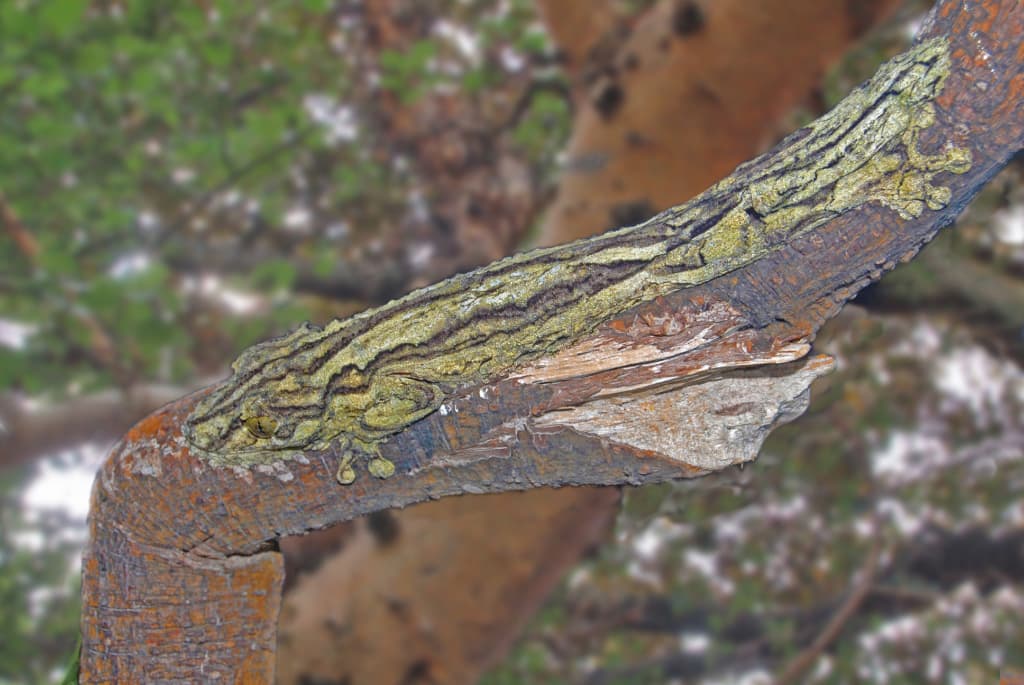
Mossy Leaf-Tailed Gecko (Uroplatus sikorae) is an arboreal gecko endemic to Madagascar’s eastern rainforests. By day it presses against trunks with its head down, breaking up its outline with skin fringes and bark-colored patterning. At night it climbs to hunt insects and other small animals. Its extraordinary camouflage depends on intact humid forest and does not make the gecko invisible once its shelter trees are removed. This guide separates well-supported biology from common assumptions and covers identification, range, habitat, diet, behavior, reproduction and conservation.
Identification
The head is broad and flattened, the eyes large, and the body patterned in mottled gray, brown, greenish and black like bark coated with moss or lichen. Irregular skin fringes along the jaw, body and limbs erase the shadow line when the animal flattens against a trunk. Wide toe pads grip bark. The tail is broad, leaf-like and irregularly edged rather than long and cylindrical. Pattern, texture and color vary markedly between individuals. Males have a swollen hemipenal base behind the vent and may have different cloacal features, while females generally lack that bulge. Body size overlaps, so sex should be determined by an experienced keeper or researcher without rough handling.
Identification should combine body shape, markings, size, voice or movement, and location. One feature by itself can overlap with a related animal, a juvenile, or an individual in unusual light.
Photographs are most useful when they preserve scale and show several diagnostic features. Handling or repositioning a wild mossy leaf-tailed gecko for identification can cause stress and is unnecessary.
Size and physical adaptations
Mossy Leaf-Tailed Gecko typically measures commonly about 15–20 cm total length including the flattened tail and weighs often several tens of grams; dependable wild mass ranges are limited. Total length includes the broad tail, which may be damaged or regenerated; published measurements differ in method and population.
Its useful adaptations include skin fringes erase the body outline, mottled pattern resembles mossy bark, broad toe pads adhere to trunks, large eyes gather dim nocturnal light, vertical pupils adjust across changing light, flattened tail continues the bark disguise, wide mouth supports a startling threat display. These traits work together in the animal’s normal setting rather than serving as isolated curiosities.
Published measurements may use different methods, life stages or sample locations. Comparing figures responsibly means checking what was measured rather than selecting the largest number available.
Range and distribution
Native only to eastern and southeastern Madagascar, mainly in humid forest at moderate elevations. Current taxonomy separates the lowland Uroplatus sameiti from U. sikorae, so older records and photographs may include both species and require re-evaluation. The native range includes Madagascar.
A country-level map indicates broad distribution, not continuous occupation. Climate, elevation, water, vegetation, prey, breeding sites, barriers and survey effort all affect where records occur.
Records near the edge of the range deserve careful documentation because they may reflect natural movement, improved survey coverage, accidental transport or a genuine distribution change.
Habitat
Humid evergreen rainforest with mature trunks, layered understory, high nighttime humidity and abundant bark crevices, generally at moderate elevation.
Adults rest head-down on trunks and substantial branches during daylight, selecting bark whose color and texture match their bodies. After dark they move through the understory and lower canopy to forage. The forest supplies stable humidity, shade, egg-laying substrate and continuous woody surfaces. Fragmentation exposes edges to heat, wind and drying even when a few trees remain. Protecting a population therefore requires the feeding, shelter and breeding features that make a site usable, along with connections that allow movement.
Microhabitat matters. Shade, soil, current, moisture, shelter or host plants can determine whether a small area is usable even when the surrounding landscape appears suitable.
Diet and feeding
Mossy Leaf-Tailed Gecko is a nocturnal predator of small forest animals. Important foods include moths, crickets, cockroaches, beetles, spiders, other arthropods, occasional small vertebrates. The gecko waits motionless or moves slowly along bark, then lunges with a wide mouth when prey comes within reach. Large eyes and low-light vision support night hunting. Prey availability changes with rain and season, and captive feeder lists should not be treated as a complete description of the wild diet.
Diet changes with age, season, location and food supply. A dramatic prey record does not establish what most individuals eat most of the time; repeated field observations provide a stronger picture.
Feeding opportunities also create risk. An animal focused on prey may be less alert to predators, traffic or people, while contaminated prey can transfer pollutants through the food web.
Behavior and communication
Nocturnal and arboreal, resting motionless on trunks by day and foraging after dark. Daytime defense begins with stillness, outline-breaking posture and camouflage. If detected, the gecko may shift around the far side of a trunk, leap, gape its mouth, hiss or call and bite as a last defense. At night individuals patrol branches and trunks. They are usually solitary and can become stressed by crowding or repeated handling.
Vision, body posture and scent are important at close range. Males and females locate one another during the breeding period, and defensive gaping exposes the mouth while hissing or vocal sounds intensify the warning. Like other geckos, they detect vibration through surfaces and use chemical cues deposited in the environment. Behavior should be interpreted in context: alarm, courtship, feeding and temperature regulation can produce very different actions from the same animal.
Daily schedules are flexible responses, not rigid rules. Weather, breeding condition, disturbance, tides or food can move activity into a different part of the day.
Reproduction and development
Mating occurs on vegetation and fertilization is internal. A female usually deposits two hard-shelled eggs in leaf litter, soil pockets or concealed forest-floor sites rather than guarding them on a trunk. Several clutches may be possible in a favorable season, but output depends on adult condition and environmental moisture. Usually two eggs per clutch Hatchlings emerge as miniature camouflaged geckos and immediately climb and hunt very small prey. They receive no parental feeding or protection. Young animals dehydrate quickly, face arthropod and vertebrate predators, and depend on dense microhabitat at a scale that coarse forest maps may miss.
Young animals face different risks and may use different microhabitats or food than adults. Breeding success depends on adult condition, suitable sites and the survival of offspring through vulnerable early stages.
Counts of eggs or young describe reproductive output, not the number expected to reach adulthood. Mortality is normally greatest during eggs, larval or juvenile stages.
Predators and ecological role
The gecko consumes forest arthropods and becomes prey for snakes, birds and small carnivores. Its camouflage is tuned to particular bark, lichen and light environments, making it an example of how microhabitat shapes evolution. Eggs link arboreal adults to the forest floor, so both standing trees and intact litter are necessary for a complete life cycle. Documented or likely predators include Madagascar Tree Boa, Madagascar Harrier-Hawk, Owls, Fossa, Introduced rats.
This animal is both a consumer and a food source. Its influence comes through many repeated interactions, so ecological claims should be based on measured populations rather than assumptions drawn from appearance.
Predator and prey relationships differ among places. A species can be ecologically influential without being abundant everywhere, and its role can change across its range.
Relationship with people
The species attracts ecotourists, photographers, researchers and reptile keepers. Guides should avoid peeling animals from bark or repeatedly lighting them at night. International trade is regulated, and buyers should insist on legal documentation and credible captive-bred origin. Removing adults from small forest fragments can affect local breeding even when global trade totals appear modest.
This gecko is not venomous and poses little danger, but it can bite when restrained and its skin and toes are delicate. Observe without touching in the wild. Captive enclosure work should use calm transfer methods, hand washing and separate equipment to limit stress and reptile-associated Salmonella. Responsible observation means keeping an appropriate distance, avoiding capture or feeding, protecting habitat and following local wildlife or invasive-species guidance.
Wildlife guidance should come from the responsible local agency because collection rules, reporting requests and appropriate responses differ between native and introduced ranges.
Conservation
The species is assessed as Least Concern because it remains distributed across multiple eastern forest sites, including protected areas. That category does not remove local concern: habitat is fragmented, taxonomic boundaries complicate older records and demand from the pet trade requires monitoring. The reported global trend is Decreasing where humid forest is cleared or degraded.
Important pressures include rainforest clearing, fragmentation and edge drying, illegal or unsustainable collection, fire and agricultural expansion, climate change, introduced predators, pathogen movement through trade. Global status can hide local decline or recovery, so current regional monitoring and habitat management remain necessary.
The most useful conservation action follows the documented pressure. Protecting breeding sites, reducing road deaths or limiting pollutants can require different tools in different populations.