
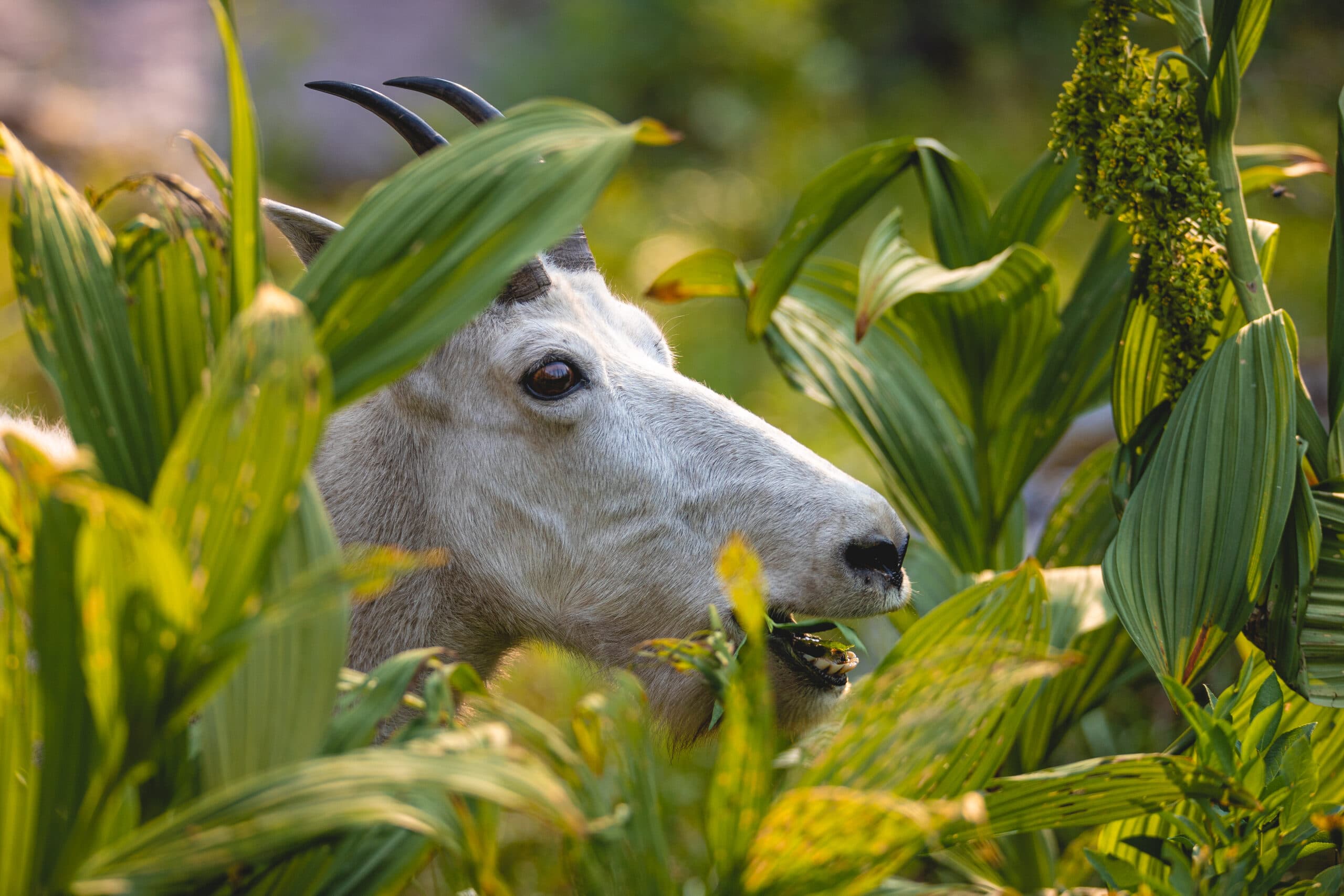
Mountain Goat (Oreamnos americanus) is the only living species in the genus Oreamnos. Despite its common name, it is not a true goat of the genus Capra but a North American caprine related to gorals, serows and chamois. A compact body, massive shoulders and flexible split hooves let it cross ledges and slopes that exclude many predators. This guide separates well-supported biology from common assumptions and covers identification, range, habitat, diet, behavior, reproduction and conservation.
Identification
Adults have a shaggy white coat, a shoulder hump, narrow face, beard and short tail. Black lips, nose, eyes and hooves contrast with the fur. Both sexes carry slender black horns that sweep gently backward and retain annual growth rings. Winter guard hairs may approach 20 centimeters and cover a dense woolly undercoat; the coat becomes shorter and ragged while shedding in spring. Males, called billies, become substantially heavier and thicker through the shoulders than females, or nannies. Female horns are often more slender but sex is difficult to judge at distance.
Identification should combine body shape, markings, size, voice or movement, and location. One feature by itself can overlap with a related animal, a juvenile, or an individual in unusual light.
Photographs are most useful when they preserve scale and show several diagnostic features. Handling or repositioning a wild mountain goat for identification can cause stress and is unnecessary.
Size and physical adaptations
Mountain Goat typically measures About 1.2–1.8 m and weighs Females commonly 55–80 kg; large males may exceed 120 kg. Mass varies with sex, age, season, habitat and population.
Its useful adaptations include cloven toes spread independently for stability, soft rubbery inner hoof pads grip rock, hard hoof rims catch tiny ledges, powerful shoulders pull the body uphill, dense undercoat and hollow guard hairs conserve heat, white coat blends with snowfields, compact body reduces heat loss, cliff habitat offers refuge from predators. These traits work together in the animal’s normal setting rather than serving as isolated curiosities.
Published measurements may use different methods, life stages or sample locations. Comparing figures responsibly means checking what was measured rather than selecting the largest number available.
Range and distribution
Native from southeastern Alaska and western Canada south through the Coast and Cascade ranges into Washington, northern Idaho and western Montana. People introduced Mountain Goats to additional ranges in states including Colorado, Utah, Wyoming, South Dakota and parts of Washington; some introduced herds now overlap sensitive native wildlife. The native range includes United States, Canada.
A country-level map indicates broad distribution, not continuous occupation. Climate, elevation, water, vegetation, prey, breeding sites, barriers and survey effort all affect where records occur.
Records near the edge of the range deserve careful documentation because they may reflect natural movement, improved survey coverage, accidental transport or a genuine distribution change.
Habitat
Alpine and subalpine cliffs, talus, rocky ridges, avalanche chutes, meadows and nearby conifer forest.
Escape terrain is central to Mountain Goat life. Nannies with kids remain especially close to broken cliffs, while billies may use gentler meadows when danger is low. Seasonal movements follow new plant growth uphill in spring and seek wind-scoured slopes, forest forage or lower elevations during deep winter. Mineral licks can draw goats repeatedly to exposed soil and roadsides. Protecting a population therefore requires the feeding, shelter and breeding features that make a site usable, along with connections that allow movement.
Microhabitat matters. Shade, soil, current, moisture, shelter or host plants can determine whether a small area is usable even when the surrounding landscape appears suitable.
Diet and feeding
Mountain Goat is a herbivore. Important foods include grasses, sedges, forbs, shrubs, willow, conifer twigs, mosses, lichens. Mountain Goats are flexible browsers and grazers. Summer diets emphasize nutritious grasses, sedges, alpine flowers and leaves, while winter brings more shrubs, lichens and conifer foliage. Strong shoulders help them paw through snow. They visit natural mineral licks and may become dangerously habituated to human urine, sweat or salted objects at busy recreation sites.
Diet changes with age, season, location and food supply. A dramatic prey record does not establish what most individuals eat most of the time; repeated field observations provide a stronger picture.
Feeding opportunities also create risk. An animal focused on prey may be less alert to predators, traffic or people, while contaminated prey can transfer pollutants through the food web.
Behavior and communication
Active through daylight and twilight, alternating feeding with rumination and rest on secure ledges. Nannies, kids and immature animals form bands, while mature billies are often solitary outside the rut. Females establish dominance with threats and occasional horn jabs. Goats move deliberately across cliffs, testing footholds rather than making reckless leaps. Seasonal home ranges can be small where food and escape cover occur together, but some animals migrate between low winter and high summer ranges.
Visual posture carries much of Mountain Goat communication. An erect stance, direct approach, lowered head or horn presentation can threaten a rival, while subordinate animals yield space. During the rut, billies scent themselves by urinating into pits and rubbing the liquid into their coat, then court nannies with low stretches, lip curls and close following. Mothers and kids recognize one another through voice, scent and proximity. Behavior should be interpreted in context: alarm, courtship, feeding and temperature regulation can produce very different actions from the same animal.
Daily schedules are flexible responses, not rigid rules. Weather, breeding condition, disturbance, tides or food can move activity into a different part of the day.
Reproduction and development
The rut occurs mainly in November and December. Mature billies follow nanny groups, display and compete, but direct clashes are risky because the sharp horns can cause serious wounds. After a gestation of about six months, females isolate on secure terrain to give birth in late spring. Usually one kid; twins occur occasionally Kids are precocial, standing and nursing soon after birth and following their mothers across steep ground within days. They begin tasting plants early, are weaned at roughly four months and normally remain with their mothers until the following spring. Survival depends strongly on maternal condition, weather, forage and safe terrain.
Young animals face different risks and may use different microhabitats or food than adults. Breeding success depends on adult condition, suitable sites and the survival of offspring through vulnerable early stages.
Counts of eggs or young describe reproductive output, not the number expected to reach adulthood. Mortality is normally greatest during eggs, larval or juvenile stages.
Predators and ecological role
Mountain Goats convert alpine vegetation into food for wolves, cougars, bears and scavengers while disturbing soil at bedding and mineral sites. Their specialization makes them sensitive to changes in snow, forage and disturbance. Introduced goats may compete with native bighorn sheep, alter fragile alpine vegetation or carry pathogens, so managers sometimes translocate or remove them from nonnative ranges. Documented or likely predators include Gray Wolf, Cougar, Brown Bear, Golden Eagle.
This animal is both a consumer and a food source. Its influence comes through many repeated interactions, so ecological claims should be based on measured populations rather than assumptions drawn from appearance.
Predator and prey relationships differ among places. A species can be ecologically influential without being abundant everywhere, and its role can change across its range.
Relationship with people
Indigenous peoples have long used Mountain Goat wool, hides and horns for blankets, clothing, tools and ceremonial objects. Today the species is valued in wildlife viewing and regulated hunting. Roads, aircraft and recreation can displace goats from limited habitat, while animals seeking salt sometimes approach hikers. Management differs sharply between native herds needing protection and introduced herds that threaten local ecosystems.
Mountain Goats are powerful wild animals with sharp horns. Stay at least the distance required by the park, commonly 25 yards or more, never feed them, keep dogs controlled and yield the trail. Do not urinate near trails or leave salty gear accessible; animals seeking minerals can become aggressive. Back away if a goat approaches or changes behavior. Responsible observation means keeping an appropriate distance, avoiding capture or feeding, protecting habitat and following local wildlife or invasive-species guidance.
Wildlife guidance should come from the responsible local agency because collection rules, reporting requests and appropriate responses differ between native and introduced ranges.
Conservation
The IUCN lists the Mountain Goat as Least Concern across its broad range, but recent research shows that trends differ greatly among herds and some native populations are declining. Slow reproduction, severe winters, disturbance, disease and climate-driven habitat change can limit recovery. The reported global trend is Variable by population; some native herds are declining.
Important pressures include climate change and altered snowpack, human disturbance, severe winter weather and avalanches, disease and parasites, overharvest in vulnerable herds, habitat fragmentation. Global status can hide local decline or recovery, so current regional monitoring and habitat management remain necessary.
The most useful conservation action follows the documented pressure. Protecting breeding sites, reducing road deaths or limiting pollutants can require different tools in different populations.