
Home/Animals/Aves/Muscovy Duck
Species profileIUCN: LC

Muscovy Duck

Cairina moschata

A large tropical perching duck native to wooded wetlands from Mexico to South America.

Wild-type Muscovy Duck Cairina moschata standing near water
Dmitry A. Mottl / Wikimedia Commons / CC BY-SA 3.0
๐ŸŒ Read in Language:

โšก At a Glance

Species profile
Also Known As
Muscovy, musk duck, pato criollo
Diet Category
Omnivore
Activity Rhythm
Mostly active by day, feeding on land, in shallow water and around wetland vegetation.
Wild Lifespan
Variable; dependable population-wide maximum is not established
Typical Weight
Females about 1โ€“2 kg; males about 2โ€“4.5 kg in wild populations
Conservation Status
LC
๐Ÿ’ก Key Biological Insight: Muscovy Ducks are the only widely domesticated duck lineage that did not originate from the mallard.

๐ŸŒณ Scientific Taxonomy Hierarchy

The Muscovy Duck is Cairina moschata, a distinct species in the waterfowl family Anatidae. Unlike most domestic ducks, which descend chiefly from the mallard, domestic Muscovies descend from this tropical American species.

KingdomAnimalia
PhylumChordata
ClassAves
OrderAnseriformes
FamilyAnatidae
GenusCairina
SpeciesCairina moschata

Distinguishing Anatomical Features

  • โœ“Large, heavy-bodied duck with broad wings and a long tail
  • โœ“Adult males develop prominent red facial caruncles
  • โœ“Wild-type plumage is mostly glossy black with bold white wing patches
  • โœ“Strong feet and claws allow perching in trees
  • โœ“Males are substantially larger than females

๐Ÿ“ Physical Measurements

Total LengthFemales about 21โ€“25 in; males about 30โ€“34 in
Body WeightFemales about 2.2โ€“4.4 lb; males about 4.4โ€“9.9 lb
Tail LengthLong and broad
WingspanNo single dependable range across wild and domestic forms
Top SpeedNo dependable universal maximumFlight performance varies with sex, condition and domestication.

๐ŸŽจ Appearance & Distinctive Markings

BlackWhiteRedGreenPurpleBrown

Skin / Covering: Waterproof feathers and down

Sexual Dimorphism: Males are much larger than females and usually have heavier facial caruncles.

๐Ÿ—บ๏ธ Geographic Distribution & Habitat

Wild Muscovy Ducks are native from northeastern Mexico and the lower Rio Grande region of Texas through Central America and much of tropical South America.

Wooded freshwater wetlands, forested rivers, swamps, lagoons, marsh edges and quiet ponds with trees suitable for roosting or nesting.

Country-level distribution map

Native range
FijiTanzaniaWestern SaharaCanadaUnited States โ€” Native rangeKazakhstanUzbekistanPapua New GuineaIndonesiaArgentina โ€” Native rangeChileCongo - KinshasaSomaliaKenyaSudanChadHaitiDominican RepublicRussiaBahamasFalkland IslandsNorwayGreenlandFrench Southern TerritoriesTimor-LesteSouth AfricaLesothoMexico โ€” Native rangeUruguay โ€” Native rangeBrazil โ€” Native rangeBolivia โ€” Native rangePeru โ€” Native rangeColombia โ€” Native rangePanama โ€” Native rangeCosta Rica โ€” Native rangeNicaragua โ€” Native rangeHonduras โ€” Native rangeEl Salvador โ€” Native rangeGuatemala โ€” Native rangeBelize โ€” Native rangeVenezuela โ€” Native rangeGuyana โ€” Native rangeSuriname โ€” Native rangeFranceEcuador โ€” Native rangePuerto RicoJamaicaCubaZimbabweBotswanaNamibiaSenegalMaliMauritaniaBeninNigerNigeriaCameroonTogoGhanaCรดte dโ€™IvoireGuineaGuinea-BissauLiberiaSierra LeoneBurkina FasoCentral African RepublicCongo - BrazzavilleGabonEquatorial GuineaZambiaMalawiMozambiqueEswatiniAngolaBurundiIsraelLebanonMadagascarPalestinian TerritoriesGambiaTunisiaAlgeriaJordanUnited Arab EmiratesQatarKuwaitIraqOmanVanuatuCambodiaThailandLaosMyanmar (Burma)VietnamNorth KoreaSouth KoreaMongoliaIndiaBangladeshBhutanNepalPakistanAfghanistanTajikistanKyrgyzstanTurkmenistanIranSyriaArmeniaSwedenBelarusUkrainePolandAustriaHungaryMoldovaRomaniaLithuaniaLatviaEstoniaGermanyBulgariaGreeceTรผrkiyeAlbaniaCroatiaSwitzerlandLuxembourgBelgiumNetherlandsPortugalSpainIrelandNew CaledoniaSolomon IslandsNew ZealandAustraliaSri LankaChinaTaiwanItalyDenmarkUnited KingdomIcelandAzerbaijanGeorgiaPhilippinesMalaysiaBruneiSloveniaFinlandSlovakiaCzechiaEritreaJapanParaguay โ€” Native rangeYemenSaudi ArabiaCyprusMoroccoEgyptLibyaEthiopiaDjiboutiUgandaRwandaBosnia & HerzegovinaNorth MacedoniaSerbiaMontenegroKosovoTrinidad & TobagoSouth Sudan
Highlighted countries are recorded profile locations, not precise biological range boundaries.Map boundaries: Natural Earth

๐Ÿ’ก Did You Know?

  • ๐Ÿ’กStrong claws help birds perch on branches
  • ๐Ÿ’กBroad wings support powerful flight in wild birds
  • ๐Ÿ’กA broad bill gathers plant and animal foods
  • ๐Ÿ’กWaterproof plumage insulates the body
  • ๐Ÿ’กTree-cavity nesting helps conceal eggs

๐ŸŒฟ Conservation Status & Threats

IUCN: LC โ€” Least Concern

โ€œThe wild species is globally listed as Least Concern, but intact wooded wetlands and large nest trees remain important and local pressure can be substantial.โ€

Population Trend๐Ÿ“‰ Decreasing
Wild Population EstimateNo precise global total is established in the cited sources.
CITESNot listed in the CITES appendices

โš ๏ธ Major Threats to Muscovy Duck

  • โ€ขLoss and drainage of wooded wetlands
  • โ€ขRemoval of large cavity trees
  • โ€ขHunting and egg collection
  • โ€ขDisturbance at nesting sites
  • โ€ขHybridization and competition involving free-ranging domestic birds
  • โ€ขWater pollution

๐Ÿ”„ Life Cycle & Reproduction

Wild vs. Captivity Lifespan Comparison

๐ŸŒฟ In the WildVariable; dependable population-wide maximum is not established
๐Ÿ  In Captivity (with veterinary care)Can live for many years with appropriate managed care, but lifespan varies widely.
Clutch / Litter SizeCommonly about 8โ€“15 eggs, with larger nests possible when more than one female lays in a cavity
Incubation / GestationAbout 35 days
Fledging / WeaningYoung remain with the female until capable of sustained flight; timing varies with conditions.
Sexual MaturityUsually within the first year under favorable conditions
Mating SystemPolygynous tendencies, with large males mating with multiple females
Nesting / Den TypeNatural tree cavity, hollow trunk or occasionally a sheltered artificial site, lined with down

๐Ÿฆ… Behavior & Field Ecology

Omnivore

๐ŸŒ Ecological Food Web & Relationships: Muscovy Ducks consume seeds, vegetation and invertebrates, move nutrients between land and water, and may disperse some plant material. Their reliance on large cavities connects their breeding success to mature trees around wetlands.

Social Group SizePairs, family groups and small flocks
Activity RhythmMostly diurnal, with timing influenced by heat, disturbance and local food availability.
Feeding StrategyOmnivore

๐Ÿฅฉ Primary Prey & Preferred Diet

โœ“ Seedsโœ“ Aquatic plantsโœ“ Grassesโœ“ Fruitsโœ“ Insectsโœ“ Mollusksโœ“ Small aquatic animalsโœ“ Agricultural grain where available

๐Ÿ“ข Communication & Territorial Signals

  • Hisses
  • Soft trills and calls
  • Head and tail movements
  • Threat postures

๐Ÿพ Wild Temperament & Traits

โ€ข Alertโ€ข Socialโ€ข Territorial near nests

๐Ÿค Human Interaction & Pet Advisory

โš ๏ธ Strictly Wild Species
๐Ÿšซ

Can You Keep a Muscovy Duck as a Pet?

Domestic Muscovies require secure outdoor space, water for bathing, protection from predators, compatible companions and lawful ownership. Wild birds should not be kept as pets.

Domestication StatusDomesticated in the Americas for meat and eggs; domestic and feral birds now occur far beyond the native range.
Danger to HumansLow risk to people
Economic & Ecotourism RoleDomestic meat and egg production, smallholder farming, pest consumption, education and birdwatching.

โš ๏ธ Behavioral Risk Factors & Wildlife Safety

  • Large males may peck, scratch or strike when cornered
  • Handling wild birds causes stress
  • Feeding dense urban flocks can worsen conflict and water quality

๐ŸŒ Ecological Food Web & Relationships

๐Ÿฆ… Natural Predators (4)

Large snakeSerpentes
RaccoonProcyon lotor
CaimanCaimaninae
RaptorAccipitridae

๐Ÿงฌ Related Species (3)

MallardAnas platyrhynchosAncestor of most other domestic duck breeds, but not the Muscovy
Wood DuckAix sponsaAnother cavity-nesting perching duck in the family Anatidae
Brazilian TealAmazonetta brasiliensisSouth American duck that overlaps part of the native range

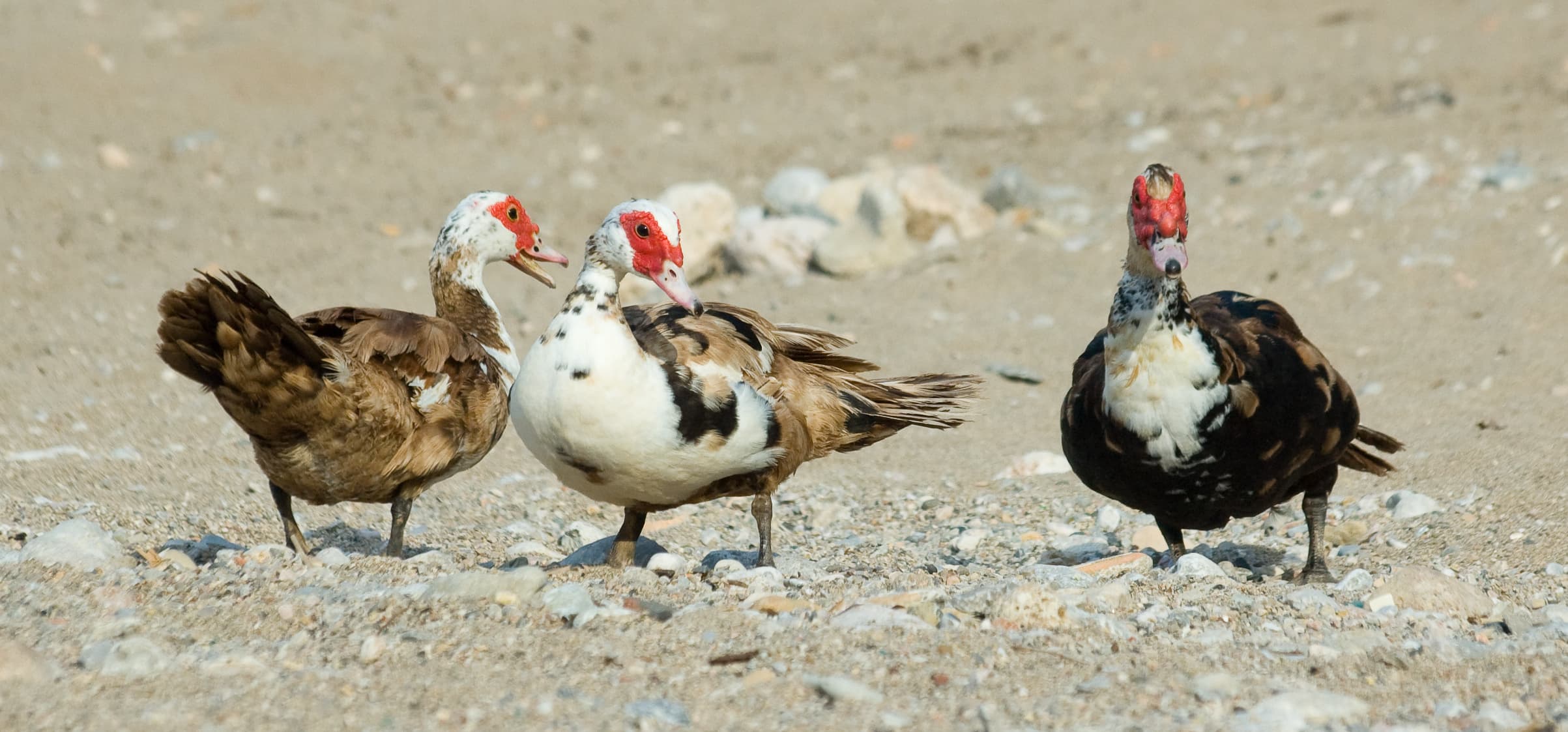
The Muscovy Duck (Cairina moschata) is a large tropical American waterfowl species with glossy dark plumage, bold white wing patches and bare red facial skin. Truly wild birds are forest ducks native from Mexico through Central America and much of South America. Domestic and feral Muscovies occur far beyond that range and may be white, pied, brown or otherwise unlike the wild form. Keeping those populations separate is essential: a park duck in Europe or Florida may belong to the same species, but it does not represent the ecology or conservation status of a native wild population.

Identification and appearance

Wild adults are mostly blackish brown with green and purple gloss in good light. The upperwing carries a conspicuous white patch, especially visible in flight. Adults have red to blackish bare skin around the eyes and bill; males develop larger fleshy caruncles than females. The bill is relatively broad and the tail is long. Strong feet and claws suit a bird that perches and roosts in trees more often than many familiar domestic ducks.

Sexual size difference is unusually strong. Wild males are much heavier and longer than females, with bulkier heads and more extensive facial caruncles. Juveniles are duller and have less developed bare facial skin. Domestic selection has produced heavier bodies and many color patterns, so color alone cannot show whether a bird is wild, feral or owned. Location, behavior, body shape and local history all matter.

Native range and wetland habitat

The native range extends from northeastern Mexico and the lower Rio Grande region south through Central America to tropical and subtropical South America, reaching northern Argentina and Uruguay. Wild birds use wooded country near fresh water: slow rivers, oxbows, lagoons, forest pools, marshes, mangroves and seasonally flooded woodland. Large trees provide nest holes and safe roosts, while shallow wetlands supply food.

Feral populations derived from domestic stock live in parks, farms and urban ponds on several continents. Those populations can tolerate cooler climates when food and shelter are available. They should not be mapped as part of the species’ native distribution. Likewise, abundance in city parks does not mean wild Muscovies are secure everywhere; hunting and loss of mature wetland forest can reduce native populations.

Diet and foraging

Muscovy Ducks are flexible omnivores. They take seeds, grasses, sedges, aquatic vegetation, fruits, roots and tubers as well as insects, spiders, worms, snails, crustaceans and other small animals. Cornell documents birds breaking into termite mounds, grazing shorelines, taking grain in fields and dabbling in shallow water. They may tip forward to reach submerged food but are not specialized deep-diving ducks.

The broad bill strains small material and grasps larger prey. Diet changes with season, habitat and whether birds receive human food. Feeding feral ducks bread or other poor-quality food can crowd birds, foul water and create dependency. Wild birds should be watched from a distance and left to forage naturally.

Behavior and communication

Wild Muscovies are often wary and spend time in forest cover. They fly strongly, perch on branches and roost in trees. Individuals or small groups move between feeding wetlands and roosts, and larger gatherings may occur where food is concentrated. Their flight looks powerful and direct, with the white wing patch flashing against dark feathers.

The species is quieter than many mallard-derived domestic ducks. Males use breathy hisses and soft calls, while females produce trills and other vocalizations. Courtship also relies on posture, head movement, tail movement and close following. Facial caruncles are normal adult structures rather than injuries or disease, although damaged or infected skin still requires professional assessment in managed birds.

Nesting and life cycle

Wild females usually nest in natural cavities high in mature trees, though sheltered ground sites or suitable nest boxes are sometimes used. The female lines the nest with down and incubates without help from the male. Cornell reports large tree cavities, often 3โ€“20 metres above ground. After hatching, downy ducklings leave the cavity and follow their mother to water.

Clutch size varies and can be large, commonly around 8โ€“15 eggs. Incubation is roughly five weeks, longer than the approximately 28-day period typical of mallard-derived domestic ducks. Young feed themselves under the female’s protection and gain flight ability over the following weeks. Predation, flooding, cold exposure and separation from the brood can cause heavy losses.

Wild birds, domestic birds and hybrids

Muscovies were domesticated in Latin America before European contact and are now kept globally for meat, eggs and small-scale farming. Domestic Muscovies remain the same species as wild Cairina moschata, but generations of selection changed size, color and behavior. Escaped domestic birds can establish feral populations around people.

The species is genetically distinct from the mallard-derived domestic duck. Cornell University’s Duck Research Laboratory explains that Muscovies can be crossed with common domestic ducks, but the resulting โ€œmuleโ€ or โ€œmoulardโ€ ducks are sterile. This is a hybrid between different lineages, not a new fertile breed. Domestic welfare requires clean water, balanced feed, dry shelter, space, social companionship, protection from predators and veterinary care familiar with poultry.

Ecological role and conservation

In native wetlands, Muscovy Ducks consume plant material and aquatic invertebrates and may move seeds between feeding and roosting sites. They are prey for large raptors, crocodilians, snakes and mammalian predators, while eggs and ducklings face an even wider range of nest and wetland predators. Their dependence on wooded wetlands connects their future to mature cavity trees as well as clean water.

The global species is listed as Least Concern, but that broad category should not erase local pressure. Habitat clearing, removal of old trees, wetland alteration and hunting affect wild populations. Conservation should protect native forest wetlands and avoid confusing abundant feral domestic birds with wild-range recovery. Outside the native range, management rules vary and may aim to reduce conflict, hybridization or water pollution.

Living safely with Muscovy Ducks

People should not approach nests, chase broods or release unwanted domestic birds. Adult males can scratch, strike or bite when cornered, although they generally avoid conflict if given space. Dogs and cats should be controlled near nesting areas. Anyone responsible for a domestic bird should arrange secure lifelong care rather than abandoning it at a pond.

Wildlife authorities or licensed rehabilitators are the right contacts for an injured wild bird. Healthy ducklings found together with an attentive female usually need distance, not rescue. Feral population control and legal status differ among countries and regions, so local wildlife and animal-welfare rules should guide any intervention.

Sources

โ“ Frequently Asked Questions

Answers to frequently asked questions verified against peer-reviewed zoological research.

Wild Muscovy Ducks are native from northeastern Mexico and the lower Rio Grande region of Texas through Central America and much of tropical South America.