
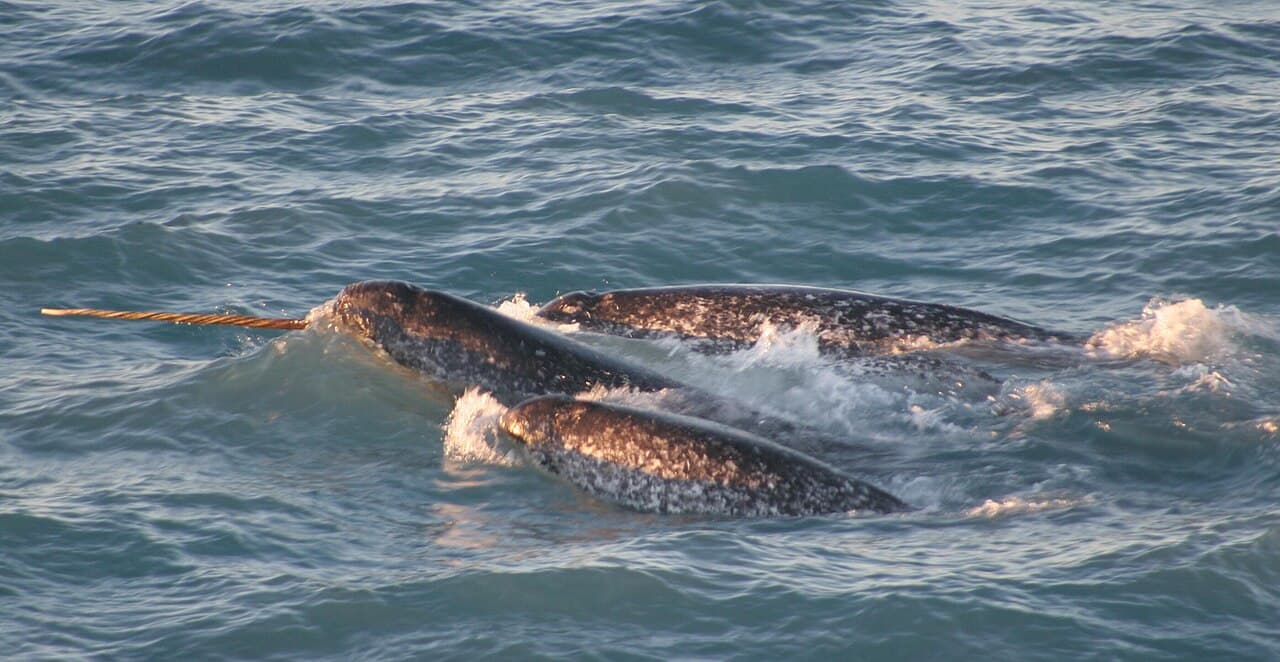
Narwhal (Monodon monoceros) is a medium-sized Arctic whale recognized by the long spiraled tusk carried by most adult males. It spends its entire life in cold northern seas, moving between sheltered summer fjords and deep winter pack ice. Narwhals make some of the deepest dives among marine mammals to hunt Greenland halibut, cod and squid. Their dependence on predictable ice and quiet migration routes makes rapid Arctic change especially important. This guide separates well-supported biology from common assumptions and covers identification, range, habitat, diet, behavior, reproduction and conservation.
Identification
A Narwhal has a robust spindle-shaped body, small rounded head, short flippers, no dorsal fin and a low dorsal ridge suited to swimming beneath ice. Calves are gray-brown; adults become black-and-white mottled and old animals may appear nearly white. Most mature males grow a left upper canine into a counterclockwise-spiraled tusk, while a small proportion of females have one and rare males grow two. Males are larger and usually carry a long tusk; most females retain both teeth inside the upper jaw.
Identification should combine body shape, markings, size, voice or movement, and location. One feature by itself can overlap with a related animal, a juvenile, or an individual in unusual light.
Photographs are most useful when they preserve scale and show several diagnostic features. Handling or repositioning a wild narwhal for identification can cause stress and is unnecessary.
Size and physical adaptations
Narwhal typically measures Females up to about 4.2 m; males commonly 4.0–4.8 m, excluding tusk and weighs Females up to about 1,000 kg; males up to roughly 1,600 kg. The tusk may add up to 3 m but is excluded from body-length measurements.
Its useful adaptations include thick blubber insulates in arctic water, no dorsal fin eases travel beneath ice, flexible neck vertebrae aid maneuvering, large oxygen stores support deep dives, blood flow slows to nonessential tissues during dives, echolocation locates prey in darkness, tusk contains millions of nerve endings, mottled coloration provides camouflage. These traits work together in the animal’s normal setting rather than serving as isolated curiosities.
Published measurements may use different methods, life stages or sample locations. Comparing figures responsibly means checking what was measured rather than selecting the largest number available.
Range and distribution
Arctic and sub-Arctic Atlantic waters centered on the Canadian High Arctic, Baffin Bay, Davis Strait, West and East Greenland, Svalbard and parts of the Russian Arctic. Occasional animals reach Alaska and more southern Atlantic waters. Distinct summering groups use particular fjords, inlets and island channels, then migrate to offshore winter pack ice. The native range includes Canada, Greenland, Norway, Russia, United States.
A country-level map indicates broad distribution, not continuous occupation. Climate, elevation, water, vegetation, prey, breeding sites, barriers and survey effort all affect where records occur.
Records near the edge of the range deserve careful documentation because they may reflect natural movement, improved survey coverage, accidental transport or a genuine distribution change.
Habitat
Deep Arctic fjords, continental slopes, ice-covered offshore basins, polynyas and leads in seasonal and multi-year sea ice.
Summer groups gather in relatively shallow, ice-free fjords and inlets, where females raise calves. As ice forms, they travel through narrow corridors to deep wintering grounds with dense pack ice and limited breathing cracks. There they repeatedly dive along continental slopes. Reliable leads are essential; rapid freezing can trap entire groups. Protecting a population therefore requires the feeding, shelter and breeding features that make a site usable, along with connections that allow movement.
Microhabitat matters. Shade, soil, current, moisture, shelter or host plants can determine whether a small area is usable even when the surrounding landscape appears suitable.
Diet and feeding
Narwhal is a carnivore. Important foods include greenland halibut, arctic cod, polar cod, gonatid squid, shrimp, capelin. Narwhals use rapid echolocation clicks to scan dark water, increasing click rate as they close on prey. They may create suction with the mouth to draw in fish because their functional teeth are reduced. Winter dives can exceed 1,000 meters and last many minutes. Feeding intensity is especially high in Baffin Bay winter habitat where Greenland halibut concentrate near the bottom.
Diet changes with age, season, location and food supply. A dramatic prey record does not establish what most individuals eat most of the time; repeated field observations provide a stronger picture.
Feeding opportunities also create risk. An animal focused on prey may be less alert to predators, traffic or people, while contaminated prey can transfer pollutants through the food web.
Behavior and communication
Seasonally migratory, with intensive deep diving and feeding during winter. Narwhals travel in groups that range from a few individuals to large seasonal aggregations. They surface quietly and usually avoid boats. Under dense ice they navigate between small breathing openings, an ability that also creates entrapment risk when weather closes leads. Males sometimes cross tusks gently, a behavior called tusking that may assess rivals or maintain social relationships rather than represent full combat.
A rich sound repertoire includes clicks for echolocation, whistles, pulsed calls and knocks. Click beams are highly directional and can be focused ahead of the head. Mothers and calves likely recognize individual calls. Sound travels far beneath ice, so shipping, seismic work and industrial activity can mask communication or trigger avoidance on migration and feeding grounds. Behavior should be interpreted in context: alarm, courtship, feeding and temperature regulation can produce very different actions from the same animal.
Daily schedules are flexible responses, not rigid rules. Weather, breeding condition, disturbance, tides or food can move activity into a different part of the day.
Reproduction and development
Mating is thought to occur in spring within offshore pack ice. After a long gestation, females give birth in summer migration or calving areas. One calf is normal, and the mother nurses it through at least the first year. Females reproduce slowly, with multiple years between calves, making populations sensitive to sustained adult mortality. One calf; twins extremely rare A calf is roughly 1.5–1.6 meters long and about 80 kilograms at birth. It begins with little blubber and depends on rich milk and close contact with its mother. Nursing lasts at least a year while the calf learns breathing-hole routes, migration timing and feeding behavior. Maturity takes several years and females may remain reproductively active for decades.
Young animals face different risks and may use different microhabitats or food than adults. Breeding success depends on adult condition, suitable sites and the survival of offspring through vulnerable early stages.
Counts of eggs or young describe reproductive output, not the number expected to reach adulthood. Mortality is normally greatest during eggs, larval or juvenile stages.
Predators and ecological role
Narwhals transfer energy from deep Arctic fish and squid to surface predators and scavengers. Killer whales are major predators when sea ice retreats; Polar Bears and Greenland Sharks may take vulnerable animals. Carcasses support benthic and ice-edge food webs. Changes in halibut and cod abundance can affect whales and northern fisheries simultaneously. Documented or likely predators include Killer Whale, Polar Bear, Greenland Shark, Human.
This animal is both a consumer and a food source. Its influence comes through many repeated interactions, so ecological claims should be based on measured populations rather than assumptions drawn from appearance.
Predator and prey relationships differ among places. A species can be ecologically influential without being abundant everywhere, and its role can change across its range.
Relationship with people
Narwhals have supported Inuit and Greenlandic communities for generations with meat, mattak, oil and tusk material. Community knowledge guides migration and ice-safety understanding. Harvest is managed through regional rules and international trade controls. Outsiders should avoid treating tusks as souvenirs; trade across borders requires permits and may be prohibited. Tourism boats can disturb resting or migrating groups if they approach too closely.
Narwhals are not considered aggressive toward people, but close approach by swimmers or boats is unsafe for both whale and observer. Follow local marine-mammal distances, reduce speed near pods, never cut across travel direction and avoid separating calves. Arctic ice and weather add serious hazards, so observation requires experienced local operators. Responsible observation means keeping an appropriate distance, avoiding capture or feeding, protecting habitat and following local wildlife or invasive-species guidance.
Wildlife guidance should come from the responsible local agency because collection rules, reporting requests and appropriate responses differ between native and introduced ranges.
Conservation
The IUCN lists the Narwhal as Least Concern globally, but recognized stocks differ in abundance and trend. Climate change, altered sea ice, noise, contaminants, hunting and killer-whale access affect regions differently. Conservation must therefore manage individual summering stocks rather than assume the global category protects every group. The reported global trend is Varies among stocks; some stable or increasing and others uncertain or declining.
Important pressures include loss and redistribution of sea ice, underwater noise and shipping, oil and gas development, hunting pressure on small stocks, contaminants accumulating in tissues, ice entrapment, increasing killer-whale access. Global status can hide local decline or recovery, so current regional monitoring and habitat management remain necessary.
The most useful conservation action follows the documented pressure. Protecting breeding sites, reducing road deaths or limiting pollutants can require different tools in different populations.