
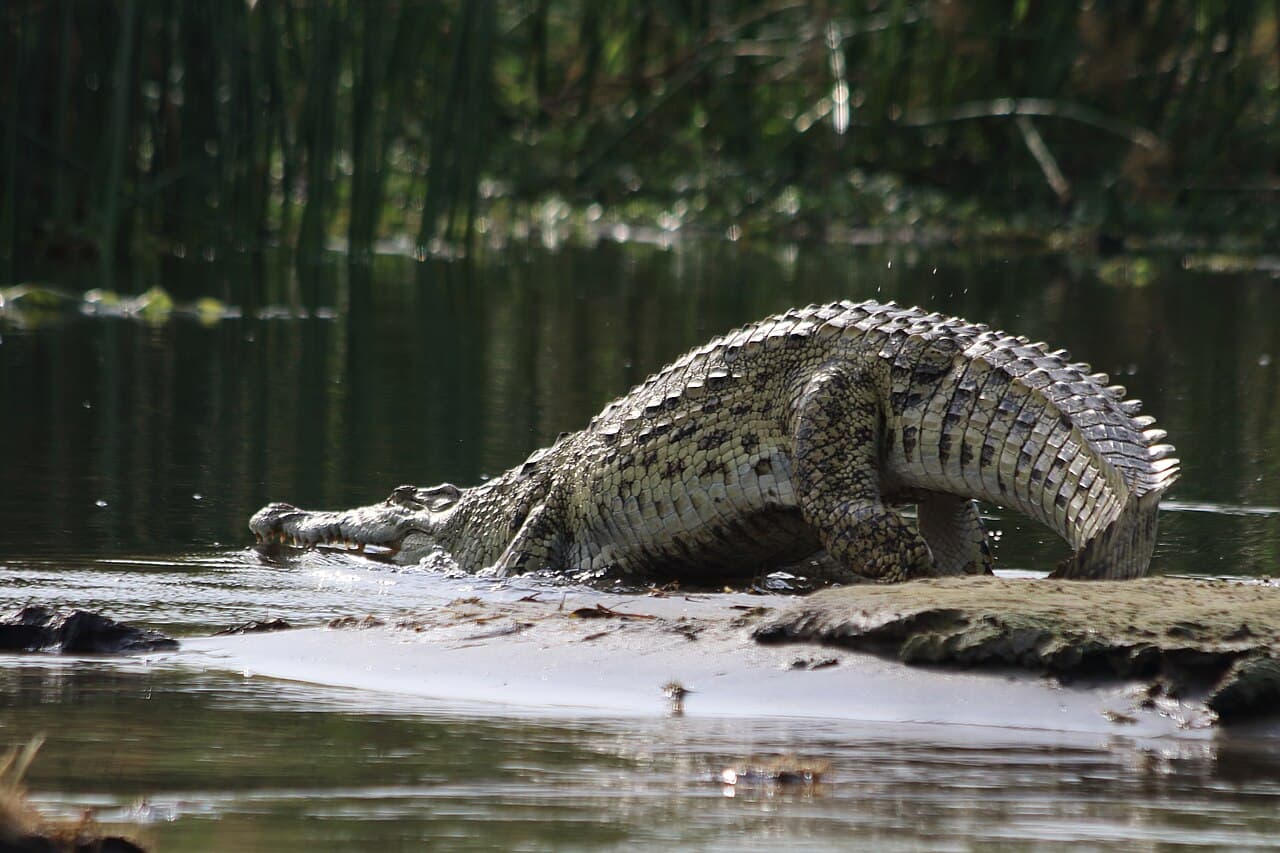
Nile Crocodile (Crocodylus niloticus) is a powerful crocodilian of rivers, lakes, wetlands and estuaries across much of sub-Saharan Africa. This guide separates well-supported biology from common assumptions and covers identification, range, habitat, diet, behavior, reproduction and conservation.
Identification
A heavy-bodied crocodile with a broad triangular snout, eyes and nostrils on top of the head, armored dorsal scutes and a powerful vertically flattened tail. Adults are olive, gray or brown with a paler belly; young have clearer dark bands and spots. Males grow substantially longer and heavier than females, although sex is difficult to judge at a distance.
Identification should combine body shape, markings, size, voice or movement, and location. One feature by itself can overlap with a related animal, a juvenile, or an individual in unusual light.
Photographs are most useful when they preserve scale and show several diagnostic features. Handling or repositioning a wild nile crocodile for identification can cause stress and is unnecessary.
Size and physical adaptations
Nile Crocodile typically measures females often 2.4–3.8 m; mature males commonly 3.5–5 m, exceptionally longer and weighs large males commonly 225–750 kg; females much lighter. Growth varies strongly with age, habitat and food; sensational maximum claims are often poorly documented.
Its useful adaptations include eyes and nostrils sit high for near-total submergence, palatal valve blocks water from the throat, tail powers rapid swimming and lunges, pressure-sensitive facial organs detect water movement, replaceable conical teeth grip prey, armored scutes protect the back. These traits work together in the animal’s normal setting rather than serving as isolated curiosities.
Published measurements may use different methods, life stages or sample locations. Comparing figures responsibly means checking what was measured rather than selecting the largest number available.
Range and distribution
Patchily distributed through major freshwater systems of eastern and southern Africa, the Nile basin, parts of central Africa and Madagascar; many West African records once assigned here represent Crocodylus suchus. The native range includes South Africa, Botswana, Namibia, Zimbabwe, Mozambique, Zambia, Malawi, Tanzania, Kenya, Uganda, Rwanda, Burundi, Democratic Republic of the Congo, Angola, Ethiopia, South Sudan, Sudan, Egypt, Somalia, Madagascar.
A country-level map indicates broad distribution, not continuous occupation. Climate, elevation, water, vegetation, prey, breeding sites, barriers and survey effort all affect where records occur.
Records near the edge of the range deserve careful documentation because they may reflect natural movement, improved survey coverage, accidental transport or a genuine distribution change.
Habitat
Rivers, lakes, floodplains, marshes, reservoirs, seasonal pools and some brackish estuaries.
Adults bask on banks, shelter in deep water during heat, drought or danger and concentrate at shrinking pools in dry seasons. Females need elevated sandy soil for nests close enough to guard from water. Protecting a population therefore requires the feeding, shelter and breeding features that make a site usable, along with connections that allow movement.
Microhabitat matters. Shade, soil, current, moisture, shelter or host plants can determine whether a small area is usable even when the surrounding landscape appears suitable.
Diet and feeding
Nile Crocodile is a carnivore and opportunistic ambush predator. Important foods include fish, crustaceans, frogs, waterbirds, turtles, snakes, antelope, wildebeest, carrion. Young crocodiles take insects, frogs and small fish. As jaws and body grow, prey size expands. An adult waits nearly submerged, accelerates with its tail and clamps rather than chews; large food is swallowed in chunks, sometimes after rolling or pulling with other crocodiles nearby.
Diet changes with age, season, location and food supply. A dramatic prey record does not establish what most individuals eat most of the time; repeated field observations provide a stronger picture.
Feeding opportunities also create risk. An animal focused on prey may be less alert to predators, traffic or people, while contaminated prey can transfer pollutants through the food web.
Behavior and communication
Basks by day and often hunts from dusk through night, adjusted for temperature and prey movement. Nile crocodiles regulate temperature by moving between sun, shade and water and by holding the mouth open. Large animals maintain dominance around basking, feeding and breeding sites. They communicate with bellows, head slaps, growls, hisses and water vibrations.
Adults signal size and status through low bellows, surface vibration, posture, jaw claps and scent. Hatchlings produce sharp calls before and after hatching, and attending females respond. Behavior should be interpreted in context: alarm, courtship, feeding and temperature regulation can produce very different actions from the same animal.
Daily schedules are flexible responses, not rigid rules. Weather, breeding condition, disturbance, tides or food can move activity into a different part of the day.
Reproduction and development
Courtship occurs in water with vocal and tactile displays. A female excavates a hole nest above the flood line, lays eggs, covers them and guards the area through incubation. Usually about 25–80 eggs, varying with female size undefined
Young animals face different risks and may use different microhabitats or food than adults. Breeding success depends on adult condition, suitable sites and the survival of offspring through vulnerable early stages.
Counts of eggs or young describe reproductive output, not the number expected to reach adulthood. Mortality is normally greatest during eggs, larval or juvenile stages.
Predators and ecological role
As a top aquatic predator and scavenger, the species affects fish, birds and mammals, recycles carrion and creates shoreline trails and nest disturbances used by other organisms. Documented or likely predators include Humans, Nile Monitor, Marabou Stork, African Fish Eagle, Nile Crocodile.
This animal is both a consumer and a food source. Its influence comes through many repeated interactions, so ecological claims should be based on measured populations rather than assumptions drawn from appearance.
Predator and prey relationships differ among places. A species can be ecologically influential without being abundant everywhere, and its role can change across its range.
Relationship with people
Nile crocodiles are ecologically valuable and support regulated tourism and ranching, but they also cause serious and fatal attacks. Conflict rises where people wash, fish, collect water or cross at unprotected shorelines and where livestock use the same access points.
Never swim or wade in crocodile habitat. Stay well back from edges, avoid repetitive shoreline routines, keep children and pets away, use designated protected water points and follow local wildlife authority guidance. Responsible observation means keeping an appropriate distance, avoiding capture or feeding, protecting habitat and following local wildlife or invasive-species guidance.
Wildlife guidance should come from the responsible local agency because collection rules, reporting requests and appropriate responses differ between native and introduced ranges.
Conservation
Listed as Least Concern globally, but local populations vary widely and some have declined through habitat change, killing, pollution and depleted prey. The reported global trend is Stable overall with regional declines and recoveries.
Important pressures include retaliatory killing after attacks, wetland drainage and dams, fishing-net entanglement, pollution, egg collection and illegal hunting, depletion of fish and large prey. Global status can hide local decline or recovery, so current regional monitoring and habitat management remain necessary.
The most useful conservation action follows the documented pressure. Protecting breeding sites, reducing road deaths or limiting pollutants can require different tools in different populations.