
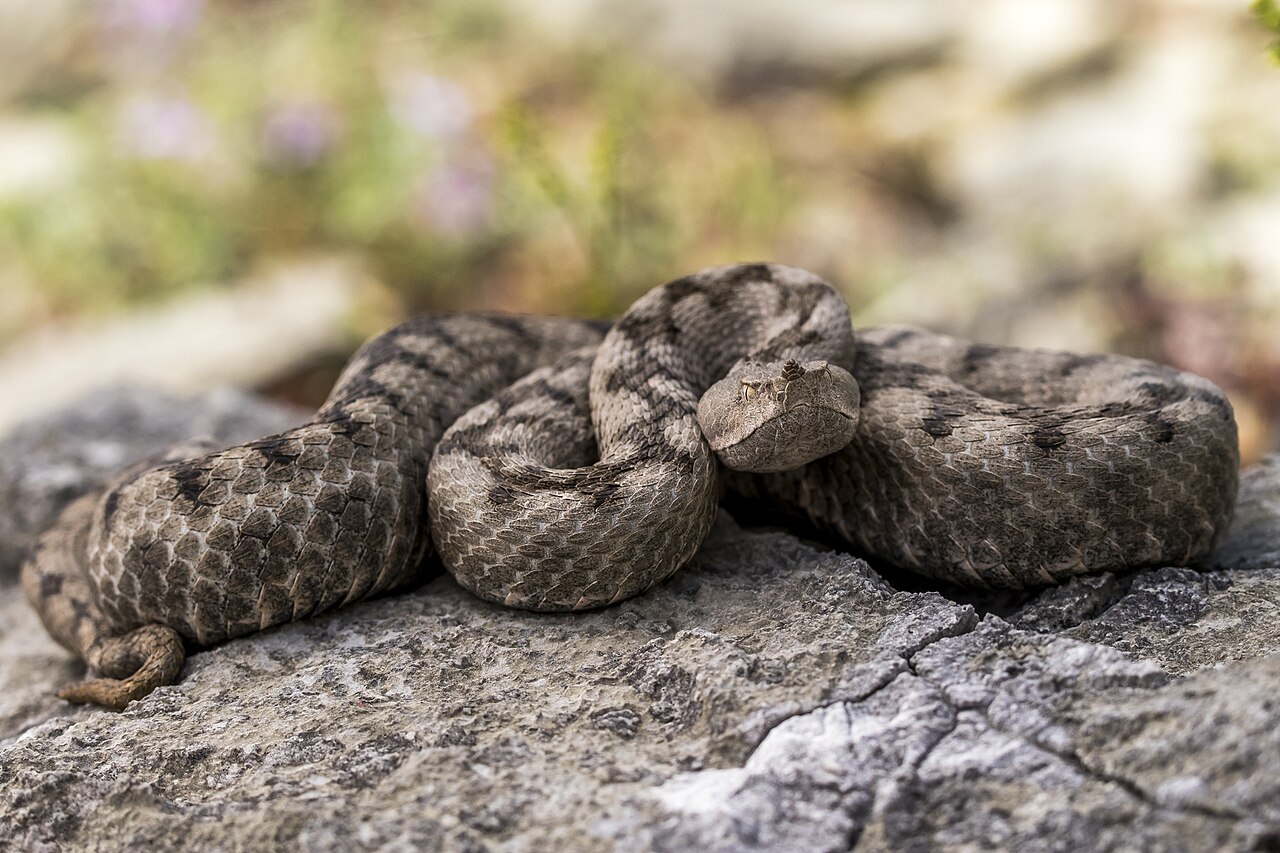
Nose-Horned Viper (Vipera ammodytes) is a venomous snake of rocky, sun-warmed habitats in southeastern Europe and parts of the Caucasus. This guide separates well-supported biology from common assumptions and covers identification, range, habitat, diet, behavior, reproduction and conservation.
Identification
A short, heavy-bodied snake with a triangular head, vertical pupils and a conspicuous flexible projection on the snout. Most individuals carry a dark zigzag along the back. Ground color ranges from gray and tan to reddish brown, while males often show stronger contrast. Males usually have more contrasting head markings and body patterns; females tend to be browner and can attain similar total length.
Identification should combine body shape, markings, size, voice or movement, and location. One feature by itself can overlap with a related animal, a juvenile, or an individual in unusual light.
Photographs are most useful when they preserve scale and show several diagnostic features. Handling or repositioning a wild nose-horned viper for identification can cause stress and is unnecessary.
Size and physical adaptations
Nose-Horned Viper typically measures usually 50–70 cm; large individuals can approach 95 cm and weighs commonly a few hundred grams, varying with sex and season. Body size differs among populations and subspecies; total length includes a relatively short tail.
Its useful adaptations include hinged hollow fangs inject venom, heat-seeking ambush posture conserves energy, keeled scales provide traction on rock, cryptic zigzag breaks up the body outline, live birth avoids an exposed egg nest. These traits work together in the animal’s normal setting rather than serving as isolated curiosities.
Published measurements may use different methods, life stages or sample locations. Comparing figures responsibly means checking what was measured rather than selecting the largest number available.
Range and distribution
Occurs patchily from northeastern Italy and southern Austria through the Balkans, with eastern populations around the Black Sea and Caucasus; modern taxonomic work has refined the limits of some peripheral records. The native range includes Austria, Italy, Slovenia, Croatia, Bosnia and Herzegovina, Montenegro, North Macedonia, Serbia, Romania, Bulgaria, Albania, Greece, Georgia, Azerbaijan, Turkey.
A country-level map indicates broad distribution, not continuous occupation. Climate, elevation, water, vegetation, prey, breeding sites, barriers and survey effort all affect where records occur.
Records near the edge of the range deserve careful documentation because they may reflect natural movement, improved survey coverage, accidental transport or a genuine distribution change.
Habitat
Rocky slopes, limestone outcrops, scrub, open woodland, dry stone walls, forest edges and sunny clearings, often where shelter crevices and basking sites occur together.
The viper moves between sun and shade to regulate body temperature, retreats into rock cracks or mammal burrows, and uses concealed edges from which it can strike passing prey. It hibernates communally or alone in frost-free shelters in colder regions. Protecting a population therefore requires the feeding, shelter and breeding features that make a site usable, along with connections that allow movement.
Microhabitat matters. Shade, soil, current, moisture, shelter or host plants can determine whether a small area is usable even when the surrounding landscape appears suitable.
Diet and feeding
Nose-Horned Viper is a carnivore and sit-and-wait predator. Important foods include lizards, mice, voles, shrews, small birds, nestlings, other snakes, centipedes. A hunting viper waits beside cover, strikes rapidly and injects venom through long folding fangs. Small prey may be held; mobile mammals are often released and followed by scent after venom takes effect. A 2021 study of Balkan specimens found lizards dominated the diet, with mammals increasingly important in larger snakes.
Diet changes with age, season, location and food supply. A dramatic prey record does not establish what most individuals eat most of the time; repeated field observations provide a stronger picture.
Feeding opportunities also create risk. An animal focused on prey may be less alert to predators, traffic or people, while contaminated prey can transfer pollutants through the food web.
Behavior and communication
Mostly active by day in cool seasons and around dawn, dusk or night during summer heat. Nose-horned vipers are generally secretive and prefer escape or concealment. They bask to reach useful body temperatures, travel during mating periods and can climb low shrubs or trees for hunting, courtship, thermoregulation or escape. A threatened snake may hiss, coil and strike.
Chemical trails carry reproductive information, and tongue-flicking delivers scent particles to the vomeronasal organs. Courtship includes following and body contact; defensive signals include hissing, flattening and strike posture. Behavior should be interpreted in context: alarm, courtship, feeding and temperature regulation can produce very different actions from the same animal.
Daily schedules are flexible responses, not rigid rules. Weather, breeding condition, disturbance, tides or food can move activity into a different part of the day.
Reproduction and development
Mating generally follows spring emergence. Males search for females and may engage in ritualized combat. Females retain developing embryos and give birth to live young rather than laying an exposed clutch. Often 5–17 live young; output rises with female size undefined
Young animals face different risks and may use different microhabitats or food than adults. Breeding success depends on adult condition, suitable sites and the survival of offspring through vulnerable early stages.
Counts of eggs or young describe reproductive output, not the number expected to reach adulthood. Mortality is normally greatest during eggs, larval or juvenile stages.
Predators and ecological role
This mid-level predator transfers energy from lizards and small mammals to larger raptors and mammalian predators. By taking rodents it also influences prey communities around rocky agricultural edges. Documented or likely predators include Short-Toed Snake Eagle, European Hedgehog, Wild Boar, Humans.
This animal is both a consumer and a food source. Its influence comes through many repeated interactions, so ecological claims should be based on measured populations rather than assumptions drawn from appearance.
Predator and prey relationships differ among places. A species can be ecologically influential without being abundant everywhere, and its role can change across its range.
Relationship with people
The species is medically important because its venom can cause severe pain, swelling, tissue injury and systemic illness. Most encounters do not end in bites if the snake is given space. Habitat protection and public education reduce needless killing while preserving a native rodent predator.
Do not handle or approach. Wear sturdy footwear in rocky scrub, look before placing hands, keep dogs close, and seek urgent professional medical care after any suspected bite. Do not cut, suck, ice or tourniquet the wound. Responsible observation means keeping an appropriate distance, avoiding capture or feeding, protecting habitat and following local wildlife or invasive-species guidance.
Wildlife guidance should come from the responsible local agency because collection rules, reporting requests and appropriate responses differ between native and introduced ranges.
Conservation
Assessed as Least Concern globally, though local populations can decline through persecution, road mortality, collection, fire and loss of rocky scrub habitat. The reported global trend is Decreasing in some regions and insufficiently known in others.
Important pressures include deliberate killing, road mortality, habitat conversion, intensive fire, illegal collection, loss of winter refuges. Global status can hide local decline or recovery, so current regional monitoring and habitat management remain necessary.
The most useful conservation action follows the documented pressure. Protecting breeding sites, reducing road deaths or limiting pollutants can require different tools in different populations.