
Species profileIUCN: EN

Numbat

Myrmecobius fasciatus

A striped, day-active Australian marsupial that can eat thousands of termites in a day.

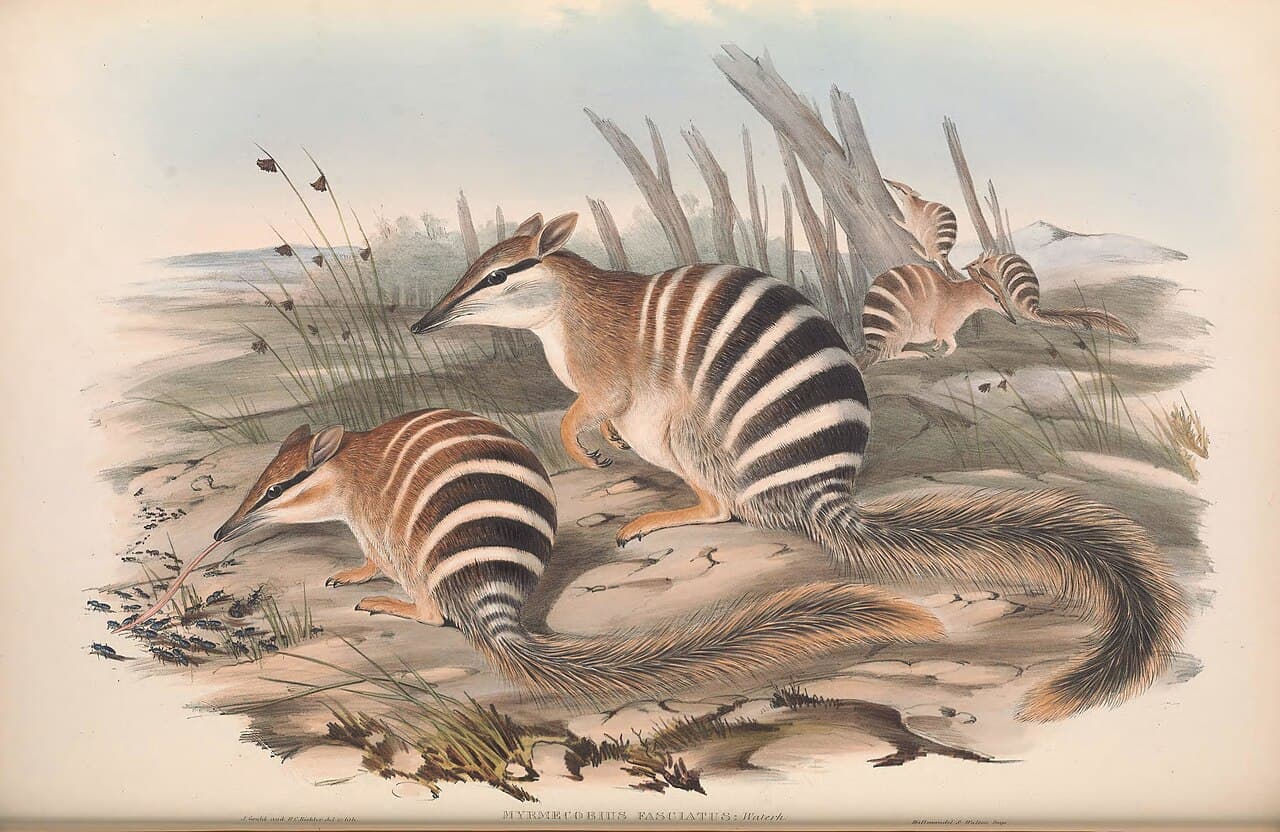
Historical natural history illustration of a striped numbat standing beside vegetation
John Gould / Biodiversity Heritage Library / public domain
🌐 Read in Language:

⚡ At a Glance

Species profile
Diet Category
Specialist insectivore dominated by termites
Activity Rhythm
Diurnal, with timing shifting seasonally to match termite activity and safe temperatures.
Wild Lifespan
Typically around 4–5 years in the wild; longer in managed care
Typical Weight
about 300–750 g
Conservation Status
EN
💡 Key Biological Insight: Unlike many marsupials, the female has no true pouch; young cling to teats beneath protective curled belly hair for their first months.

🌳 Scientific Taxonomy Hierarchy

The numbat is a species in the monotypic family Myrmecobiidae within Dasyuromorphia. It is related to carnivorous marsupials but differs sharply in anatomy and lifestyle through adaptation to termites.

KingdomAnimalia
PhylumChordata
ClassMammalia
OrderDasyuromorphia
FamilyMyrmecobiidae
GenusMyrmecobius
SpeciesMyrmecobius fasciatus

Distinguishing Anatomical Features

  • ✓A small, slender marsupial with a pointed snout, erect ears, dark eye stripe, bushy tail and four to eleven pale transverse bands across the reddish or gray-brown back and rump. Individuals have distinctive stripe patterns.
  • ✓Long sticky tongue reaches termite galleries
  • ✓Powerful foreclaws open shallow soil channels
  • ✓Narrow snout probes logs and cracks
  • ✓Daylight activity follows termite movement
  • ✓Striped coat disrupts the body outline
  • ✓Numerous small teeth suit soft prey

📏 Physical Measurements

Total Lengthhead and body 7.9–11.4 in; tail 4.7–8.3 in
Body Weightabout 10.6–26.5 oz
Tail LengthBushy tail about two-thirds of head-and-body length
WingspanNot applicable
Top SpeedNo dependable universal maximumMovement changes with context and conditions.

🎨 Appearance & Distinctive Markings

Reddish brownGray brownWhite bandsBlack eye stripeCream underside

Skin / Covering: Short fur with a bushy tail

Sexual Dimorphism: Males average somewhat larger than females, but both sexes share the same striped coat and long snout.

🗺️ Geographic Distribution & Habitat

Once extended across much of southern mainland Australia. Natural surviving populations are concentrated in southwestern Western Australia, with conservation translocations establishing additional fenced or intensively managed populations in Western Australia, South Australia and New South Wales.

Eucalypt woodland and open forest with abundant termites, hollow logs, tree hollows, fallen timber, shelter burrows and a patchwork of post-fire vegetation ages.

Country-level distribution map

Native range
FijiTanzaniaWestern SaharaCanadaUnited StatesKazakhstanUzbekistanPapua New GuineaIndonesiaArgentinaChileCongo - KinshasaSomaliaKenyaSudanChadHaitiDominican RepublicRussiaBahamasFalkland IslandsNorwayGreenlandFrench Southern TerritoriesTimor-LesteSouth AfricaLesothoMexicoUruguayBrazilBoliviaPeruColombiaPanamaCosta RicaNicaraguaHondurasEl SalvadorGuatemalaBelizeVenezuelaGuyanaSurinameFranceEcuadorPuerto RicoJamaicaCubaZimbabweBotswanaNamibiaSenegalMaliMauritaniaBeninNigerNigeriaCameroonTogoGhanaCôte d’IvoireGuineaGuinea-BissauLiberiaSierra LeoneBurkina FasoCentral African RepublicCongo - BrazzavilleGabonEquatorial GuineaZambiaMalawiMozambiqueEswatiniAngolaBurundiIsraelLebanonMadagascarPalestinian TerritoriesGambiaTunisiaAlgeriaJordanUnited Arab EmiratesQatarKuwaitIraqOmanVanuatuCambodiaThailandLaosMyanmar (Burma)VietnamNorth KoreaSouth KoreaMongoliaIndiaBangladeshBhutanNepalPakistanAfghanistanTajikistanKyrgyzstanTurkmenistanIranSyriaArmeniaSwedenBelarusUkrainePolandAustriaHungaryMoldovaRomaniaLithuaniaLatviaEstoniaGermanyBulgariaGreeceTürkiyeAlbaniaCroatiaSwitzerlandLuxembourgBelgiumNetherlandsPortugalSpainIrelandNew CaledoniaSolomon IslandsNew ZealandAustralia — Native rangeSri LankaChinaTaiwanItalyDenmarkUnited KingdomIcelandAzerbaijanGeorgiaPhilippinesMalaysiaBruneiSloveniaFinlandSlovakiaCzechiaEritreaJapanParaguayYemenSaudi ArabiaCyprusMoroccoEgyptLibyaEthiopiaDjiboutiUgandaRwandaBosnia & HerzegovinaNorth MacedoniaSerbiaMontenegroKosovoTrinidad & TobagoSouth Sudan
Highlighted countries are recorded profile locations, not precise biological range boundaries.Map boundaries: Natural Earth

Recorded Native Countries & Territories:

💡 Did You Know?

  • 💡Long sticky tongue reaches termite galleries
  • 💡Powerful foreclaws open shallow soil channels
  • 💡Narrow snout probes logs and cracks
  • 💡Daylight activity follows termite movement
  • 💡Striped coat disrupts the body outline
  • 💡Numerous small teeth suit soft prey

🌿 Conservation Status & Threats

IUCN: EN — Endangered

“Listed as Endangered under Australian federal law and by the IUCN; predator control and translocations have prevented extinction, but populations remain small and management dependent.”

Population TrendIncreasing at some managed sites but vulnerable overall
Wild Population EstimateNo precise current total covers every wild and reintroduced site; the species survives in a network of small, intensively managed populations.

⚠️ Major Threats to Numbat

  • •Red fox predation
  • •Feral cat predation
  • •Frequent intense fire
  • •Loss of hollow logs
  • •Habitat fragmentation
  • •Small isolated populations

🔄 Life Cycle & Reproduction

Wild vs. Captivity Lifespan Comparison

🌿 In the WildTypically around 4–5 years in the wild; longer in managed care
🏠 In Captivity (with veterinary care)Can differ under managed care.
Clutch / Litter SizeUsually up to four young, matching the four teats
Incubation / GestationGestation about 14 days, followed by many months of attached and nest development
Fledging / WeaningYoung remain attached for about six months, then are deposited in a nest while the mother forages. They begin emerging and following her later in the year and disperse as independent juveniles.
Sexual MaturityFemales can breed at about one year; males usually at about two years
Mating SystemSeasonal and polygynous
Nesting / Den TypeGrass, leaves and bark in a hollow log or burrow chamber

🦅 Behavior & Field Ecology

Specialist insectivore dominated by termites

🌐 Ecological Food Web & Relationships: As an extreme termite specialist, the numbat links below-ground decomposer communities to predators. Its need for logs and varied fire ages makes it an indicator of structurally complex woodland management.

Social Group SizeMostly solitary except mothers with dependent young and brief mating encounters
Activity RhythmDiurnal, with timing shifting seasonally to match termite activity and safe temperatures.
Feeding StrategySpecialist insectivore dominated by termites

🥩 Primary Prey & Preferred Diet

✓ Termites✓ Occasional ants swallowed incidentally

📢 Communication & Territorial Signals

  • Scent marking
  • Soft courtship clicks
  • Young contact calls
  • Posture and touch

🐾 Wild Temperament & Traits

• Alert• Solitary• Specialized forager

🤝 Human Interaction & Pet Advisory

⚠️ Strictly Wild Species
🚫

Can You Keep a Numbat as a Pet?

An endangered protected native mammal managed by conservation programs, not a pet.

Domestication StatusWild and not domesticated
Danger to HumansHarmless to people
Economic & Ecotourism RoleUnique evolutionary lineage, termite predator, Western Australian faunal emblem and flagship for woodland restoration.

⚠️ Behavioral Risk Factors & Wildlife Safety

  • May scratch or bite if captured
  • Handling causes stress and is restricted

🌐 Ecological Food Web & Relationships

🦅 Natural Predators (5)

Red FoxVulpes vulpes
Feral CatFelis catus
Wedge-Tailed EagleAquila audax
Carpet PythonMorelia spilota
Brown GoshawkAccipiter fasciatus

🧬 Related Species (2)

Tasmanian DevilSarcophilus harrisiiDistant dasyuromorph relative
Western QuollDasyurus geoffroiiCarnivorous marsupial relative

Numbat (Myrmecobius fasciatus) is the sole living member of its family and a highly specialized termite hunter of southwestern Australian woodlands. This guide separates well-supported biology from common assumptions and covers identification, range, habitat, diet, behavior, reproduction and conservation.

Identification

A small, slender marsupial with a pointed snout, erect ears, dark eye stripe, bushy tail and four to eleven pale transverse bands across the reddish or gray-brown back and rump. Individuals have distinctive stripe patterns. Males average somewhat larger than females, but both sexes share the same striped coat and long snout.

Identification should combine body shape, markings, size, voice or movement, and location. One feature by itself can overlap with a related animal, a juvenile, or an individual in unusual light.

Photographs are most useful when they preserve scale and show several diagnostic features. Handling or repositioning a wild numbat for identification can cause stress and is unnecessary.

Size and physical adaptations

Numbat typically measures head and body 20–29 cm; tail 12–21 cm and weighs about 300–750 g. A lightweight terrestrial marsupial; body condition changes seasonally with food and breeding.

Its useful adaptations include long sticky tongue reaches termite galleries, powerful foreclaws open shallow soil channels, narrow snout probes logs and cracks, daylight activity follows termite movement, striped coat disrupts the body outline, numerous small teeth suit soft prey. These traits work together in the animal’s normal setting rather than serving as isolated curiosities.

Published measurements may use different methods, life stages or sample locations. Comparing figures responsibly means checking what was measured rather than selecting the largest number available.

Range and distribution

Once extended across much of southern mainland Australia. Natural surviving populations are concentrated in southwestern Western Australia, with conservation translocations establishing additional fenced or intensively managed populations in Western Australia, South Australia and New South Wales. The native range includes Australia.

A country-level map indicates broad distribution, not continuous occupation. Climate, elevation, water, vegetation, prey, breeding sites, barriers and survey effort all affect where records occur.

Records near the edge of the range deserve careful documentation because they may reflect natural movement, improved survey coverage, accidental transport or a genuine distribution change.

Habitat

Eucalypt woodland and open forest with abundant termites, hollow logs, tree hollows, fallen timber, shelter burrows and a patchwork of post-fire vegetation ages.

A numbat shelters overnight in a hollow log, tree hollow or burrow. By day it searches shallow soil and decaying wood where termites are accessible. Logs are doubly important because they provide both refuge and termite-rich feeding sites. Protecting a population therefore requires the feeding, shelter and breeding features that make a site usable, along with connections that allow movement.

Microhabitat matters. Shade, soil, current, moisture, shelter or host plants can determine whether a small area is usable even when the surrounding landscape appears suitable.

Diet and feeding

Numbat is a specialist insectivore dominated by termites. Important foods include termites, occasional ants swallowed incidentally. The numbat cannot break open hard termite mounds like an echidna. Instead it detects termites in shallow underground galleries, digs a small opening and inserts its long saliva-coated tongue. An adult may consume roughly 15,000–20,000 termites per day, so its daily schedule follows when workers approach the surface.

Diet changes with age, season, location and food supply. A dramatic prey record does not establish what most individuals eat most of the time; repeated field observations provide a stronger picture.

Feeding opportunities also create risk. An animal focused on prey may be less alert to predators, traffic or people, while contaminated prey can transfer pollutants through the food web.

Behavior and communication

Diurnal, with timing shifting seasonally to match termite activity and safe temperatures. Numbats forage alone, pausing upright to scan and listen for danger. They retreat rapidly into logs or burrows and can block an entrance with the armored skin of the rump. In hot weather activity divides between morning and late afternoon; in cool months it becomes concentrated near midday.

Adults rely on scent marking and close-range cues. Males rub strong-smelling chest-gland secretions on logs during breeding. Soft clicks occur in courtship, while young use vocal calls to communicate with their mother. Behavior should be interpreted in context: alarm, courtship, feeding and temperature regulation can produce very different actions from the same animal.

Daily schedules are flexible responses, not rigid rules. Weather, breeding condition, disturbance, tides or food can move activity into a different part of the day.

Reproduction and development

Breeding occurs once a year. A male ranges widely in summer searching for females and marks with his sternal gland. After a short gestation the tiny newborns attach to the mother’s four teats, protected by long belly hair rather than a pouch. Usually up to four young, matching the four teats undefined

Young animals face different risks and may use different microhabitats or food than adults. Breeding success depends on adult condition, suitable sites and the survival of offspring through vulnerable early stages.

Counts of eggs or young describe reproductive output, not the number expected to reach adulthood. Mortality is normally greatest during eggs, larval or juvenile stages.

Predators and ecological role

As an extreme termite specialist, the numbat links below-ground decomposer communities to predators. Its need for logs and varied fire ages makes it an indicator of structurally complex woodland management. Documented or likely predators include Red Fox, Feral Cat, Wedge-Tailed Eagle, Carpet Python, Brown Goshawk.

This animal is both a consumer and a food source. Its influence comes through many repeated interactions, so ecological claims should be based on measured populations rather than assumptions drawn from appearance.

Predator and prey relationships differ among places. A species can be ecologically influential without being abundant everywhere, and its role can change across its range.

Relationship with people

Broad land clearing, introduced foxes and cats, altered fire patterns and loss of hollow logs drove a collapse across about 99 percent of the former range. Sustained predator control, captive breeding, reintroduction and Indigenous and agency partnerships now protect multiple populations.

Observe from a distance, keep dogs controlled, never disturb occupied logs, avoid moving fallen timber and follow sanctuary rules. Report sightings to local conservation programs where requested. Responsible observation means keeping an appropriate distance, avoiding capture or feeding, protecting habitat and following local wildlife or invasive-species guidance.

Wildlife guidance should come from the responsible local agency because collection rules, reporting requests and appropriate responses differ between native and introduced ranges.

Conservation

Listed as Endangered under Australian federal law and by the IUCN; predator control and translocations have prevented extinction, but populations remain small and management dependent. The reported global trend is Increasing at some managed sites but vulnerable overall.

Important pressures include red fox predation, feral cat predation, frequent intense fire, loss of hollow logs, habitat fragmentation, small isolated populations. Global status can hide local decline or recovery, so current regional monitoring and habitat management remain necessary.

The most useful conservation action follows the documented pressure. Protecting breeding sites, reducing road deaths or limiting pollutants can require different tools in different populations.

Sources and further reading

❓ Frequently Asked Questions

Answers to frequently asked questions verified against peer-reviewed zoological research.

A numbat is an extreme termite specialist and may eat about 15,000–20,000 termites in a day, with ants taken only incidentally.